
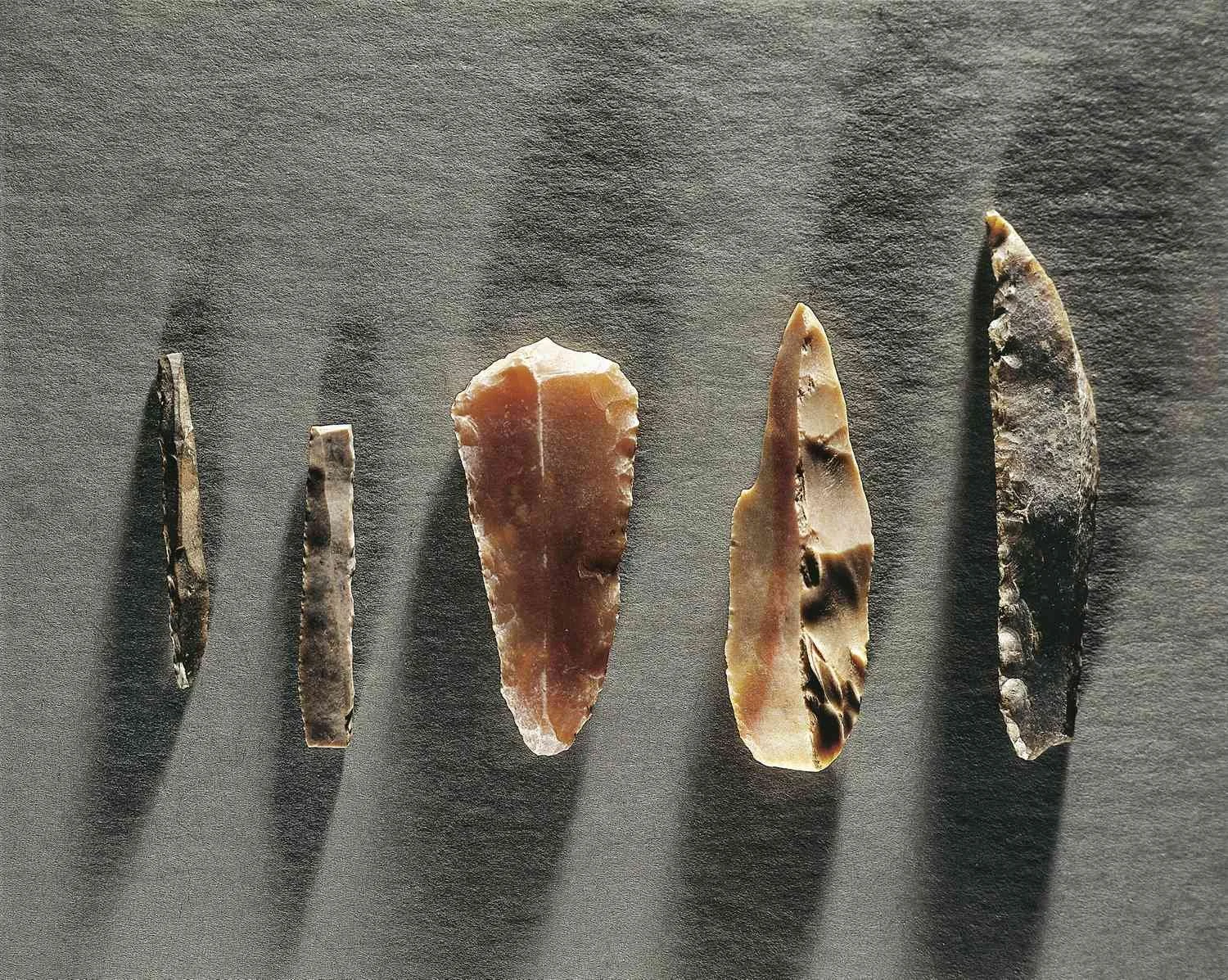
How stone artifacts, impact damage, and experimental archaeology can help reconstruct the use of thrown weapons in early human hunting.
Introduction: The Earliest Technologies of Distance
Hunting has involved a wide range of strategies, from close-range encounters to the use of tools that allow people to strike animals from a distance. Projectiles changed the relationship between hunters and their prey by creating opportunities to attack without maintaining direct physical contact.
Stone artifacts can provide clues about these strategies, but identifying early projectiles is difficult. Many stones can be used for striking, cutting, scraping, or throwing, and some acquire impact damage through natural processes.
The phrase “stone-thrown tools” can refer to stones deliberately selected or modified for throwing, as well as stone components used in more complex projectile systems. These categories should not be confused. A stone thrown directly by hand behaves differently from a stone point attached to a spear or another delivery system.
Archaeologists must therefore establish what an artifact was designed to do, how it was used, and whether it was associated with hunting rather than another activity.
Identifying Potential Projectiles
Potential projectiles may be identified through their shape, mass, surface modification, impact damage, and archaeological context. Some stones may have been selected because their weight and shape made them suitable for throwing, while others could have been modified to improve their effectiveness.
However, naturally occurring stones can have the same general shapes as deliberately selected projectiles. Researchers must determine whether the artifact shows evidence of human selection or modification rather than assuming that every rounded stone found at a hunting site was a weapon.
Impact damage can provide additional clues. Fractures, crushing, and localized surface damage may be consistent with high-energy contact, but similar marks can result from trampling, sediment pressure, or repeated movement within a deposit.
Microscopic analysis and comparison with experimentally used stones can help distinguish these possibilities. Even then, the interpretation depends on the artifact's geological properties and the conditions under which it was preserved.
Direct-Thrown Stones and Complex Weapons
A stone thrown directly by hand is not the same as a projectile launched by a spear, sling, or other mechanism. Different delivery systems influence speed, accuracy, range, and the kinds of damage produced on impact.
Researchers must distinguish these possibilities when interpreting archaeological evidence. A stone point may have been attached to a weapon, while an unmodified stone may have been thrown directly. The absence of a point does not establish that an object was thrown by hand, and the presence of a point does not automatically reveal the weapon's exact configuration.
The technological history of projectile systems also varies by region. Archaeologists should avoid assuming that a weapon documented in one period or culture was used in the same way by much earlier communities.
The strongest interpretations combine artifact analysis with the chronology of the site, the materials available, and experimental evidence about possible functions.
Experimental Archaeology and Performance Testing
Experimental archaeology can test whether a proposed projectile design is practical. Researchers may select comparable stones, reproduce plausible modifications, and examine how the objects behave when thrown at targets or into suitable test materials.
Experiments can measure distance, accuracy, impact patterns, and the kinds of damage produced under controlled conditions. They may help determine whether a stone's shape is consistent with a proposed function.
Yet modern experiments have limitations. Participants may differ from ancient hunters in skill and experience, while reconstructed weapons may not perfectly match the original objects. The physical conditions of an experiment also rarely reproduce every aspect of a prehistoric hunt.
Experimental results should therefore be used to evaluate plausibility, not to claim that an artifact was definitely used in a particular manner.
Hunting Strategies and Cooperation
Projectile technologies can influence how hunters approach animals, coordinate movement, and manage risk. A weapon that allows an attack from a distance may support different strategies from one requiring close contact.
However, hunting behavior depends on more than weapon design. Terrain, prey species, group size, animal behavior, and environmental conditions all influence the choice of strategy.
Archaeological evidence may help reconstruct these relationships. Animal remains can reveal which species were hunted, while the distribution of artifacts may indicate activity areas or repeated use of particular landscapes.
Yet a concentration of projectiles and animal bones does not automatically represent a single coordinated hunt. The remains may accumulate over many visits or reflect activities that occurred at different times.
Projectiles, Learning, and Technological Change
Making and using projectiles requires knowledge of materials, motion, and animal behavior. Such knowledge may be transmitted through observation and practice across generations.
Changes in projectile design can reveal shifts in hunting technology, but they do not necessarily indicate a single moment of invention. Similar forms may develop independently because they solve comparable practical problems.
Researchers compare artifact dimensions, manufacturing methods, and use-wear across dated assemblages to investigate technological change. They must also consider the preservation of organic weapon components, which can disappear while stone elements survive.
The archaeological record is therefore incomplete. A stone artifact may represent only one component of a weapon system whose wooden, fiber, or other parts have not survived.
Conclusion: Reconstructing Early Hunting Through Stone
Stone projectiles and potential thrown tools can help researchers investigate how early hunters used distance, accuracy, and material selection in their strategies. Impact analysis, experimental testing, and archaeological context are essential for distinguishing weapons from ordinary stones or tools used for other purposes.
The evidence rarely supports a complete reconstruction from a single artifact. Researchers must consider alternative functions, natural damage, the delivery system, and the chronology of the site.
By integrating these approaches, archaeologists can investigate the development of hunting technologies without assuming that every unusual stone was a weapon. The resulting picture emphasizes the practical knowledge and adaptability involved in human hunting across diverse environments.




