
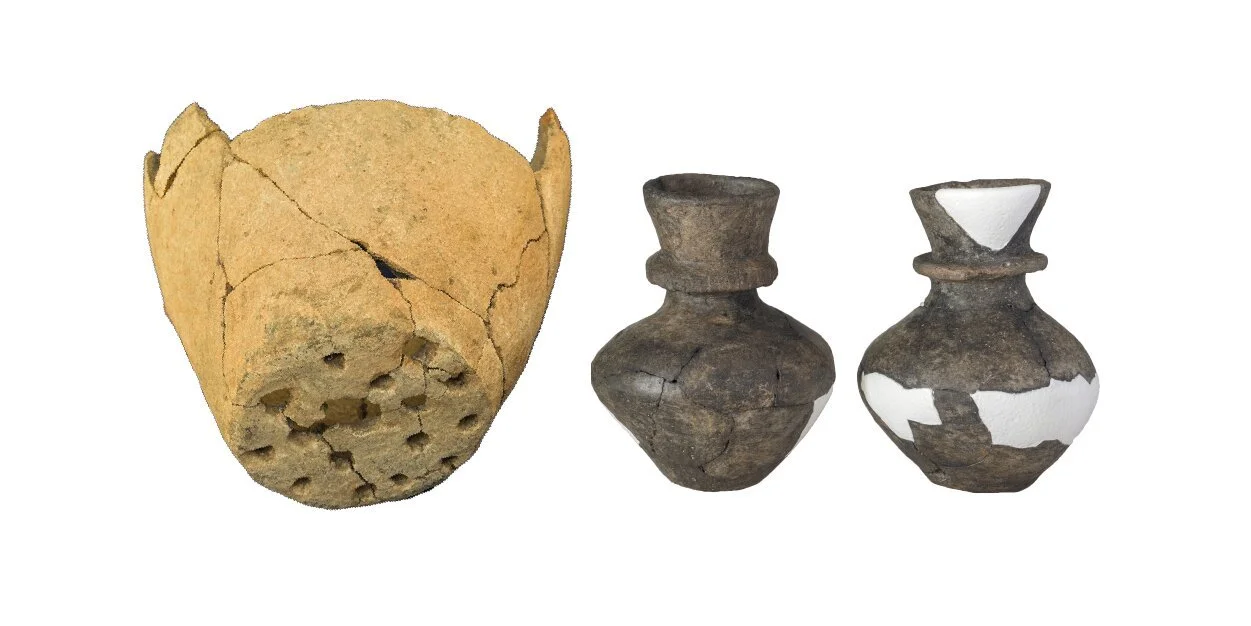
How chemical residues on ancient pottery can illuminate the development of dairying in environments where crop cultivation was difficult or unreliable.
Introduction: Dairy Beyond the Best Farmland
The development of dairying transformed the relationship between people and domesticated animals. Instead of relying exclusively on animals for meat, hides, or labor, communities could obtain milk repeatedly from living herds. This created new opportunities for nutrition, food processing, storage, and exchange.
Dairying could be especially valuable in environments where agriculture was constrained by limited rainfall, poor soils, steep terrain, or short growing seasons. Such areas are sometimes described as marginal lands, although the term is relative: a landscape unsuitable for intensive cereal farming may be well suited to grazing.
Archaeologists investigate early dairying through animal remains, settlement evidence, genetic research, and chemical residues preserved in pottery. Certain lipid compounds absorbed into ceramic vessels can help distinguish dairy fats from fats associated with meat processing.
These markers provide a powerful way to investigate the history of milk use, but they do not independently establish when milking began in a particular region or how important dairy products were within an entire economy.
What Are Dairy Lipid Markers?
Lipids are fats and related compounds that can survive in archaeological materials under suitable conditions. When milk or other animal products are processed in pottery, some lipids may be absorbed into the vessel's porous fabric.
Researchers extract these compounds and analyze their chemical composition. Particular distributions of fatty acids and their stable isotope values can help distinguish dairy fats from many non-dairy animal fats.
The method is especially useful because pottery may preserve residues long after the vessel's original contents have disappeared. Chemical analysis can therefore reveal aspects of food processing that are not visible from the vessel's shape or decoration.
However, the interpretation depends on preservation, contamination, and the chemical composition of the available reference materials. Different products may generate overlapping signatures, and the same vessel may have been used repeatedly for different foods.
A dairy-like lipid signature supports the interpretation that milk products were processed in a vessel, but researchers must still establish the date and archaeological context of the residue.
From Animal Domestication to Milking
The domestication of livestock and the development of dairying were related but distinct processes. People could manage herds for meat or other resources before routinely exploiting milk.
The emergence of milking depended on animal behavior, herd management, human knowledge, and the ability to process milk into usable products. Some populations also developed biological adaptations that improved their ability to digest fresh milk into adulthood, although dairying itself could exist without widespread adult lactase persistence.
Fermentation and other processing techniques could reduce lactose content in some dairy products, making milk-derived foods more accessible to people who had difficulty digesting fresh milk.
Archaeological evidence can help distinguish these developments. Animal age profiles may reveal whether herds were managed in ways consistent with milk production, while pottery residues can provide direct evidence of dairy processing.
Neither line of evidence is definitive alone. Herd age profiles can reflect several management strategies, and dairy residues do not necessarily reveal whether milk was consumed fresh, fermented, or transformed into other products.
Why Marginal Lands Matter
Pastoralism can be advantageous where crop yields are unreliable but grazing resources remain available. Animals can convert grasses and other vegetation into milk, meat, hides, and other products that people can use or exchange.
The value of dairying depends on the environment. In some regions, seasonal grazing and herd mobility allowed communities to exploit resources distributed across large areas. In others, mixed farming combined livestock with crop cultivation.
Archaeologists investigate these systems through settlement locations, animal remains, botanical evidence, and the distribution of processing facilities. Isotope analysis of animal teeth or bones can sometimes provide information about movement and diet, helping researchers investigate how herds used different landscapes.
The term “marginal” should not imply that such regions were economically unimportant. Their value may have depended precisely on resources that could not be exploited through intensive farming.
Pottery Residues and the Scale of Dairy Production
A single dairy residue can establish that a vessel was used to process milk products, but it cannot reveal the scale of production. To investigate whether dairying became a major economic activity, researchers need larger assemblages and evidence from several parts of the settlement system.
If dairy residues occur in many household vessels across successive periods, they may indicate that milk processing was widespread. Specialized containers, storage facilities, and evidence of repeated production could support a more intensive interpretation.
Yet the distribution of pottery residues is influenced by excavation methods, vessel preservation, and the types of containers sampled. A low proportion of dairy markers does not necessarily mean that dairy products were unimportant, because milk could have been processed in perishable containers or consumed without leaving identifiable residues.
Researchers should therefore compare the chemical evidence with animal-bone assemblages, settlement patterns, and environmental conditions.
Dairying, Trade, and Cultural Change
Dairy products can be processed into forms with different storage properties. Some products are more suitable for transport than fresh milk, potentially allowing producers to supply distant consumers.
Archaeological evidence may reveal changes in dairy processing over time, but identifying the movement of finished dairy products is difficult. Pottery containing dairy residues at a distant settlement could have been imported, locally manufactured, or reused for several purposes.
The spread of dairying knowledge may also occur without the large-scale movement of populations. Communities can adopt livestock management techniques through contact, trade, or observation.
Genetic and archaeological evidence can help investigate these possibilities, but genetic ancestry does not directly establish the transfer of a particular food practice. The development of dairying is best understood through the interaction of biology, technology, environment, and cultural learning.
Conclusion: Reconstructing the Growth of Dairy Economies
Lipid analysis of pottery has transformed the study of ancient dairying by allowing researchers to identify evidence of milk processing in vessels that may otherwise reveal little about their contents.
In marginal lands, dairy production may have offered an important way to use grazing resources and diversify household economies. Nevertheless, the presence of dairy markers does not by itself establish the scale of production, the precise processing method, or the social organization of herding.
The strongest reconstructions combine chemical residues with animal-bone analysis, environmental evidence, and regional chronology. Together, these sources can reveal how people developed new ways of obtaining food from livestock and adapted their economies to landscapes where other forms of subsistence were less reliable.




