
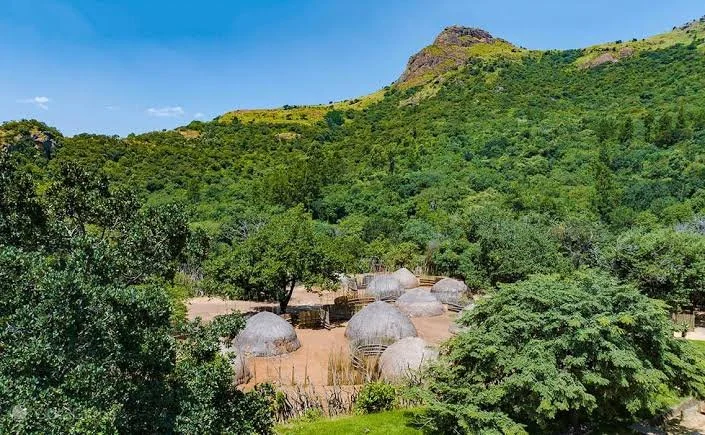
Introduction
The Ezulwini Valley is one of Eswatini's most culturally and geographically significant landscapes.
The valley lies between prominent mountains and has long been associated with royal history, political authority, sacred landscapes, and traditional settlement.
The title Ezulwini Valley: Eswatini's Royal Kraals refers to the relationship between royal authority and cattle enclosures or traditional settlement spaces.
The word "kraal" historically refers to an enclosure, particularly one associated with livestock, although in southern African historical contexts it can also refer more broadly to a settlement or royal residence.
Cattle and Royal Authority
Cattle have played an important role in the social and economic history of southern Africa.
They provide:
milk,
meat,
hides,
wealth,
bridewealth,
and political prestige.
For royal households, cattle could also symbolize authority and prosperity.
The Royal Kraal
A royal settlement was not simply a collection of houses.
It could contain different spaces for:
the ruler,
royal family members,
advisers,
servants,
visitors,
livestock,
ceremonies,
and political gatherings.
The arrangement of these spaces could reflect social hierarchy.
Ezulwini as a Political Landscape
The Ezulwini Valley's geography helped shape its historical importance.
Mountains surround the valley.
Such landscapes can provide protection and strategic advantages.
They can also become symbolically important.
Prominent mountains, rivers, and caves may acquire associations with royal ancestors or sacred traditions.
Architecture
Traditional royal settlements could contain circular houses, storage structures, cattle enclosures, pathways, and meeting areas.
Construction materials included:
earth,
timber,
grass,
stone,
and other locally available materials.
Much traditional architecture was biodegradable.
Consequently, archaeological remains may be less substantial than those of stone-built civilizations.
Oral Tradition
Royal history in Eswatini has been transmitted through oral traditions as well as written records.
Oral traditions can preserve:
genealogies,
royal succession,
battles,
migrations,
place names,
rituals,
and political relationships.
Historians compare such traditions with archaeological and documentary evidence.
Cattle Enclosures as Archaeological Evidence
Stone or earth boundaries can sometimes preserve evidence of former livestock management.
Archaeologists examine their size, entrances, associated deposits, and relationship to settlement structures.
However, not every enclosure is royal.
Attribution to a royal household requires contextual evidence.
Modern Heritage
The Ezulwini Valley is also an important modern cultural landscape.
Tourism, conservation, development, and traditional heritage overlap.
This creates both opportunities and challenges.
Sites can gain public recognition, but increased visitation can also damage fragile archaeological remains.
Conclusion
Ezulwini Valley: Eswatini's Royal Kraals illustrates how architecture, livestock, political authority, and landscape can combine to create a distinctive cultural environment.
The royal kraal was not merely a livestock enclosure.
It could represent political organization, social hierarchy, economic wealth, and ceremonial life.
Understanding these spaces requires archaeology, oral history, historical research, and respect for living traditions.





