
Introduction
Rock art is among the most visually powerful forms of southern African archaeological heritage.
Painted and engraved images provide evidence for symbolic expression, social identity, ritual activity, and relationships between humans and animals.
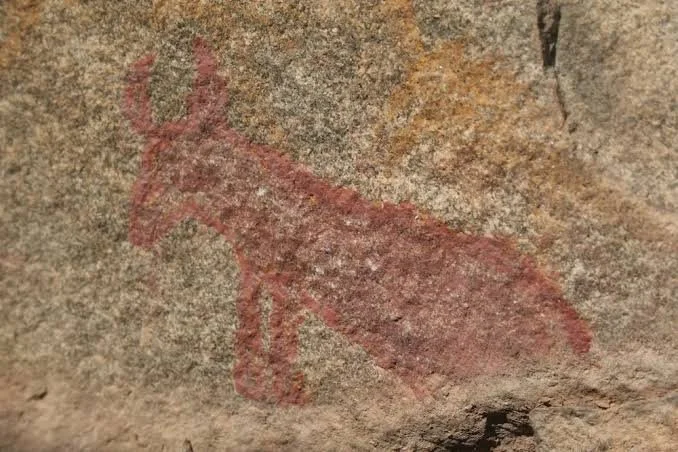
The title Makhaya: Eswatini's Rock Art Panels refers to rock art associated with the Makhaya area.
The specific identification and dating of individual panels should be confirmed through archaeological documentation, but the broader rock-art traditions of Eswatini form an important part of the region's heritage.
Southern African Rock Art
Rock art in southern Africa includes both paintings and engravings.
Paintings were commonly produced using mineral and organic pigments.
Red and orange pigments were frequently derived from iron-rich minerals.
White pigments could be produced from minerals such as kaolin.
Black could come from charcoal or manganese-rich materials.
Images of Animals
Animals appear frequently in southern African rock art.
Common subjects include:
eland,
antelope,
giraffe,
elephants,
and other large animals.
Animal imagery does not necessarily represent ordinary hunting scenes.
Some images may have ritual or symbolic significance.
Human Figures
Human figures may appear as hunters, dancers, ritual specialists, or supernatural beings.
Some figures have unusual postures or features.
These have been interpreted through ethnographic comparison with San religious traditions.
However, interpretation must account for the possibility that imagery changed across different periods and communities.
Trance and Ritual Interpretations
One influential approach connects some southern African rock art with San trance experiences.
In ethnographic accounts, ritual specialists could enter altered states during healing ceremonies.
Researchers have suggested that some rock-art imagery represents aspects of these experiences.
This interpretation is valuable but should not be treated as a universal explanation for every image.
Dating Rock Art
Dating paintings can be difficult.
Researchers may use:
radiocarbon analysis of suitable pigments,
archaeological association,
superimposition,
mineral alteration,
and stylistic comparison.
Not every painting can be directly dated.
Preservation Challenges
Rock art is vulnerable to both natural and human damage.
Water can erode pigment.
Lichen can grow over painted surfaces.
Temperature changes can affect rock.
Modern visitors may touch surfaces, apply graffiti, or unintentionally damage paintings.
Heritage Significance
Rock-art sites are not merely archaeological records.
They may also be connected to Indigenous heritage and cultural memory.
Interpretation should therefore be undertaken respectfully.
Local communities should be involved in decisions concerning access, recording, and presentation.
Conclusion
Makhaya: Eswatini's Rock Art Panels represents the intersection of archaeology, artistic expression, religion, and landscape.
The images preserved on rock surfaces can provide rare evidence for symbolic worlds that existed long before written records.
Their greatest value lies not in treating them as mysterious pictures, but in carefully studying their chronology, context, technique, and relationship to the societies that produced them.





