• MAIN PAGE
  • LATEST NEWS
    • Lost Cities
    • Archaeology's Greatest Finds
    • Underwater Discoveries
    • Greatest Inventions
    • Studies
    • Blog
  • PHILOSOPHY
  • HISTORY
  • RELIGIONS
    • Africa
    • Anatolia
    • Arabian Peninsula
    • Balkan Region
    • China - East Asia
    • Europe
    • Eurasian Steppe
    • Levant
    • Mesopotamia
    • Oceania - SE Asia
    • Pre-Columbian Civilizations of America
    • Iranian Plateau - Central Asia
    • Indus Valley - South Asia
    • Japan
    • The Archaeologist Editor Group
    • Scientific Studies
    • Aegean Prehistory
    • Historical Period
    • Byzantine Middle Ages
    • Predynastic Period
    • Dynastic Period
    • Greco-Roman Egypt
  • Rome
  • PALEONTOLOGY
  • About us
Menu

The Archaeologist

  • MAIN PAGE
  • LATEST NEWS
  • DISCOVERIES
    • Lost Cities
    • Archaeology's Greatest Finds
    • Underwater Discoveries
    • Greatest Inventions
    • Studies
    • Blog
  • PHILOSOPHY
  • HISTORY
  • RELIGIONS
  • World Civilizations
    • Africa
    • Anatolia
    • Arabian Peninsula
    • Balkan Region
    • China - East Asia
    • Europe
    • Eurasian Steppe
    • Levant
    • Mesopotamia
    • Oceania - SE Asia
    • Pre-Columbian Civilizations of America
    • Iranian Plateau - Central Asia
    • Indus Valley - South Asia
    • Japan
    • The Archaeologist Editor Group
    • Scientific Studies
  • GREECE
    • Aegean Prehistory
    • Historical Period
    • Byzantine Middle Ages
  • Egypt
    • Predynastic Period
    • Dynastic Period
    • Greco-Roman Egypt
  • Rome
  • PALEONTOLOGY
  • About us
No results found

Hidden Thracian Fire Walking in Serres Villages

November 22, 2026

Fire and ritual traditions in northern Greece

Fire has been an important symbol in religious and cultural traditions across many societies. It can represent purification, transformation, renewal, protection, danger, and the boundary between ordinary and sacred experience.

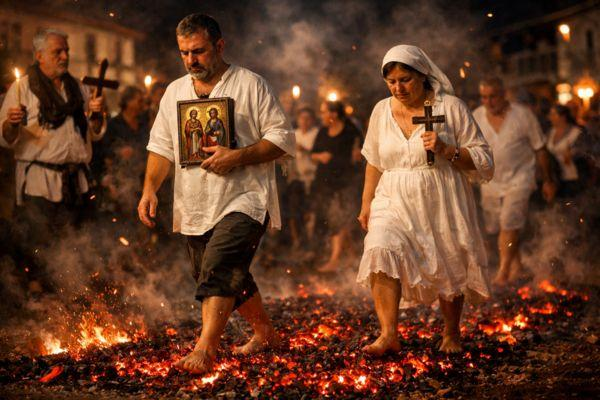
In northern Greece, the Anastenaria tradition is associated with ritual dancing on embers and the veneration of saints, particularly Saints Constantine and Helen. The tradition is documented in particular communities and is commonly discussed in relation to ritual performance, religious devotion, music, community identity, and inherited practices.

However, the exact form, history, and local variations of fire-related rituals must be established through ethnographic documentation. The title's reference to hidden fire walking in Serres villages does not independently confirm a specific ceremony in any village.

Fire walking and religious devotion

Fire walking in ritual contexts is often interpreted by participants through religious or spiritual meanings. The experience may be connected to faith, devotion, the protection of sacred figures, and the continuity of community traditions.

Music, movement, and collective participation can contribute to the ritual atmosphere. The event may involve a defined sequence of preparations, processions, prayers, dances, and other activities.

Anthropological interpretation should not reduce such traditions to spectacle. Understanding them requires examining participants' beliefs, community histories, ritual rules, and the meaning of the event within their lives.

The role of community

Rituals can strengthen social relationships by bringing people together around shared beliefs and practices. They may also connect participants with family histories and memories of previous generations.

The transmission of fire-related rituals often involves learning through participation, observation, and community membership. Such traditions may remain meaningful even when the social and economic conditions of the community change.

Documentation and safety

Research into fire walking should prioritize participant perspectives, historical documentation, and observation of ritual contexts. It should not encourage people to imitate the practice.

Walking on hot embers can cause serious burns and injury. Traditional ritual participation should not be treated as a safe activity for recreation or experimentation.

A study of fire walking in Serres would be useful for exploring ritual, religious devotion, folklore, and community identity, provided the specific local practice is verified rather than assumed.

← Obscure Arcadian Goat Calls in Menalon WoodsForgotten Dodona Whispers in an Ioannina Village →
Featured
image_2026-11-19_214108362.png
November 22, 2026
Forgotten Roman Chain Links in a Skiathos Cove
November 22, 2026
Read more →
November 22, 2026
image_2026-11-19_214326666.png
November 22, 2026
Hidden Cycladic Pegs in a Seriphos Attic Beam
November 22, 2026
Read more →
November 22, 2026
image_2026-11-19_214513977.png
November 22, 2026
Hidden Hellenistic Bricks in Kozani Side Streets
November 22, 2026
Read more →
November 22, 2026
image_2026-11-19_214554639.png
November 22, 2026
Forgotten Minoan Pits in a Petras Garden
November 22, 2026
Read more →
November 22, 2026
image_2026-11-19_214632804.png
November 22, 2026
Hidden Fresco Underpaint in an Ikaria Chapel
November 22, 2026
Read more →
November 22, 2026
image_2026-11-19_214710478.png
November 22, 2026
Obscure Road Pegs in a Serifos Field Path
November 22, 2026
Read more →
November 22, 2026
read more

Powered by The archaeologist