
How accumulated shells can help reconstruct ancient shorelines, coastal resource use, and the changing relationships between island communities and the sea.
Introduction: Shells as Records of Coastal Change
Molluscs have provided food and materials for coastal communities for thousands of years. Oysters, mussels, clams, limpets, and other shellfish could be collected from intertidal zones, where the shoreline is alternately exposed and submerged by the tides.
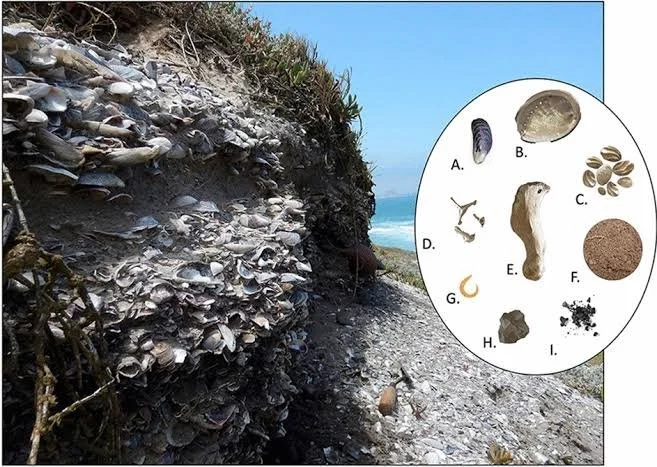
The discarded shells sometimes accumulated into substantial deposits known as shell middens. These deposits can contain not only mollusc remains but also charcoal, animal bones, stone tools, pottery, and other evidence of human activity.
Shell middens are important records of diet and coastal life, but they can also contribute to the reconstruction of ancient sea levels. Because many mollusc species occupy particular ecological zones, their remains may indicate the conditions under which people collected them.
The method requires caution. A midden is a human-made accumulation, not a natural shoreline marker in the same sense as an undisturbed geological deposit. Its elevation and species composition may reflect collection practices as well as environmental conditions.
Understanding the Intertidal Zone
The intertidal zone lies between the high- and low-water marks. Its ecological conditions vary with tidal range, wave exposure, salinity, temperature, substrate, and the availability of suitable surfaces for marine organisms.
Different mollusc species occupy different parts of this environment. Some are adapted to regular exposure to air, while others require more continuous immersion. Their distribution can therefore provide information about the conditions of the shoreline where they lived.
However, ecological ranges are not fixed everywhere. Local wave action, freshwater input, temperature, substrate, and other factors can shift the position of a species within the intertidal zone.
Researchers use modern ecological surveys to establish how particular species relate to tidal height in the study region. They then compare those patterns with archaeological shell assemblages, taking into account possible changes in climate and coastal ecology.
The result is a more nuanced reconstruction than simply treating every shell as a direct indicator of sea level.
How Shell Middens Form
A shell midden develops when people repeatedly discard shellfish remains in a particular area. Some middens accumulate through many small meals over long periods, while others may form during short episodes of intensive harvesting and processing.
The formation process influences the archaeological signal. A midden may combine shells collected from different tidal heights, seasons, and locations. Shells may also have been transported from the shore to a settlement some distance inland.
Researchers investigate the deposit's structure, species composition, shell condition, and relationship to other materials. Fragmentation patterns may indicate processing or trampling, while burning can suggest cooking or later exposure to fire.
Stratigraphy helps establish whether the midden accumulated gradually or contains distinct episodes of activity. Secure dating is essential because a shell deposit may represent repeated use across generations rather than one moment in time.
Reconstructing Past Sea Levels
Shellfish remains can contribute to sea-level reconstruction when their original ecological position is sufficiently well understood. If a species lived within a narrow tidal range, its preserved remains may help constrain the relative elevation of the shoreline at the time it was collected.
Researchers compare the elevation of the archaeological deposit with modern tidal datums and reconstruct the effects of later land movement. In some island regions, tectonic uplift or subsidence can significantly alter the relationship between an archaeological site and modern sea level.
The distinction between relative sea level and global sea level is important. Relative sea level describes the position of the sea relative to the land at a particular location. It can change because of ocean volume, land movement, sedimentation, and other processes.
A shell midden's elevation cannot be interpreted accurately without considering these local factors. A deposit now well above the shoreline may have been created by people collecting shellfish at a lower sea level, but it may also have been affected by uplift or other landscape changes.
Dating Shell Deposits and Correcting for Marine Reservoir Effects
Shells can sometimes be radiocarbon dated, but marine organisms may appear older than contemporaneous terrestrial materials because dissolved carbon in seawater can have a different radiocarbon history. This is known as the marine reservoir effect.
The size of the effect varies geographically and can change over time. Researchers therefore use appropriate regional corrections and, where possible, compare shell dates with independently dated terrestrial materials from the same archaeological context.
Another issue is redeposition. Shells may be collected from older deposits or moved by waves, currents, and human activity. A dated shell does not automatically establish the age of the entire midden or the moment when it was deposited.
Reliable sea-level studies combine dating with stratigraphic analysis, elevation measurements, and ecological information. Multiple independent indicators provide stronger constraints than a single shell sample.
Human Harvesting and Environmental Change
Middens also reveal how island communities used coastal resources. Species diversity, shell size, and changes in the abundance of particular molluscs may reflect harvesting preferences, environmental shifts, or changes in population and settlement patterns.
A decline in shell size could suggest intensive harvesting, but other explanations include changing collection locations, ecological stress, and differences in the species represented. Researchers must compare archaeological patterns with modern ecological knowledge and other environmental evidence.
Changes in midden composition may also reflect cultural choices. Communities could shift their preferred foods, alter processing techniques, or obtain shellfish from different areas as transport and settlement patterns changed.
The archaeological record therefore captures an interaction between human behavior and coastal ecology. Shell middens are not passive environmental archives; they are deposits shaped by deliberate harvesting, food preparation, and disposal.
Island Archaeology and Coastal Adaptation
Island communities often depended on a diverse combination of marine and terrestrial resources. Sea-level change could alter access to shellfish beds, coastal routes, landing places, and settlement areas.
By combining shell midden evidence with sediment cores, submerged landscapes, shoreline deposits, and settlement archaeology, researchers can investigate how communities responded to these changes.
Some populations may have shifted settlement locations or changed their harvesting strategies, while others adapted through different technologies or broader resource networks. These responses cannot be inferred from sea-level evidence alone; the social and economic context matters.
Shell middens also remind researchers that coastal change was experienced locally. Two islands exposed to similar global sea-level trends could undergo different changes because of their geology, topography, and tectonic history.
Conclusion: Shell Middens as Both Cultural and Environmental Archives
Intertidal mollusc middens can provide valuable information about ancient shorelines, tidal ecology, and coastal subsistence. Their shells may help constrain past sea levels when species ecology, elevation, chronology, and local land movement are carefully understood.
Yet shell middens are human-made deposits, and their contents reflect harvesting choices as well as natural conditions. Marine reservoir effects and redeposition can further complicate dating.
The most reliable reconstructions combine mollusc ecology with geological evidence, precise elevation measurements, and independent chronological methods. In doing so, researchers can use the same shell deposits to explore both environmental change and the everyday decisions through which island communities adapted to a changing sea.




