Introduction
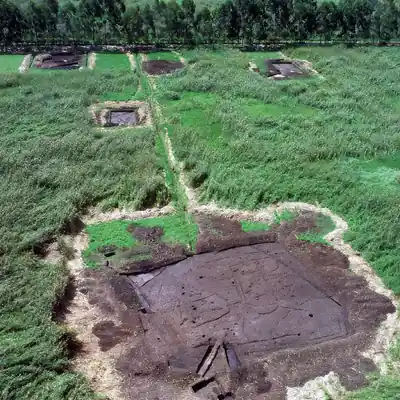
Situated at 1,550 meters above sea level in the Wahgi Valley of the Western Highlands Province, Papua New Guinea, Kuk Swamp is one of the most important archaeological sites in the world for understanding the origins of agriculture. UNESCO World Heritage-listed, Kuk provides continuous, multi-phased stratigraphic evidence showing that early Papuans independently developed plant cultivation and wetland engineering starting as early as 10,000 to 7,000 years ago—contemporaneous with, or even predating, early agricultural centers in the Fertile Crescent, China, and Mesoamerica.
Archaeological Sequence and Drainage Engineering
Decades of excavation led by Professor Jack Golson and subsequent international teams revealed a six-phase chronological sequence of human manipulation of the wetland ecosystem:
1.Phase 1: Early Mounds (~10,000–9,000 BP):Palaeoenvironment Modification.
Discovery of artificial clay mounds, stake holes, and cooking hearths. Starch grain and phytolith analysis on stone tools confirms the processing of native taro (Colocasia esculenta) and banana (Musa ingens).
2.Phase 2: Systematic Mounding (~7,000–6,400 BP):Independent Agriculture Emergence.
Clear evidence of intentional wetland manipulation. Farmers constructed raised earth mounds surrounded by shallow basins to raise crop roots above the water table, creating ideal growing conditions for cultivated taro and yam.
3.Phase 3: Major Drainage Canals (~4,500–4,000 BP):Large-Scale Hydraulic Engineering.
Construction of long, straight, hand-dug wooden-lined ditches and main arterial canals designed to drain water from the catchment basin into the nearby Wahgi River, reclaiming hundreds of hectares of swamp for farming.
4.Phases 4–6: Grid Ditches & Casuarina Fallowing (~2,000–100 BP):Late Prehistoric Intensification.
Development of tight, grid-like network ditches, followed by the introduction of Casuarina tree fallowing and eventually sweet potato mound systems in the post-Columbian era.
Key Agricultural Takeaway: Kuk Swamp provides definitive proof that the New Guinea Highlands was an independent center of plant domestication. Key global crops—including taro, greater yam, sugarcane (Saccharum officinarum), and the Australimusa banana—were first brought into systematic cultivation here long before outside contact.
Conclusion
Kuk Swamp fundamentally altered global perspectives on the history of human innovation. It proves that early Papuan communities were sophisticated ecological engineers who mastered land reclamation, hydraulic management, and plant domestication thousands of years ago, establishing an enduring agricultural legacy in the heart of the Pacific.