Introduction
In the rugged, high-altitude interior of Southern Highlands Province, Papua New Guinea, the Wola Valley provides a classic, living laboratory for understanding how Indigenous highland societies transformed mountain rainforests into hyper-productive agricultural landscapes.
Central to Wola subsistence and socio-economic life is the intensive cultivation of the sweet potato (Ipomoea batatas), known locally as kaukau. Introduced to New Guinea via historic Iserian/Spanish trade routes through the Pacific around 300–400 years ago, the sweet potato triggered a major agricultural revolution—often termed the "Ipomoean Revolution"—that reshaped highland demography, pig husbandry, and social structures.
Agricultural Engineering and Soil Management
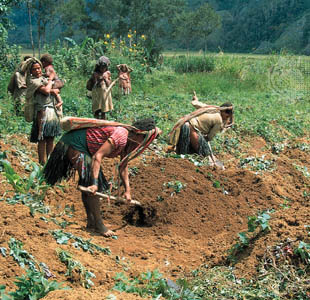
The Wola people developed sophisticated agronomic techniques to cultivate steep, frost-prone mountain slopes up to 2,800 meters above sea level:
Composting Mounds (Mond): Farmers construct large, circular soil mounds (often 2–4 meters in diameter and 1 meter high) packed with decaying organic mulch (weeds, sweet potato vines, and green manure) at their core. As this organic core decomposes, it generates internal heat that protects tender roots from night frosts, while simultaneously enriching the soil with nitrogen and organic matter.
Fallow Management & Drainage: Fields are farmed in cyclical rotations, interspersed with long fallow periods planted with nitrogen-fixing trees (Casuarina oligodon). Deep perimeter ditches prevent soil erosion on steep hillsides and drain excess rainfall during heavy wet seasons.
The high caloric yield and cold-tolerance of the sweet potato allowed the Wola to expand settlements higher into the mountains than was ever possible with traditional taro (Colocasia esculenta) or yam (Dioscorea) crops.
This agricultural surplus directly fueled the scaling-up of massive ceremonial exchange networks (Moka or Ya), where hundreds of domesticated pigs—fed primarily on undersized sweet potato tubers—were traded to build political prestige and settle inter-clan alliances.
Conclusion
The sweet potato gardens of the Wola Valley demonstrate the extraordinary capacity of New Guinea Highlanders to innovate within challenging montane environments. The strategic integration of mound composting, forest fallowing, and crop selection transformed the regional economy, providing a powerful example of Indigenous environmental engineering in the Pacific.