
Introduction
Burial archaeology provides some of the most intimate evidence available for reconstructing prehistoric societies.
Unlike stone tools, which primarily reveal technology, human burials can provide information about age, health, diet, trauma, mobility, mortuary behavior, and biological relationships.
The title Lion's Cave: Eswatini's San Burials refers to a cave context associated with Eswatini and the broader history of San hunter-gatherer populations.
The specific attribution of a burial assemblage to a particular cultural group requires archaeological evidence and should not be assumed solely from location or burial style.
San Archaeological Heritage
The term "San" refers to diverse southern African hunter-gatherer communities rather than one ancient homogeneous population.
Their histories stretch across thousands of years.
Different groups developed distinct languages, traditions, territories, and relationships with neighboring societies.
Archaeology therefore needs to avoid treating all hunter-gatherers as culturally identical.
Caves as Burial Locations
Caves and rockshelters can become burial locations for several reasons.
They provide sheltered spaces.
They may hold spiritual significance.
They can be associated with ancestors or sacred landscapes.
A burial inside a cave may therefore reflect both practical and symbolic choices.
Human Remains
Archaeologists study skeletal remains to reconstruct aspects of past life.
Analysis may reveal:
age at death,
biological sex,
skeletal injuries,
dental health,
nutritional stress,
disease,
and physical activity.
Modern bioarchaeology can also use isotopic and genetic techniques where preservation and ethical considerations permit.
Mortuary Practices
Burials may involve:
body position,
grave construction,
ochre,
personal ornaments,
stone arrangements,
tools,
or other objects.
However, burial customs can change through time.
A single practice should not automatically be assigned to an entire population.
San and Rock Art
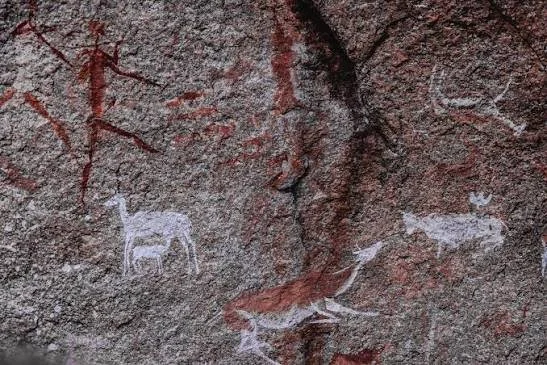
Southern African hunter-gatherer archaeology is closely associated with rock art.
Paintings sometimes depict humans, animals, and supernatural beings.
Researchers have proposed connections between rock art and ritual specialists, trance experiences, healing, and social relationships.
These interpretations are powerful but must be applied carefully to individual sites.
Chronology
Dating burials is essential.
A burial may be thousands of years old or considerably more recent.
Radiocarbon dating can sometimes provide direct chronological information when suitable material is available.
Stratigraphic relationships can also establish relative chronology.
Ethical Archaeology
Human remains require particularly careful treatment.
Modern archaeological practice emphasizes respect for descendant communities and appropriate legal and ethical procedures.
Excavation, analysis, storage, and display of human remains should be governed by professional standards.
Eswatini's Archaeological Importance
Eswatini sits within a wider southern African archaeological landscape connecting eastern South Africa and Mozambique.
Its caves and shelters provide evidence for human occupation across different periods.
Burials can complement information from tools, rock art, environmental remains, and settlement evidence.
Conclusion
Lion's Cave: Eswatini's San Burials highlights the importance of mortuary archaeology in understanding southern Africa's prehistoric communities.
If a specific burial assemblage is securely associated with a particular archaeological context, it can reveal extraordinary information about past lives.
At the same time, the cultural identity of ancient burials should never be assigned casually.
Careful dating, skeletal analysis, archaeological context, and collaboration with relevant communities are essential for transforming human remains into responsible historical knowledge.





