
Introduction
The Malolotja Nature Reserve occupies a mountainous region of northwestern Eswatini characterized by dramatic terrain, grasslands, cliffs, and valleys.
The region's archaeological significance includes evidence of human activity extending deep into the past.
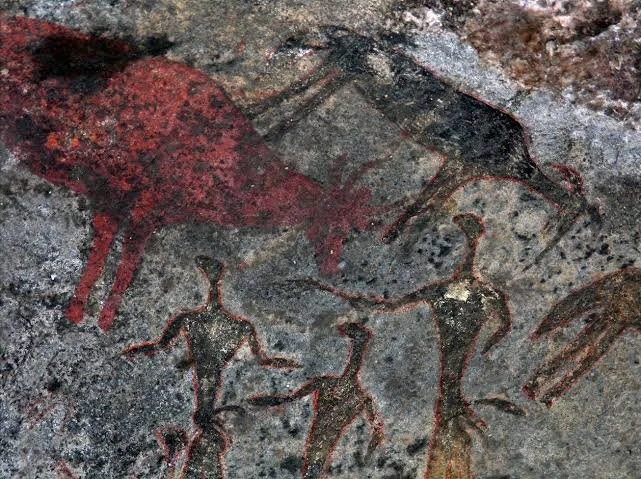
The title Malolotja: Eswatini's 4,000-Year Rock Art refers to rock-art traditions attributed to a period approximately four millennia ago.
Specific dates must be established through archaeological analysis, because not every painting at a rock-art site is necessarily the same age.
A Long Human Presence
Southern Africa has one of the world's longest archaeological records of human activity.
People have occupied its landscapes for tens of thousands of years.
Rock art forms one component of this enormous record.
By several thousand years ago, hunter-gatherer communities had developed sophisticated symbolic traditions.
Mountain Landscapes
Malolotja's mountainous environment provided numerous rock surfaces and shelters.
Such places could serve as:
temporary camps,
observation points,
shelters,
ritual locations,
or places for creating rock art.
The landscape itself may have influenced where paintings were placed.
The Artists
Rock art was produced by human communities with extensive knowledge of local environments.
Artists understood pigments, surfaces, application techniques, and symbolic conventions.
The production of art was therefore an intellectual and technical activity.
Pigments
Red and orange pigments often derive from iron oxides.
White pigments can originate from clay minerals.
Black pigments may contain charcoal or manganese.
Pigments could be mixed with binders to help them adhere to rock.
Different techniques created variations in line quality and durability.
Animals and Humans
Southern African rock art frequently includes animals and human figures.
Large antelope species can be particularly prominent.
Researchers have proposed that some animal imagery had religious significance.
However, the meaning of individual images cannot always be determined with certainty.
The 4,000-Year Question
A claim of approximately 4,000 years old must be treated as a chronological estimate rather than automatically assigned to every image.
Rock-art panels can be used repeatedly.
Different paintings may have been added centuries or millennia apart.
Superimposition can sometimes reveal the relative sequence.
Cultural Context
Rock art should be studied alongside other archaeological evidence.
Nearby stone tools, hearths, animal remains, and settlement deposits can provide information about the communities using the landscape.
This integrated approach is stronger than interpreting paintings alone.
Conservation
Rock art is extremely fragile.
Even apparently stable paintings can deteriorate through:
moisture,
sunlight,
biological growth,
mineral deposition,
and human contact.
Digital recording and high-resolution photography can preserve information about panels without physically disturbing them.
Conclusion
Malolotja: Eswatini's 4,000-Year Rock Art highlights an extraordinary aspect of Eswatini's prehistoric heritage.
If securely dated to around four millennia ago, such imagery would provide valuable evidence for symbolic expression in southeastern Africa during a period of major environmental and social change.
The paintings are more than decorative images. They are fragments of intellectual and spiritual history preserved directly on the landscape.





