
Introduction
The Late Stone Age represents one of the most important periods in the archaeological history of southern Africa.
During this period, hunter-gatherer communities developed sophisticated technologies, symbolic traditions, food economies, and patterns of mobility.
The title Mbabane Rockshelter: Eswatini's Late Stone Age refers to a rockshelter landscape associated with the Mbabane region and the broader archaeological record of Eswatini.
Because individual site identifications require archaeological verification, the title should not be interpreted as proof of a particular excavation unless supported by published site records.
Nevertheless, the Mbabane region provides an important setting for understanding Stone Age occupation in Eswatini.
Rockshelters as Archaeological Archives
Rockshelters are especially valuable archaeological locations.
Unlike open-air sites, shelters can protect cultural deposits from weathering.
Sediments may accumulate over thousands of years.
These layers can preserve:
stone tools,
charcoal,
animal bones,
shell,
pigments,
hearths,
and other traces of occupation.
The Late Stone Age
The Late Stone Age in southern Africa is generally associated with hunter-gatherer societies using increasingly diverse toolkits and participating in complex symbolic traditions.
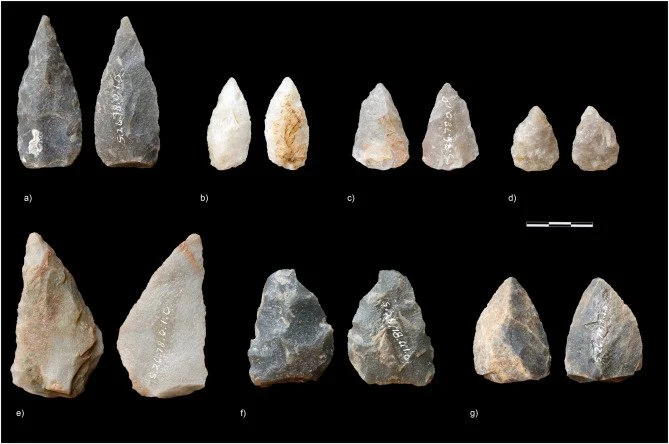
Technological changes included the widespread use of small stone tools, points, blades, bone implements, and specialized equipment.
However, the Late Stone Age was not a single uniform culture.
Different regions developed different traditions.
Hunter-Gatherer Mobility
Late Stone Age communities often moved through landscapes according to seasonal resources.
Mobility could involve movement between:
rivers,
grasslands,
forests,
mountain zones,
and rock shelters.
A rockshelter might therefore have been occupied repeatedly rather than functioning as a permanent village.
Food and Environment
Archaeological deposits can reveal what people ate.
Animal bones may identify hunted species.
Plant remains can provide evidence for gathered foods.
Shell and other organic materials can reveal environmental connections.
When multiple layers are preserved, researchers can reconstruct changes in diet through time.
Stone Technology
Stone tools provide one of the most important sources of evidence.
Archaeologists examine the raw materials selected by toolmakers.
Quartz, quartzite, chert, and other stones could be transported from different locations.
The presence of non-local stone can reveal movement and exchange.
Symbolic Culture
Late Stone Age societies in southern Africa are particularly famous for rock art.
Paintings and engravings can depict:
animals,
human figures,
hunting scenes,
geometric designs,
and complex supernatural imagery.
However, not every rockshelter contains paintings.
Archaeological occupation and rock art are related subjects but should not automatically be treated as identical evidence.
Dating
Researchers can establish chronology using several methods.
Radiocarbon dating is particularly valuable when charcoal or other organic material is preserved.
Stratigraphy also helps.
Older deposits generally occur beneath younger layers, provided the archaeological sequence has not been disturbed.
Importance for Eswatini
Eswatini occupies a strategic position between South Africa and Mozambique.
Its landscapes include highlands, valleys, rivers, and ecological zones that supported diverse prehistoric populations.
Archaeological sites can therefore help reconstruct how people moved across southeastern Africa.
Conclusion
Mbabane Rockshelter: Eswatini's Late Stone Age represents an important archaeological theme: the study of hunter-gatherer occupation in the mountainous landscapes of Eswatini.
Rockshelters provide unusually valuable records because their sediments can preserve evidence of repeated occupation.
Through stone tools, animal remains, hearths, pigments, and environmental data, archaeologists can reconstruct not only what people used but also how they adapted to changing landscapes over thousands of years.





