Medieval castles were more than just residences for nobility; they were complex, self-sufficient machines designed for psychological warfare and military defense. Every stone, spiral staircase, and window was engineered to maximize the advantage of the defender while demoralizing the attacker.
1. Defense Architecture: The Layers of "Passive" Defense
The goal of castle design was to create a "killing zone" at every possible entry point.
The Moat and Drawbridge: The first line of defense. Moats weren't always filled with water; "dry moats" were common and served to prevent attackers from using siege towers or ladders effectively.
The Barbican and Portcullis: The entrance was the most vulnerable spot. A barbican (a fortified gatehouse) often featured a portcullis—a heavy iron-shod wooden grille. If an enemy breached the first gate, they often found themselves trapped in a small courtyard (the "hole of death") between two gates.
Murder Holes and Machicolations: Located in the ceilings of gateways or projecting from the top of walls, these openings allowed defenders to drop heavy stones, boiling water, or heated sand onto attackers.
Note: Contrary to popular belief, "boiling oil" was rarely used because it was too expensive and a fire hazard to the defenders themselves.
2. The Anatomy of a Siege: Defensive Geometry
Castle architecture evolved as siege technology improved.
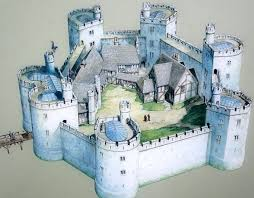
Concentric Walls: By the 13th century, castles like Beaumaris or Krak des Chevaliers used "walls within walls." The inner wall was always higher than the outer wall, allowing archers to fire over the heads of their own men on the lower ramparts.
Clockwise Spiral Staircases: Almost all castle staircases turned clockwise as they ascended. Since most swordsmen were right-handed, an attacker coming up the stairs would have their sword-arm blocked by the central stone pillar, while the defender had plenty of room to swing.
Arrow Slits (Loop-holes): These were narrow on the outside but flared widely on the inside, giving archers a wide field of vision while remaining almost impossible targets for enemies below.
3. Daily Life: The Struggle for Comfort
Behind the massive stone walls, life was often cold, cramped, and surprisingly public.
The Great Hall: This was the heart of the castle. It served as a courtroom, dining hall, and even a communal bedroom for servants. The lord and lady would eat at a "high table" on a raised dais to emphasize their status.
Heating and Light: Castles were notoriously damp. Large tapestries weren't just for decoration; they acted as insulation to keep heat in and drafts out. Windows were small to maintain structural integrity, making interiors dim and smoky from constant hearth fires.
The Garderobe (Toilet): Medieval toilets were essentially small stone closets with a hole that dropped waste directly into the moat or a cesspit below. To protect their expensive clothes from moths and fleas, nobility often hung their garments near the garderobe, as the ammonia from the waste acted as a natural pesticide.
4. The Garrison and Community
A castle was a bustling ecosystem. During times of peace, the population was relatively small, but during a siege, it could swell to hundreds.
The Constable: The man in charge of the castle's day-to-day operations and defense in the lord’s absence.
The Buttery and Pantry: Names that survive today. The "buttery" (from bouteille) was for storing wine and ale, while the "pantry" (from pain) was for bread and dry goods.
The Well: The most critical feature of any castle. If an enemy couldn't breach the walls, they would try to poison the water or wait for the garrison to die of thirst. A deep, protected well inside the Keep was the ultimate insurance policy.
5. The End of the Stone Age
The era of the great stone castle came to a crashing halt with the widespread use of gunpowder.
The Impact of Cannons: High, thin stone walls that were perfect for stopping arrows were easily shattered by iron cannonballs.
Evolution: Castles transitioned from tall towers into low, star-shaped "Trace Italienne" forts, designed to deflect shots and provide "flanking fire" from low-angled bastions.
Medieval castles remain symbols of power and permanence, but their archaeology reveals they were actually highly specialized tools—born from a specific need for security and eventually discarded when the technology of destruction outpaced the technology of stone.