The legend of El Dorado (The Golden Man) is perhaps the most famous "wild goose chase" in history. It lured thousands of European explorers into the dense jungles and high Andes of South America, fueled by a mixture of greed, desperation, and a profound misunderstanding of indigenous traditions.
While the Spanish sought a city of solid gold, the reality was far more fascinating: a ritual of the Muisca people that centered on spiritual transformation rather than material wealth.
1. The Origin: The Golden King
The true "El Dorado" was not a place, but a person. In the high-altitude plateau of modern-day Colombia, the Muisca people practiced a unique initiation ceremony for their new rulers (Zipas).
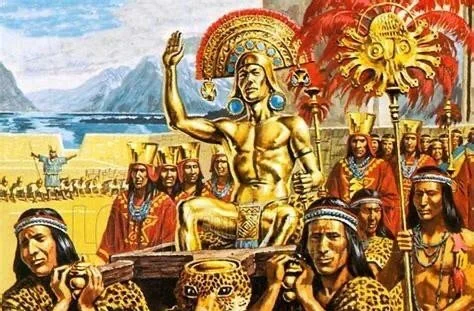
The Ritual: The heir to the throne was stripped, covered in sticky resin, and then dusted from head to toe in gold powder.
The Offering: He was placed on a raft filled with gold jewelry and emeralds. At the center of the sacred Lake Guatavita, the "Golden Man" would dive into the water to wash away the gold as an offering to the gods, while his attendants threw treasures into the lake.
2. The Spanish Transformation of the Myth
When the Spanish Conquistadors heard rumors of a "Golden Man" (El Hombre Dorado) in the 1530s, the story began to mutate.
From Person to City: Through years of retelling and mistranslation, the "Golden Man" became a "Golden City." Explorers convinced themselves that a hidden kingdom called Manoa existed, where the streets were paved with gold and the houses were made of precious metals.
The "Lost City" Obsession: As the Spanish failed to find the gold in the Muisca highlands, they pushed deeper into the Amazon and the Orinoco river basins, assuming the "real" city was just over the next mountain range.
3. Lake Guatavita: The Archaeology of Greed
Because Lake Guatavita was known to be the site of the original ritual, it became the target of centuries of "treasure hunting" that bordered on industrial engineering.
Draining the Lake: * In 1545, the Spanish used a bucket chain of laborers to lower the water level by 3 meters, recovering a small amount of gold.
In 1580, a merchant named Antonio de Sepúlveda cut a massive notch in the rim of the lake to drain it. He recovered some treasures, but the notch collapsed, killing many workers.
In 1898, a British company actually succeeded in draining the lake almost completely, but the bottom was covered in meters of deep, liquid mud that hardened like concrete in the sun, sealing the treasures away.
4. The Muisca: Masters of Goldsmithing
The gold artifacts that have been recovered—such as the famous Muisca Raft found in a cave in 1969—reveal why the Spanish were so obsessed.
Tumbaga: The Muisca used an alloy of gold and copper known as tumbaga. They were masters of the lost-wax casting technique, allowing them to create incredibly intricate, delicate figures called tunjos.
Spiritual Value vs. Monetary Value: For the Muisca, gold was not currency. It was a sacred substance that represented the energy of the sun. To "throw it away" into a lake was the ultimate act of piety, not a waste of wealth.
5. The Searchers: Famous Expeditions
The quest for El Dorado claimed the lives and reputations of some of history's most famous figures:
Gonzalo Pizarro & Francisco de Orellana: Their 1541 expedition failed to find gold but resulted in the first European navigation of the entire length of the Amazon River.
Sir Walter Raleigh: The English explorer made two trips to Guyana in search of the "Golden City of Manoa." His failure to find gold contributed to his eventual execution by King James I.
Lope de Aguirre: A soldier who went insane during an expedition, declared war on the Spanish Crown, and led a murderous rampage through the jungle in a desperate search for the myth.
6. Modern Legacy: The Museum of Gold
Today, the most significant remains of the "El Dorado" culture are housed in the Museo del Oro in Bogotá, Colombia. It contains over 34,000 pieces of gold, the largest collection of pre-Columbian goldwork in the world. These artifacts prove that while the "City of Gold" was a fantasy, the artistic and spiritual sophistication of the Muisca was very real.
The tragedy of El Dorado is that the Europeans were so blinded by the literal value of the gold that they destroyed the very culture that could have explained the mystery to them.