
Introduction
Southern Africa contains one of the world's richest traditions of prehistoric and historic rock art.
The title Ntabelanga: South Africa's Rock Paintings evokes a landscape in which painted rock surfaces preserve visual records created by communities long before modern written documentation.
A particular site named Ntabelanga should be identified through archaeological records before specific paintings, dates, or artists are attributed to it. Nevertheless, the subject provides an opportunity to examine the wider significance of South African rock paintings.
A Long Artistic Tradition
Rock art was produced over many thousands of years.
Different communities created different artistic traditions.
The paintings vary in:
subject,
technique,
pigment,
scale,
location,
and style.
This diversity demonstrates that there was no single "rock art culture."
Human Figures
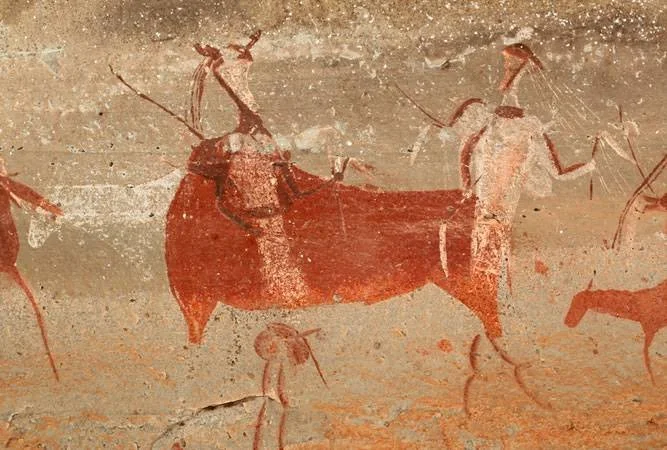
Human figures are among the most recognizable subjects.
Some appear to be hunters.
Others may be dancers, ritual specialists, or participants in social activities.
Some unusual figures appear partly human and partly animal.
These images have generated extensive scholarly discussion.
Animals
Animals dominate many southern African rock-art sites.
Common subjects include:
eland,
antelope,
giraffe,
elephant,
buffalo,
and other species.
Animals were central to subsistence but could also carry powerful symbolic meanings.
Pigments
Artists used naturally occurring minerals and other substances to create pigments.
Red and orange colors often came from iron-rich materials.
White could be produced from mineral sources such as clay or other light-colored substances.
Black pigments could be derived from charcoal or manganese-rich materials.
The ability to prepare and apply these substances demonstrates considerable technical knowledge.
Painting Techniques
Artists could apply pigment using fingers, brushes, feathers, or other tools.
Some paintings were drawn in fine lines.
Others were filled with broad areas of color.
Superimposition is particularly valuable archaeologically.
When one painting overlaps another, researchers can sometimes establish relative chronology.
The Social Meaning of Art
Rock paintings were probably produced for many reasons.
Possible functions include:
ritual activity,
communication,
storytelling,
identity,
teaching,
commemoration,
and ceremonial practice.
It is unlikely that all paintings served the same purpose.
Landscape and Sacred Places
Rock-art locations were not random canvases.
The choice of shelter or cliff could itself be meaningful.
A site might overlook a valley, water source, hunting area, or important route.
The landscape therefore formed part of the artwork's context.
Conservation Challenges
Rock paintings are fragile.
Natural weathering gradually removes pigment.
Human activities can accelerate deterioration.
Graffiti, touching, smoke, water, and uncontrolled tourism can permanently damage surfaces.
Digital recording is increasingly important.
High-resolution photography and three-dimensional documentation can preserve information for future researchers.
Heritage and Indigenous Perspectives
Rock art is archaeological heritage, but it also concerns the descendants and cultural traditions of communities associated with southern Africa.
Interpretation should therefore avoid treating the paintings as anonymous curiosities.
Community involvement can help researchers understand cultural meanings and develop responsible conservation strategies.
Conclusion
Ntabelanga: South Africa's Rock Paintings represents the extraordinary depth of southern Africa's visual heritage.
Whether a particular site contains paintings from one period or several, each image forms part of a much larger history of human creativity.
The paintings demonstrate that prehistoric and historic communities communicated through visual symbolism, possessed sophisticated knowledge of pigments and landscapes, and created enduring cultural records without relying on written language.
Their survival allows modern researchers to study not only what ancient people saw, but also what they considered important enough to place upon the walls of the landscapes they inhabited.





