
Introduction
Southern African rock shelters and caves preserve some of the most important evidence for San symbolic traditions.
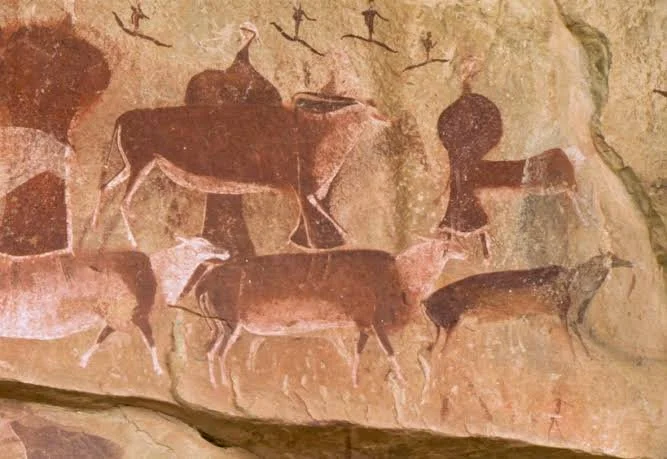
The title Mkuzane Cave: South Africa's San Mythology suggests a cave landscape associated with stories, beliefs, or artistic traditions connected with San communities.
The distinction between archaeology and mythology is essential.
Archaeologists can document paintings, engravings, artifacts, and settlement remains.
They cannot automatically reconstruct the complete mythological meaning of an image without ethnographic, linguistic, or historical evidence.
San Cosmology
San societies have historically maintained diverse religious traditions.
There was never one single San religion shared identically by every community.
Nevertheless, ethnographic studies have documented recurring themes involving:
animals,
rain,
healing,
trance,
spiritual potency,
ancestors,
and transformation.
Rock Art and Belief
Rock paintings are frequently interpreted as expressions of spiritual experience.
Some figures appear human but display unusual features.
Others combine human and animal characteristics.
These images have sometimes been interpreted as transformed ritual specialists.
Trance and Healing
Ethnographic research among several southern African San communities has documented healing ceremonies involving dancing, music, altered states of consciousness, and perceived spiritual power.
Researchers have used this information to interpret earlier rock art.
However, ethnographic analogy must be used cautiously.
Modern practices cannot automatically be assumed to have remained unchanged for thousands of years.
The Eland
The eland frequently appears in southern African rock art.
It has been associated in some interpretations with spiritual potency and ritual transformation.
The animal's behavior and physical appearance may have contributed to its symbolic significance.
But individual paintings may have different meanings.
Mythology and Landscape
Caves and rock shelters can become culturally meaningful landscapes.
A location may be associated with particular stories, supernatural beings, ancestors, or ritual events.
Such associations may continue even after the original paintings become difficult to interpret.
Oral Traditions
Oral traditions can help preserve cultural meanings.
However, they must be recorded carefully.
Stories may change over generations.
Different communities may interpret the same landscape differently.
Archaeological Method
A responsible interpretation combines:
rock-art analysis,
archaeological deposits,
ethnography,
linguistics,
oral history,
environmental context,
and chronology.
No single source is sufficient.
Conclusion
Mkuzane Cave: South Africa's San Mythology highlights the extraordinary symbolic dimension of southern African archaeology.
The cave should not be treated simply as a place containing "myths carved in stone."
Instead, it represents a meeting point between material evidence and cultural memory.
Its greatest significance lies in the possibility of understanding how people connected animals, landscape, ritual, healing, and spiritual experience.





