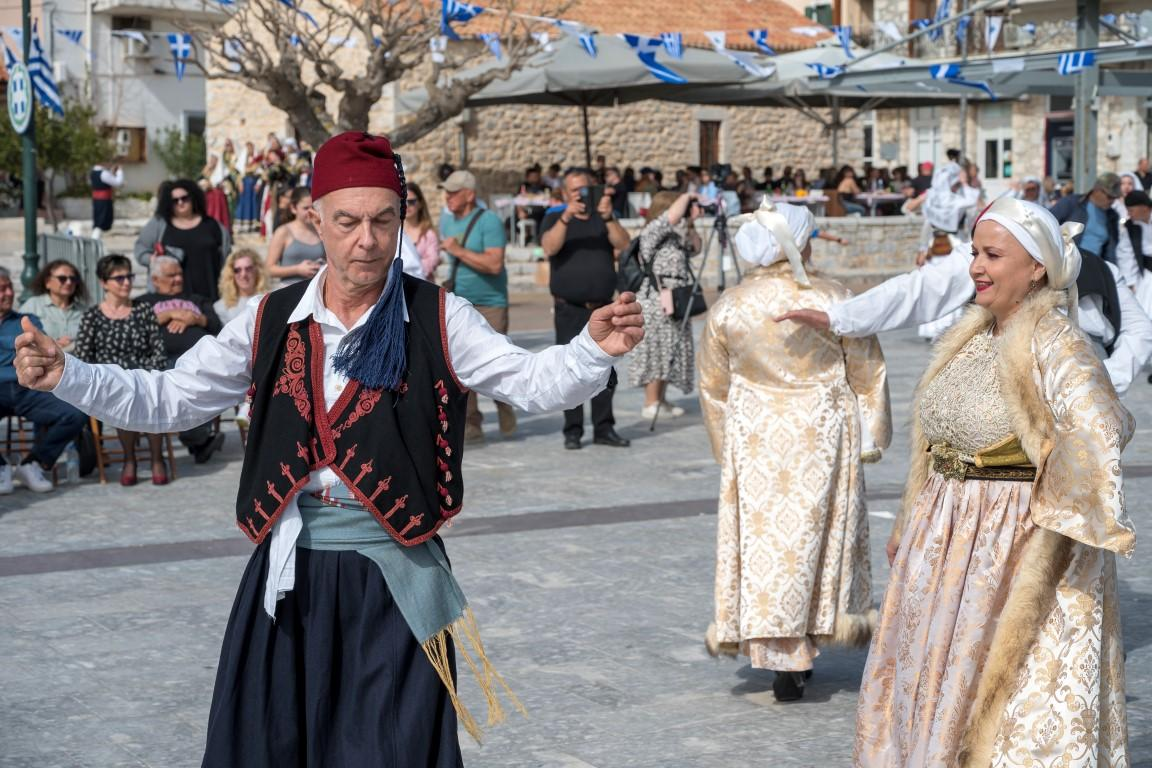
Dance and regional identity in the Mani
The Mani region of the Peloponnese is known for its distinctive architecture, social history, traditions of family identity, and strong regional cultural character. Folklore concerning bravery, honor, conflict, and community solidarity has often been associated with Maniot cultural narratives.
Traditional dances can reflect these themes through their movements, rhythm, formations, costumes, and performance contexts. Some Greek dances incorporate objects or props, although specific knife dances and their meanings vary widely between regions and documented traditions.
The title places the practice in a Mystras hamlet, but a specific local knife dance in that setting cannot be assumed without evidence.
The knife as a symbolic object
In traditional societies, knives could serve practical purposes related to agriculture, livestock, food preparation, and everyday work. In some cultural contexts, knives also acquired symbolic associations with masculinity, courage, protection, status, or historical conflict.
When a knife appears in a dance, it may represent a historical memory, a dramatic narrative, or a display of skill. However, it is important not to automatically interpret every knife-related performance as a reenactment of violence.
Dance can transform an object associated with practical or dangerous use into a symbolic element of artistic expression.
Performance and communal memory
Traditional dances are often performed at weddings, festivals, celebrations, and community gatherings. These events provide opportunities for people to express regional identity and participate in collective cultural practices.
The movements of a dance may be preserved through oral teaching and imitation. Differences between local versions can emerge as dances are transmitted between villages and generations.
A dance involving knives, if documented, would require careful analysis of its choreography, music, historical references, and community interpretations.
Cultural documentation
Research into Maniot dance traditions could include interviews with dancers, musicians, cultural associations, and older community members. Video recordings and descriptions of movement would help document performance variations and their cultural meaning.
A hypothetical knife dance in a Mystras hamlet would be significant as a subject of folklore research because it could illustrate how regional identity, symbolic objects, historical memory, and performance interact. It should not, however, be presented as an established tradition solely because the title suggests it.