
Introduction
Old Dongola was the capital of the medieval kingdom of Makuria and is one of the most important archaeological sites for understanding Christian Nubia.
Located along the Nile in modern Sudan, the city developed into a major political, religious, economic, and cultural center.
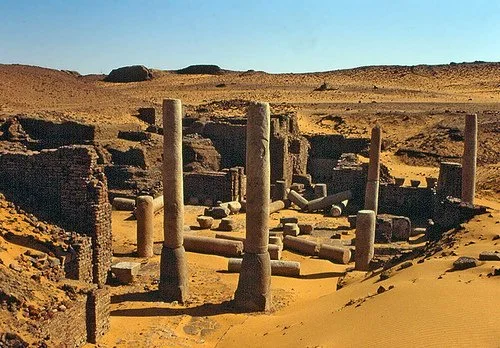
Its ruins include churches, monasteries, palaces, fortifications, domestic structures, cemeteries, and industrial areas.
The Kingdom of Makuria
Makuria was one of the major Christian kingdoms of medieval Nubia.
Its political influence extended across large portions of the Nile Valley.
The kingdom maintained complex relations with Egypt, including diplomacy, trade, warfare, and religious interaction.
Old Dongola served as the political heart of this kingdom.
Urban Development
Old Dongola was not merely a royal residence.
It was a complex city with multiple neighborhoods and institutions.
Archaeologists have identified:
churches
monasteries
administrative buildings
residential quarters
cemeteries
workshops
defensive structures
ceremonial spaces
This urban complexity demonstrates that medieval Nubia supported sophisticated city life.
The Churches
Several churches have been excavated at Old Dongola.
Their architecture reveals the development of Nubian Christianity.
Churches were not only places of worship. They could also function as centers of education, administration, and community organization.
Monasticism
Monastic institutions played a major role in medieval Nubian Christianity.
Monks participated in religious education, manuscript production, prayer, and economic activity.
Monasteries could also control agricultural land and interact with surrounding communities.
Old Dongola's archaeological remains provide important evidence for these institutions.
Palace and Political Authority
The city contained monumental structures associated with political power.
Architecture helped communicate authority.
Large buildings, ceremonial spaces, and elevated structures distinguished elite areas from ordinary residential neighborhoods.
At the same time, domestic archaeology demonstrates that ordinary people contributed to the city's economic life.
Material Culture
Pottery, glass, metal objects, coins, textiles, and other artifacts demonstrate Old Dongola's connections with neighboring regions.
Imported objects reveal trade networks extending beyond Nubia.
Local manufacturing indicates that the city also possessed specialized craftspeople.
The Decline and Transformation of Dongola
Makuria's political power changed substantially over the centuries.
The growth of Islamic political influence in the Nile Valley gradually transformed the region.
Old Dongola did not simply disappear overnight.
Parts of the city continued to be occupied, reused, or transformed.
The archaeological record therefore reveals gradual changes rather than a single moment of collapse.
Archaeological Research
Modern archaeological missions have conducted extensive excavations at Old Dongola.
The site has become one of the principal sources for reconstructing medieval Nubian history.
Archaeologists can combine architecture, inscriptions, ceramics, environmental evidence, and human remains to understand the city's development.
Conclusion
Old Dongola represents the extraordinary urban and cultural achievements of medieval Makuria.
Its ruins demonstrate that Christian Nubia possessed sophisticated political institutions, religious architecture, craft production, trade networks, and urban communities.
The city deserves to be understood not as a peripheral settlement but as one of the great centers of medieval African civilization.





