
Introduction
Faras Cathedral is one of the masterpieces of medieval Nubian archaeology.
Located in Lower Nubia, the cathedral belonged to the Christian kingdom of Nobadia and became famous for its extraordinary wall paintings.
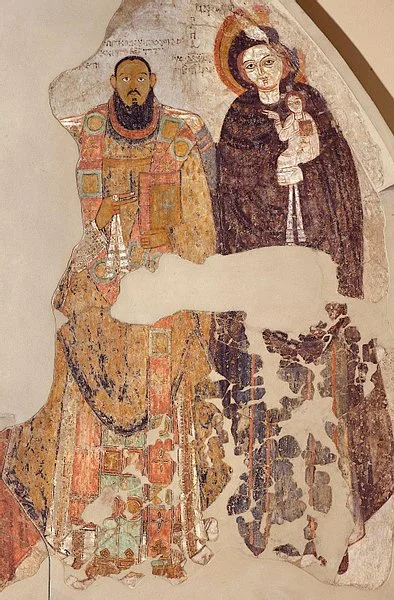
The paintings provide an unparalleled visual record of Nubian Christian religious culture, including bishops, saints, biblical figures, and royal imagery.
The Cathedral at Faras
Faras was an important religious center.
The cathedral developed through multiple construction and rebuilding phases.
Rather than representing a single moment, the building preserves centuries of architectural and artistic development.
Its religious importance was closely connected to the Christian institutions of medieval Nubia.
The Wall Paintings
The cathedral's paintings are among the most famous examples of Nubian Christian art.
They depict religious figures with large expressive eyes, elaborate clothing, halos, and ceremonial objects.
Some paintings show Nubian bishops and rulers under divine protection.
These images reveal the relationship between religion and political authority.
Nubian Artistic Identity
The paintings demonstrate that Nubian Christianity was not simply an imitation of Byzantine or Egyptian Christianity.
Artists incorporated broader Christian visual conventions while developing local styles.
The depiction of Nubian rulers and bishops is especially important because it places African political and religious leaders directly within Christian sacred imagery.
The Cathedral and Medieval Politics
Churches were important institutions within Nubian kingdoms.
Bishops could hold considerable influence, while religious centers could serve administrative and educational roles.
Royal imagery within churches reinforced relationships between political authority and divine legitimacy.
Rescue Archaeology
Faras became famous partly because the construction of the Aswan High Dam threatened the archaeological site.
An international archaeological campaign excavated the cathedral and recovered its paintings before the site was inundated.
Many of the paintings were removed and conserved.
Important examples are now preserved in museums, particularly the National Museum in Warsaw and the Sudan National Museum.
The Importance of Faras
Faras transformed scholarly understanding of medieval African art.
Its paintings demonstrated the sophistication of Nubian Christian visual culture and challenged older assumptions that major medieval artistic traditions were confined to Europe and the Mediterranean.
Conclusion
Faras Cathedral stands as a powerful reminder of the intellectual, artistic, and religious achievements of medieval Nubia.
Its painted walls provide a vivid record of Christian Nubian identity, while the rescue of the cathedral's artworks demonstrates the importance of archaeological preservation in the face of major environmental and infrastructure projects.





