
Introduction
African rock art represents one of the world's most extensive records of prehistoric human expression.
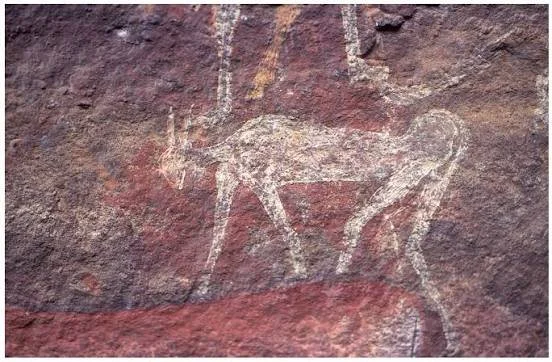
Paintings and engravings occur across deserts, mountains, rock shelters, cliffs, and open landscapes. Some depict animals and people; others consist of geometric designs, footprints, symbols, and abstract forms.
One of the major challenges in studying rock art is chronology.
Researchers frequently want to know when an image was created, but unlike a ceramic vessel or a buried bone, a petroglyph is often directly exposed to the environment.
Micro-erosion analysis offers one potential method for addressing this problem.
What Is Micro-Erosion?
Rock surfaces change gradually after they are exposed.
Mineral grains weather.
Edges become rounded.
Microscopic fractures expand.
Chemical alteration modifies exposed surfaces.
When a groove or engraving is cut into rock, the newly exposed surface begins to weather.
Researchers can therefore investigate the microscopic condition of an engraved surface.
In certain geological contexts, differences in microscopic erosion may provide clues about relative age.
Why Dating Rock Art Is Difficult
A petroglyph does not usually contain organic material that can be directly radiocarbon dated.
Researchers therefore rely on indirect techniques.
These may include:
mineral accretion
weathering analysis
superimposition
associated archaeological deposits
lichenometry in appropriate environments
cosmogenic exposure dating
radiocarbon dating of associated pigments or organic materials
Each method has limitations.
Relative Versus Absolute Dating
Micro-erosion is particularly valuable when used as a relative or calibrated dating method.
If two engravings were made on similar rock surfaces and one displays substantially greater microscopic weathering, researchers may be able to establish a sequence.
But weathering rates can vary.
Temperature, humidity, sunlight, rainfall, mineral composition, and surface orientation can all influence erosion.
Therefore, a universal "erosion clock" cannot simply be applied to every African rock-art site.
African Rock-Art Traditions
Africa contains extraordinarily diverse rock-art traditions.
Southern Africa is famous for painted imagery associated with hunter-gatherer communities, including scenes involving animals, humans, and ritual activities.
The Sahara preserves engravings and paintings documenting major environmental and cultural changes.
East and North Africa contain additional traditions with their own chronological histories.
These traditions should not be treated as one homogeneous artistic system.
Micro-Erosion and Petroglyphs
Researchers examine microscopic features along engraved grooves.
The shape of mineral crystals, development of weathering features, and condition of groove edges can provide chronological information.
The method works best when environmental conditions are sufficiently stable and when researchers possess suitable calibration data.
Calibration Is Essential
Suppose a modern researcher creates experimental engravings on the same type of rock.
The researchers can then monitor how those experimental surfaces change.
Modern and historically dated surfaces can provide calibration points.
This does not eliminate uncertainty, but it improves the reliability of the method.
Superimposition
Another powerful technique involves examining overlapping images.
If one engraving clearly cuts across another, the cutting image must be later.
This creates a relative sequence.
Micro-erosion can potentially strengthen such sequences by determining whether surfaces have experienced different durations of exposure.
Conservation Challenges
Rock art is vulnerable to modern damage.
Tourism, graffiti, road construction, mining, climate change, water erosion, and biological growth can alter surfaces.
Some modern damage may even mimic ancient weathering.
Digital recording is therefore increasingly important.
High-resolution photography, 3D scanning, and microscopic documentation allow researchers to create detailed records without repeatedly touching the art.
Conclusion
Micro-erosion represents an important tool for investigating African petroglyph chronologies, but it should not be treated as an automatic dating technique.
Its greatest value comes from combining microscopic analysis with geological study, archaeological context, experimental calibration, superimposition, and other dating methods.
The broader goal is to transform rock art from an undated collection of images into a chronological record of human activity across changing African landscapes.





