
Introduction
The Swahili Coast stretches along the eastern African shoreline from southern Somalia through Kenya and Tanzania and into northern Mozambique and the offshore islands.
For centuries, coastal communities participated in maritime networks connecting Africa with Arabia, Persia, India, and beyond.
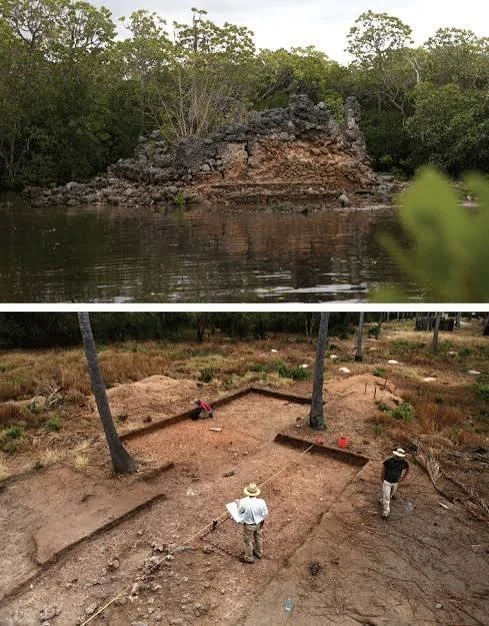
One of the most distinctive features of Swahili architecture is the extensive use of coral stone.
Coral-built mosques, houses, tombs, palaces, and other structures survive at numerous coastal settlements, creating an architectural record that reveals the sophistication of medieval and early modern Swahili society.
Coral Stone Architecture
The coral stone used in Swahili architecture generally came from reef formations and fossil coral.
After extraction, blocks could be shaped and incorporated into walls.
Coral limestone was particularly suitable for coastal construction because it was locally available and relatively workable.
Its widespread use reflects an adaptation to the island and coastal environment.
Swahili Cities
Major Swahili settlements developed as maritime trading centers.
Important archaeological sites include Kilwa Kisiwani, Songo Mnara, Gede, Manda, Pate, and numerous smaller settlements.
These cities were connected to maritime trade routes crossing the Indian Ocean.
Their inhabitants participated in commerce involving ceramics, beads, textiles, metals, ivory, gold, and other commodities.
Mosques and Religious Architecture
Mosques were among the most important coral-built structures.
Their architecture varied between settlements and periods.
Some mosques were relatively simple.
Others developed monumental forms with courtyards, prayer halls, columns, mihrabs, and elaborate masonry.
The architecture demonstrates the development of Islam within African coastal communities.
Beyond the Mosque
Coral architecture was not restricted to religious buildings.
Elite houses could contain decorated rooms, courtyards, storage areas, and specialized spaces.
Tombs were sometimes constructed from coral blocks.
Palatial complexes demonstrate the existence of powerful urban elites.
This diversity makes architecture an important source for reconstructing social hierarchy.
Archaeological Excavations
New excavations can reveal information that monumental ruins alone cannot provide.
Domestic deposits may contain pottery, animal bones, beads, metal objects, and food remains.
These materials help researchers reconstruct everyday life.
They can also reveal differences between elite and non-elite households.
Indian Ocean Connections
Imported ceramics are particularly useful for studying Swahili trade.
Chinese porcelain, Persian ceramics, Indian wares, and other imports have been found at coastal sites.
Their presence demonstrates that African communities were active participants in Indian Ocean commerce.
The Swahili Coast was therefore not an isolated African frontier.
It was part of an international maritime system.
African Foundations of Swahili Civilization
Older scholarship sometimes described Swahili civilization as primarily the product of foreign influence.
Archaeology has increasingly demonstrated the importance of local African development.
Swahili communities developed from African coastal societies while participating in international Islamic and Indian Ocean networks.
The resulting culture was neither simply imported nor isolated.
It was a dynamic synthesis rooted in East Africa.
New Excavation Questions
Contemporary archaeological research increasingly asks questions about ordinary residents, labor, food production, environmental change, and social inequality.
Researchers also investigate how coastal settlements responded to changing sea levels, storms, coral ecology, and shifting trade routes.
These questions move beyond the traditional focus on wealthy merchants and monumental buildings.
Conservation Challenges
Coral-built architecture is vulnerable to erosion, salt crystallization, vegetation, rising groundwater, coastal storms, and human development.
Climate change adds further pressure to archaeological sites near the ocean.
Conservation therefore requires both archaeological research and environmental management.
Conclusion
The coral-built temples and settlements of the Swahili Coast demonstrate the sophistication of African maritime civilization.
New excavations are helping archaeologists understand not only spectacular mosques and palaces but also the ordinary communities that built and maintained them.
The archaeological record ultimately reveals a society deeply rooted in East Africa while simultaneously connected to one of the largest commercial networks of the medieval world.





