
Introduction
Tattooing is one of the oldest forms of permanent body modification. It has been practiced in different societies for purposes involving identity, social belonging, spirituality, healing, status, aesthetics, and cultural tradition.
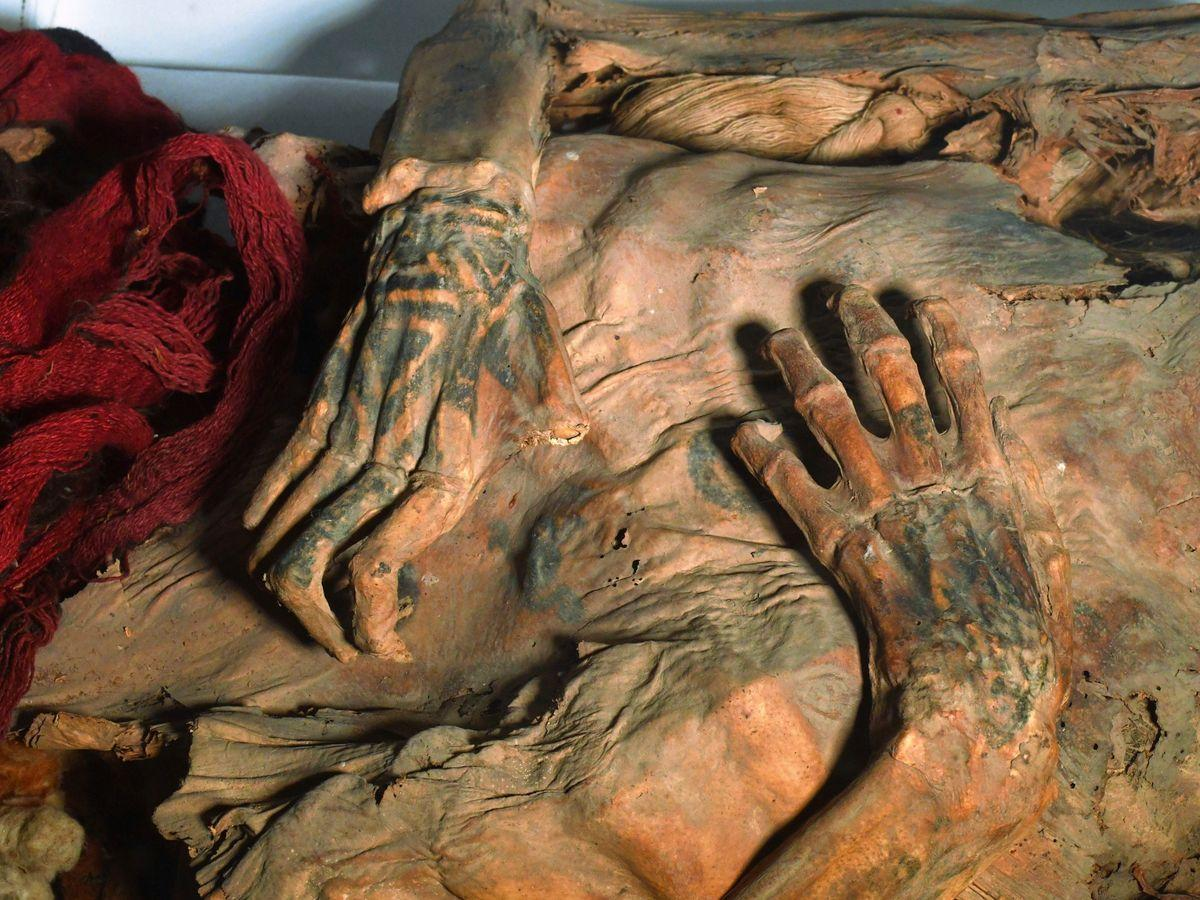
The preservation of tattooed skin in mummified remains provides archaeologists with a rare opportunity to study body modification directly. Unlike depictions of tattoos in pottery, sculpture, or historical descriptions, preserved skin can reveal the actual patterns, pigments, and techniques used.
The Andes contain diverse archaeological environments in which human remains have sometimes been naturally or intentionally preserved. However, the specific tattooed mummy assemblage described in the title is not independently verified as a particular cave discovery.
Tattooing in Ancient Andean Societies
The Andean region supported complex societies with diverse cultural traditions, political systems, religious practices, and artistic forms.
Body modification may have played a role in communicating social identity, community affiliation, ritual status, or personal experience.
Tattooing, scarification, painting, and other forms of body modification could be associated with different cultural meanings. These meanings varied across time and region.
The interpretation of tattooing must therefore be based on archaeological context rather than assumptions that all ancient tattoos had the same function.
Natural and Intentional Mummification
Mummification refers to the preservation of human remains through processes that reduce decomposition.
In some environments, preservation may occur naturally through desiccation, freezing, or other conditions that limit microbial activity.
Caves may provide relatively stable temperatures, limited sunlight, or particular ventilation and humidity conditions, although cave environments are not uniformly favorable for preservation.
The preservation of skin is especially valuable because it may retain evidence of tattoos, scars, pigment application, hair, and other soft-tissue characteristics.
However, preserved remains must be handled carefully to prevent deterioration caused by exposure, temperature changes, humidity, and physical manipulation.
Forensic Examination of Ancient Tattoos
The investigation of tattoos in mummified remains involves techniques adapted from forensic science, conservation, and archaeological analysis.
Researchers may use high-resolution photography, microscopy, imaging techniques, and pigment analysis to examine tattooed skin.
The investigation may include:
Recording tattoo location on the body.
Identifying shapes, lines, and patterns.
Examining the depth and distribution of pigment.
Documenting skin preservation.
Identifying possible pigment materials.
Assessing evidence of intentional insertion.
Comparing patterns across individuals.
Tattoos may be difficult to distinguish from postmortem discoloration, natural pigmentation, stains, or damage caused by preservation processes.
Forensic documentation should therefore include careful examination of the surrounding skin and the condition of the remains.
Pigments and Tattooing Techniques
Ancient tattoo pigments may have included carbon-based substances, mineral pigments, or other materials available within particular environments.
The composition of a pigment can provide information about the materials used and possibly the technological choices made by the tattooing practitioner.
However, identifying a pigment does not necessarily establish where it was sourced or what it symbolized.
Researchers may use analytical techniques such as microscopy, Raman spectroscopy, X-ray fluorescence, and other non-invasive or minimally invasive methods, depending on the preservation condition and conservation requirements.
The method used to introduce pigment into the skin may also be investigated through the appearance of the tattoo, although identifying a precise tool or technique may be difficult.
Tattoo Patterns and Cultural Identity
The patterns preserved on mummified skin may offer information about body decoration traditions.
Researchers may compare tattoos across different individuals, burial contexts, archaeological periods, and geographical regions.
Patterns may include geometric designs, lines, dots, animal motifs, or other forms of imagery.
Possible interpretations may involve social identity, ritual practices, personal symbolism, or cultural affiliation.
However, the significance of a tattoo cannot be reliably determined from its appearance alone.
A repeated design may indicate a shared tradition, but researchers would need contextual evidence to establish its meaning.
Bioarchaeological Context
Tattoo research becomes more informative when integrated with broader bioarchaeological analysis.
Researchers may investigate the age, sex-related biological characteristics, health, diet, mobility, and burial context of individuals where appropriate and ethically justified.
Stable isotope analysis may provide information about diet or geographical mobility. Archaeological context may help determine whether the individual was associated with a particular settlement, burial tradition, or cultural group.
The relationship between tattoos and other forms of body modification may also be investigated.
These studies must recognize that mummified remains are human ancestors and cultural heritage, not simply scientific specimens.
Ethics and the Study of Human Remains
The study of mummified remains raises important ethical questions.
Research must consider legal frameworks, cultural affiliation, descendant communities, museum policies, and the dignity of the deceased.
Photography, publication, display, sampling, and digital dissemination of tattooed remains may require additional ethical review.
Researchers should avoid sensationalizing tattoos or treating preserved bodies as objects of entertainment.
The appropriate approach is one that combines scientific inquiry with respectful stewardship.
Conclusion
Tattooed mummified remains from Andean caves could provide direct evidence of ancient body modification, pigment use, and cultural expression.
Through forensic imaging, pigment analysis, bioarchaeological study, and contextual research, archaeologists may investigate the techniques and patterns of ancient tattooing.
Such research can contribute to understanding identity, ritual, aesthetics, and social life while emphasizing the importance of ethical treatment and respectful interpretation of human remains.





