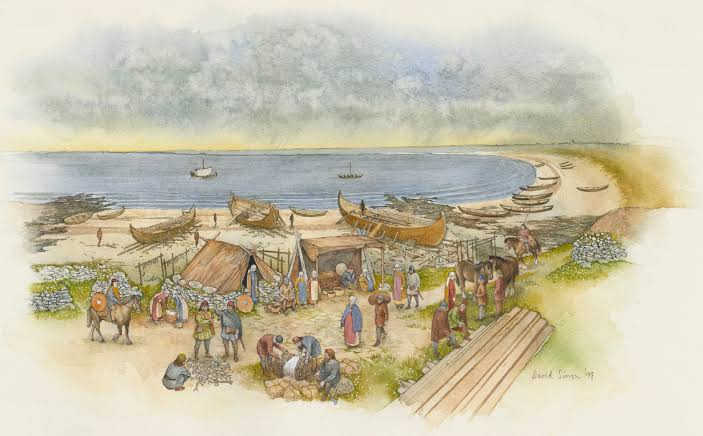
Pierowall, on the island of Westray in Orkney, forms part of the island's important Viking and medieval archaeological landscape.
The cemetery evidence associated with Pierowall helps illuminate the transformation of Orkney under Norse influence and the development of Christian burial practices.
Westray in the Viking Age
During the Viking Age, Norse settlers established communities throughout Orkney.
They introduced or strengthened traditions associated with:
Norse language;
law;
maritime culture;
farming;
and religion.
Viking Cemeteries
Burial sites are particularly useful for studying past societies because human remains can reveal information about:
age;
sex;
health;
diet;
mobility;
and ancestry.
Pagan and Christian Traditions
The Viking Age was a period of religious transformation.
Earlier Norse pagan practices eventually gave way to Christianity.
This transition affected:
burial orientation;
grave goods;
cemetery organization;
and funerary rituals.
Grave Goods
Earlier Viking burials could contain objects such as:
weapons;
jewelry;
tools;
combs;
and personal equipment.
Christian burials generally placed less emphasis on grave goods.
This makes burial archaeology useful for studying religious change.
Maritime Identity
Westray's island environment meant that maritime culture remained important.
People depended on the sea for:
fishing;
transportation;
trade;
and communication.
Farming
Norse communities also practiced agriculture.
They raised:
cattle;
sheep;
pigs;
and other livestock.
They cultivated crops suited to Orkney's climate.
Church and Community
The spread of Christianity created new institutions.
Churches and cemeteries became important centers of community life.
Burial within a Christian cemetery could communicate membership in the Christian community.
Archaeological Science
Modern researchers can analyze human remains using:
isotopic studies;
DNA;
osteological examination;
and radiocarbon dating.
These techniques can reveal movement and relationships that are invisible from grave architecture alone.
Continuity With Earlier Populations
The arrival of Norse settlers did not necessarily mean that the existing population disappeared.
Archaeological and genetic evidence from the North Atlantic suggests that Scandinavian settlers interacted with existing communities.
The precise balance between migration and local continuity varied between places.
Why Pierowall Matters
The cemetery helps demonstrate how Westray changed from a prehistoric farming landscape into a Norse medieval community.
It provides evidence for:
migration;
religious transformation;
burial customs;
maritime society;
and cultural integration.
Conclusion
Pierowall's Viking Age cemetery is an important part of Westray's long archaeological history.
The graves preserve evidence of a society undergoing profound cultural transformation.
Norse settlers brought new languages, political traditions, and religious practices, while island communities continued to depend on the land and sea.
The cemetery therefore represents not simply death, but the transformation of Westray into an important part of the medieval Norse world.