
Introduction
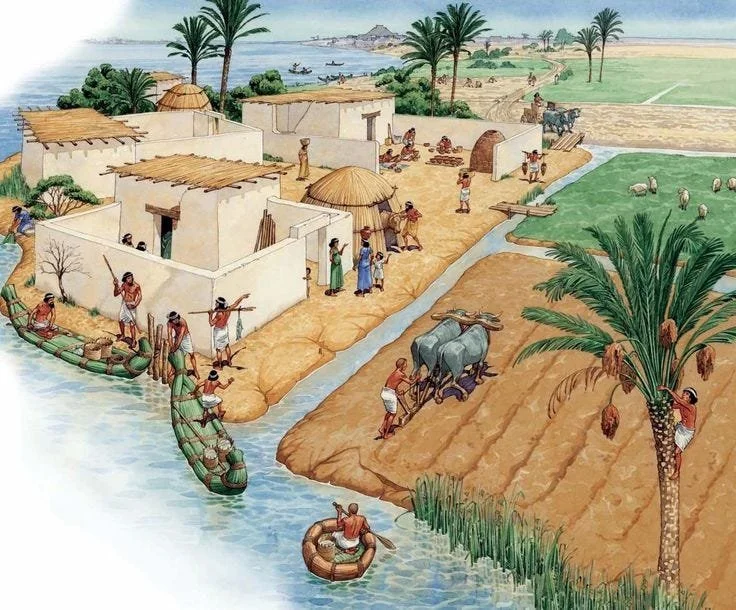
Ancient Mesopotamia is traditionally associated with irrigation canals, wheat and barley cultivation, date palms, and the great cities of the Tigris and Euphrates.
But the archaeological study of ancient agriculture increasingly extends beyond visible fields and abandoned canals.
Submerged landscapes may preserve evidence of agricultural environments that later disappeared beneath rivers, wetlands, reservoirs, or shifting sediments.
The concept of "submerged orchards" is particularly intriguing because perennial crops such as date palms leave different archaeological signatures from annual cereals.
Mesopotamian Agriculture
Agriculture was fundamental to Mesopotamian civilization.
Irrigation allowed communities to cultivate large areas in environments where rainfall alone was insufficient.
Canals transported water from rivers into agricultural zones.
Farmers cultivated cereals, legumes, vegetables, fruits, and dates.
Date palms were particularly important because they provided food, shade, fiber, wood, and other useful products.
Why Orchards Can Disappear
Ancient agricultural landscapes were vulnerable to environmental change.
Rivers shifted their channels.
Floods deposited sediment.
Canals filled with silt.
Marshes expanded and contracted.
Human communities also abandoned fields because of political disruption, salinization, changing water management, or economic transformation.
Over centuries, former agricultural landscapes can become buried or submerged.
Underwater Archaeology
Underwater archaeology can investigate landscapes that are inaccessible from the surface.
Researchers may use:
sonar mapping
sediment cores
underwater excavation
remote sensing
pollen analysis
phytolith analysis
botanical remains
wood identification
These methods can reconstruct former environments even when buildings have disappeared.
Evidence for Ancient Orchards
Tree cultivation may leave traces in several forms.
Charred seeds, date pits, pollen, phytoliths, root channels, irrigation structures, and wooden agricultural equipment can all contribute to interpretation.
Ancient texts also provide valuable information.
Mesopotamian administrative documents record agricultural production, land ownership, labor, and crop management.
Combining written and environmental evidence provides a much stronger reconstruction than relying on either source alone.
Date Palms
The date palm was particularly significant.
It could support intensive agricultural systems because the canopy provided shade beneath which other crops could grow.
This created a layered agricultural environment.
Such systems could maximize productivity in limited irrigated areas.
The archaeological study of date cultivation therefore contributes to understanding not only food production but also landscape engineering.
Climate and Water Management
Mesopotamian farming depended on controlling water.
Too little water caused crop failure.
Too much could create flooding.
Poor drainage could also lead to increasing soil salinity.
Ancient farmers developed sophisticated strategies to manage these problems.
Submerged or buried agricultural landscapes can reveal how these systems changed over time.
Caution About "Submerged Orchards"
The phrase should not be interpreted as evidence that archaeologists have discovered vast intact orchards beneath Mesopotamian waters.
Organic remains rarely survive in perfect form.
Instead, the concept represents a research opportunity: using underwater and environmental archaeology to identify traces of ancient cultivation in landscapes that are no longer visible.
Conclusion
The study of submerged Mesopotamian agricultural landscapes expands our understanding of one of humanity's earliest farming civilizations.
Ancient orchards were complex systems involving irrigation, labor, crop management, trade, and environmental adaptation.
Recovering their traces can reveal how Mesopotamian communities engineered landscapes and responded to changing rivers and climates.





