
Introduction
The Caucasus was one of the most important metallurgical regions of the ancient world.
Its mountains contained rich deposits of copper, arsenic, tin-related minerals, gold, silver, and iron-bearing ores, while its location between Anatolia, the Eurasian steppe, Iran, and the Near East encouraged technological exchange.
Bronze Age metalworkers transformed these resources into tools, weapons, ornaments, vessels, and symbols of social status.
Modern archaeological science is now allowing researchers to reconstruct their techniques with increasing precision.
The Caucasus as a Metallurgical Landscape
The Caucasus contains a remarkable diversity of geological environments.
Mountainous terrain exposed mineral deposits that could be exploited using relatively simple mining technologies.
Ancient communities could collect ore from surface exposures before developing deeper extraction techniques.
Mining and metallurgy therefore developed alongside broader changes in settlement and social organization.
Copper and Bronze
Bronze is primarily an alloy of copper and tin, although ancient metallurgists also used arsenic and other elements.
Arsenical copper alloys were particularly important in some prehistoric contexts.
The addition of particular materials changed the hardness, color, casting properties, and durability of metal.
This means that metallurgical traditions cannot always be understood simply through the modern definition of "bronze."
Blacksmiths and Metalworkers
The term "blacksmith" is convenient but can be misleading for Bronze Age contexts.
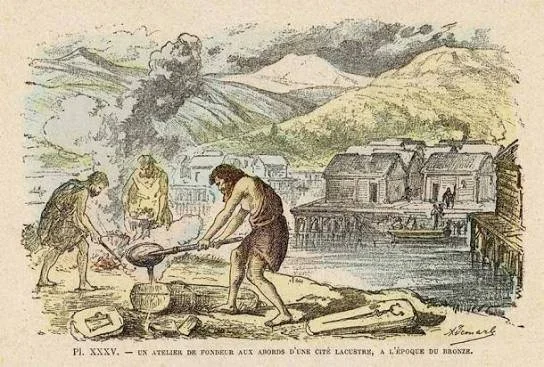
Many Bronze Age metals were cast rather than forged in the manner associated with later ironworking.
Ancient metalworkers could use molds to produce standardized forms.
They also reheated, hammered, polished, sharpened, and repaired objects.
Their expertise required extensive practical knowledge of heat, ore, fuel, molds, and alloy composition.
Archaeological Metallurgy
Modern research can analyze ancient metal objects at microscopic and chemical levels.
Researchers can examine:
alloy composition
trace elements
metallurgical inclusions
casting structures
hammer marks
heat treatment
corrosion patterns
These analyses can reveal how an object was manufactured.
Provenance and Trade
One of the most important questions concerns where metals originated.
Lead-isotope analysis can sometimes help compare metal objects with geological ore sources.
However, provenance is rarely straightforward.
Ore may have been transported far from its original source.
Metal could also be recycled repeatedly.
Therefore, chemical signatures must be interpreted together with archaeological context.
Social Importance of Metal
Metal objects were not merely practical tools.
Weapons could symbolize authority.
Ornaments could communicate identity and status.
Ceremonial objects could participate in religious rituals.
Access to metal production may therefore have contributed to social inequality.
Specialized metallurgical knowledge could also have given certain communities economic advantages.
The Caucasus and Wider Eurasia
Caucasian metallurgical traditions did not develop in isolation.
The region was connected to Anatolia, Mesopotamia, Iran, and the Eurasian steppe.
Metal objects and technological concepts moved between communities.
The Caucasus therefore provides a valuable case study for examining how technology spreads without requiring entire populations to migrate.
New Research Directions
Archaeologists increasingly combine excavation with experimental archaeology.
Researchers can reproduce ancient furnaces, molds, and alloying processes to understand what ancient metalworkers could realistically achieve.
Microscopic analysis can then compare experimental products with archaeological artifacts.
This approach transforms metallurgy from a study of objects into a study of human skill.
Conclusion
The Bronze Age metalworkers of the Caucasus were highly skilled technological specialists operating within complex economic networks.
Modern scientific analysis is revealing the sophistication of their production methods and the extensive exchange networks that connected the region.
Their story demonstrates that technological innovation in ancient Eurasia was often collaborative, mobile, and deeply connected to geography.





