
Introduction
The North Sea contains a complex archaeological landscape shaped by prehistoric settlement, changing sea levels, erosion, sediment deposition, and human activity. Many landscapes that were once dry land are now submerged, making underwater archaeology essential for investigating prehistoric communities and their environments.
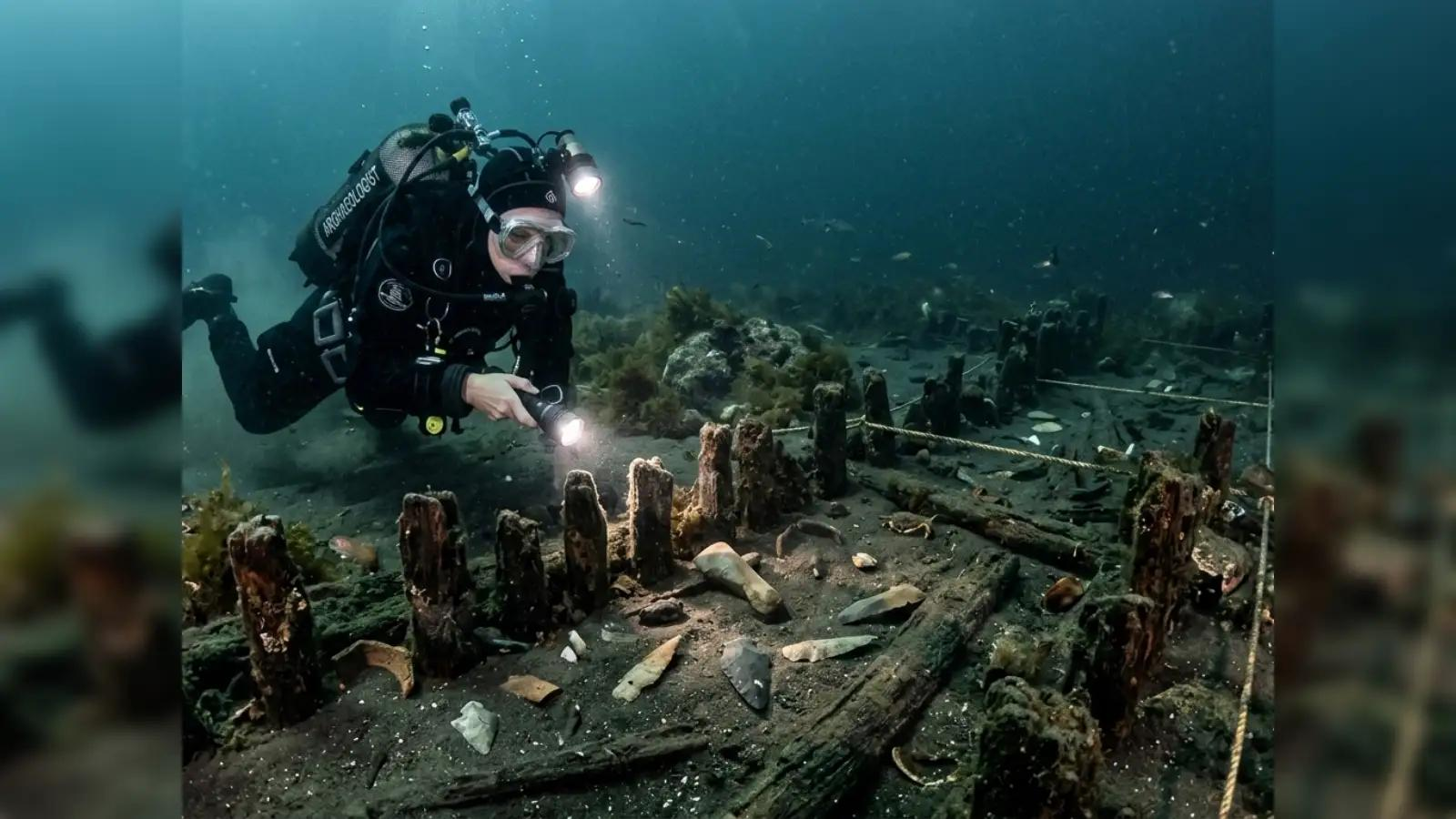
Submerged timber structures, including rows of stakes, wooden barriers, and possible palisades, can provide valuable information about ancient settlement organization, coastal defense, resource management, and landscape use.
The specific palisade lines described in this title are not verified as a particular archaeological discovery. However, submerged timber archaeology and dendrochronological dating offer established methods for investigating wooden structures in marine and coastal environments.
Submerged Prehistoric Landscapes of the North Sea
During the late Pleistocene and early Holocene, the North Sea region contained extensive landscapes that differed substantially from the modern marine environment.
Sea-level rise gradually inundated low-lying areas, transforming former plains, river systems, wetlands, and settlement landscapes.
These submerged environments may preserve archaeological evidence of human activity, including stone tools, organic remains, structures, and environmental deposits.
The preservation of wooden materials depends on the conditions in which they are buried. Waterlogged sediments may limit oxygen exposure and slow the decomposition of timber, although preservation varies significantly across the seabed.
Palisades and Timber Structures
A palisade generally consists of vertically positioned wooden posts forming a barrier or enclosure.
Palisades could have served different functions depending on their location and construction. Possible purposes include:
Defensive barriers.
Settlement boundaries.
Animal enclosures.
Control of access.
Water-management structures.
Fish traps or resource-management installations.
Temporary barriers.
The interpretation of submerged rows of timber requires careful investigation because similar arrangements may have been used for different purposes.
Researchers must consider the spacing of posts, their dimensions, the relationship between individual timbers, construction methods, associated artifacts, and the surrounding landscape.
A line of wooden stakes cannot automatically be identified as a defensive palisade.
Underwater Survey and Timber Documentation
Submerged timber structures may be documented through underwater photography, photogrammetry, sonar mapping, measured drawings, and archaeological recording.
Researchers may examine:
Timber dimensions.
Post spacing.
Orientation.
Depth of burial.
Construction patterns.
Wood species.
Evidence of shaping.
Joinery or fastening.
Associated sediment deposits.
Wood identification can help determine whether builders selected particular species for structural properties or local availability.
The relationship between timber structures and environmental features may also provide clues to function.
For example, a barrier positioned across a water channel may have served a different purpose from one surrounding a settlement or placed along a former shoreline.
Dendrochronology and Timber Dating
Dendrochronology is the study of annual tree-ring patterns.
Trees in temperate environments generally produce growth rings that reflect annual growth conditions. Ring widths may vary according to temperature, rainfall, soil conditions, and other environmental factors.
By comparing the ring sequence from archaeological timber with reference chronologies, researchers may establish the calendar date when the tree grew.
If enough outer rings are preserved, dendrochronology may help determine when the timber was felled.
This can provide a highly precise chronological framework for archaeological structures.
What Tree Rings Can Reveal
Timber analysis can contribute information beyond dating.
Researchers may investigate:
Tree species.
Timber selection.
Growth conditions.
Forest environments.
Construction phases.
Possible repair or rebuilding.
Timber procurement.
If several timbers from a structure have matching or overlapping ring patterns, researchers may investigate whether they were harvested from the same forest region or during the same period.
A group of timbers showing similar felling dates may suggest a single construction episode, although additional evidence is necessary.
Dating Challenges in Marine Environments
Dendrochronology is not always successful.
A timber may preserve too few rings to establish a reliable chronology. The outermost rings may be missing, preventing researchers from determining the exact felling date.
Wood may also have been reused. A timber incorporated into a structure may have been cut years or decades before its final use.
Marine environments can complicate preservation through erosion, boring organisms, sediment movement, and changes in water chemistry.
Researchers may combine dendrochronology with radiocarbon dating, archaeological typology, sediment analysis, and environmental reconstruction.
Palisades and Prehistoric Social Organization
If a submerged palisade were confirmed, its interpretation could contribute to understanding how prehistoric communities organized space and resources.
A barrier may indicate a need to control movement, protect settlement areas, manage animals, or modify water flow.
The construction of timber structures requires access to wood, tools, labor, planning, and knowledge of the environment.
However, these requirements do not necessarily imply centralized political authority. Communities may have constructed barriers through cooperative labor or repeated household activity.
Conservation of Submerged Timber
Submerged archaeological wood is vulnerable when removed from stable underwater conditions.
Once exposed to air, waterlogged timber may shrink, crack, deform, and deteriorate rapidly.
Conservation may involve controlled storage, stabilization, desalination, specialist treatment, and careful drying or preservation procedures.
In many cases, recording and leaving the structure in place may be preferable to excavation if conservation resources are insufficient.
Conclusion
Submerged palisade lines in the North Sea would offer an important opportunity to investigate prehistoric construction, landscape organization, and environmental adaptation.
Dendrochronology could provide precise dating and contribute to the reconstruction of construction phases, timber procurement, and environmental conditions.
The interpretation of such structures must combine timber analysis, underwater survey, environmental archaeology, and careful consideration of alternative functions.





