
Introduction
Textiles are among the most fragile materials in archaeology.
Cloth usually decomposes rapidly unless preserved in exceptionally dry, frozen, waterlogged, or otherwise unusual environments.
Yet prehistoric people produced textiles across much of the world.
How, then, can archaeologists study fabrics that no longer survive?
One answer comes from impressions.
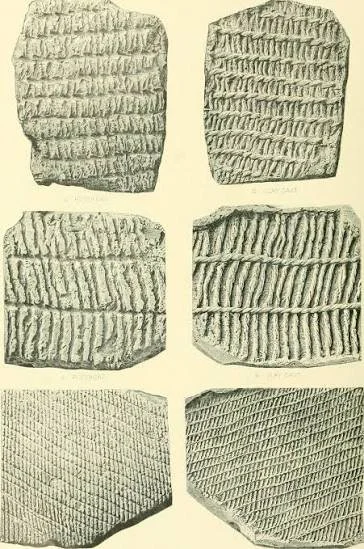
When woven fibers press against wet clay, they can leave detailed patterns behind. Once the clay hardens through firing or drying, the impression may survive long after the original textile has disappeared.
These impressions provide an indirect but remarkably detailed record of ancient textile technology.
How Textile Impressions Form
A textile impression may occur accidentally or deliberately.
Clay used to make pottery can be placed on woven material during manufacture.
A basket or cloth surface may leave impressions in wet clay.
Textiles may also be associated with clay structures or objects.
If the clay is subsequently fired, the impression can become permanently preserved.
What Impressions Reveal
A textile impression may reveal:
thread thickness
weave structure
fiber spacing
spinning direction
textile density
decorative patterns
manufacturing technique
This allows archaeologists to reconstruct aspects of textile production even when the fibers themselves have vanished.
Weaving Technology
Different weaving structures require different technical knowledge.
Simple plain weave can be produced with relatively straightforward equipment.
More complex patterns require additional control over warp and weft threads.
The appearance of an impression can therefore provide clues about the sophistication of textile production.
Spinning Fibers
Before yarn could be woven, fibers had to be prepared and spun.
Spindle whorls are common archaeological evidence for spinning.
The combination of spindle whorls and textile impressions can reveal relationships between spinning and weaving.
Researchers can also infer the direction of twist.
Identifying Fibers
A major challenge is determining what the original textile was made from.
Potential materials include:
flax
wool
cotton
bast fibers
grasses
reeds
other plant fibers
An impression alone may not always permit secure identification.
Microscopic residues or associated organic fibers can sometimes provide additional evidence.
Textiles and Social Organization
Textile production was economically important.
Clothing protected people from environmental conditions.
Textiles could also serve as containers, bedding, sails, nets, ropes, and ceremonial objects.
Specialized production could become an important household or community activity.
In some societies, high-quality textiles became markers of status.
Worldwide Evidence
Textile impressions occur in archaeological contexts across Eurasia, Africa, the Americas, and other regions.
They demonstrate that textile technology developed through multiple traditions rather than following one universal path.
Different environments encouraged different raw materials.
Coastal societies might exploit marine plant resources.
Pastoral societies often relied on wool.
Agricultural communities could cultivate flax, cotton, or other fibers.
Digital Reconstruction
Modern imaging techniques can greatly improve the study of textile impressions.
Three-dimensional scanning and digital microscopy can reveal structures too small for ordinary photography.
Researchers can create digital models of impressions and compare them across sites.
This makes it possible to study prehistoric textiles without repeatedly handling fragile artifacts.
Conclusion
Textile impressions provide a remarkable solution to one of archaeology's preservation problems.
Although the original fabrics have often disappeared, their impressions survive in clay.
By studying these traces, archaeologists can reconstruct spinning, weaving, clothing, trade, and social organization, demonstrating that textile technology was an important part of prehistoric innovation worldwide.





