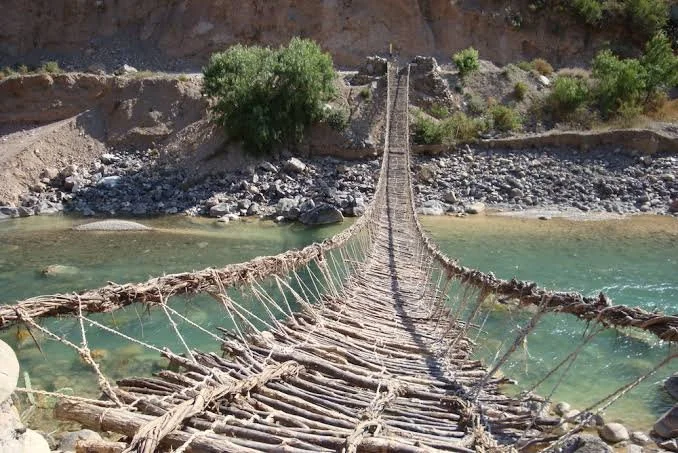
Minor river bridges are important features of past landscapes because they connected settlements, fields, markets, religious sites, and neighboring communities across streams and small rivers. Unlike major bridges associated with prominent cities or imperial roads, these smaller crossings may have been constructed from timber, stone slabs, packed earth, or combinations of locally available materials. Many were repeatedly repaired or replaced as floods, erosion, and ordinary use damaged their structures. Their archaeological remains can be subtle, but they offer valuable evidence about local movement, engineering knowledge, cooperation, and the everyday organization of communities.
The first challenge in identifying an ancient minor river bridge is distinguishing a constructed crossing from natural features. Stone concentrations near a riverbank may represent a bridge foundation, but they could also result from erosion, river deposits, retaining walls, or later agricultural activity. Archaeologists therefore examine the arrangement of stones, the relationship between opposing banks, changes in the river channel, and the presence of constructed approaches. Regularly spaced supports, aligned stonework, or evidence of timber sockets may strengthen the interpretation that a crossing once existed. Surveying the surrounding landscape can reveal whether the feature connects with an ancient road, settlement, field system, or other route.
The materials used to build minor bridges depended on local resources and environmental conditions. Timber bridges could be relatively quick to construct, particularly where suitable trees were available, but their remains are often poorly preserved in ordinary soil conditions. Waterlogged environments may preserve wooden posts, planks, and other structural components that would otherwise decay. Stone bridges or stone-supported crossings may survive more visibly, especially when foundations were designed to withstand flowing water. In some settings, builders may have used a combination of stone abutments and wooden superstructures, leaving only the foundations for archaeologists to investigate.
The construction of a bridge required knowledge of water movement, soil stability, and the behavior of building materials. Even a small crossing needed to withstand the pressure of flowing water, the weight of people and animals, and seasonal changes in river level. Builders may have raised approaches above flood-prone ground, strengthened banks with stones or timber, or placed supports where the current was less destructive. Evidence of repeated repairs can show how communities responded to changing environmental conditions. However, identifying the precise construction method often requires excavation and careful analysis because later repairs can obscure the original design.
Minor bridges also reveal how communities organized their daily activities. A crossing might shorten the journey between a village and its agricultural land, provide access to a water source, or connect households with a market or workshop. Its importance could be especially significant during harvest periods, when crops and equipment needed to move between fields and settlements. Livestock movement, the transport of building materials, and visits to neighboring communities may also have depended on reliable crossings. By mapping bridges alongside roads, field boundaries, and settlement locations, archaeologists can explore how infrastructure influenced the practical geography of everyday life.
The community role of a bridge extended beyond transportation. A shared crossing could become a place where residents encountered one another, exchanged information, or coordinated activities. In some communities, construction and maintenance may have required collective labor, contributions from landholders, or support from local authorities. Archaeological evidence alone rarely identifies the exact social arrangements behind a bridge, but the scale of the structure, its location, and patterns of repair can help researchers develop plausible interpretations. Historical documents, inscriptions, local traditions, and settlement records, where available, may provide further information about responsibility for maintenance and access.
The position of a bridge can also reveal differences in access and control. Some crossings served routes used by many residents, while others may have provided access primarily to a particular estate, religious institution, or agricultural area. A crossing located along a major route could have supported trade and communication, whereas a small bridge in a remote valley might have been essential mainly to nearby households. Archaeologists should avoid assuming that every bridge was designed for public use. Its function needs to be evaluated through the surrounding landscape and evidence of who may have benefited from the route.
Environmental change complicates the archaeological study of minor river bridges. Rivers migrate, channels become silted, banks collapse, and floods may bury or displace structural remains. A bridge that now appears isolated from any settlement may once have stood beside a major route before the river changed course. Sediment analysis, geomorphological mapping, aerial photography, and geophysical survey can help reconstruct earlier river conditions. Dating bridge materials, when suitable samples survive, may establish when a crossing was built or repaired, although the age of reused timber or stone does not always correspond to the construction date.
The study of minor river bridges demonstrates that significant infrastructure does not need to be monumental to shape a community. Small crossings could support agriculture, exchange, communication, and cooperation while linking people to the resources and institutions on which they depended. By combining structural analysis with landscape reconstruction and evidence from nearby settlements, archaeologists can investigate how these bridges functioned within broader networks of movement. Their remains provide a valuable perspective on the practical engineering and shared responsibilities that helped communities remain connected across rivers and streams.