Miniature figurines are small representations of humans, animals, supernatural beings, or everyday objects that appear in archaeological contexts around the world. Their size, material, and repeated discovery in domestic spaces make them particularly interesting to archaeologists studying household life. Some figurines may have been used in religious practices or personal acts of devotion, while others may have served as toys, teaching objects, decorative items, or components of games. Their distribution within settlements can help researchers investigate how objects participated in domestic rituals, childhood activities, and the organization of household space.
The interpretation of miniature figurines begins with their physical characteristics. Researchers examine their dimensions, manufacturing techniques, materials, surface decoration, and degree of wear. A carefully shaped figure made from clay may have been produced for a different purpose from a roughly modeled object made by a child or household member. Repeated forms can suggest shared conventions or established production practices, although similarity alone does not prove that figurines were mass-produced or used in the same way. Evidence of breakage, repair, polishing, or repeated handling can provide additional clues about how an object was treated during its lifetime.
The archaeological context is equally important. Figurines found near hearths, storage areas, entrances, or designated household installations may have occupied different roles within domestic life. An object placed repeatedly in a particular location could have been part of a household practice, especially if other features suggest deliberate arrangement. Figurines found in groups may indicate storage, disposal, ritual deposition, or the use of several figures together in an activity. However, their position at the time of excavation may not reflect their original placement. Objects can be moved by later construction, cleaning, animal activity, flooding, or the gradual accumulation of household refuse.
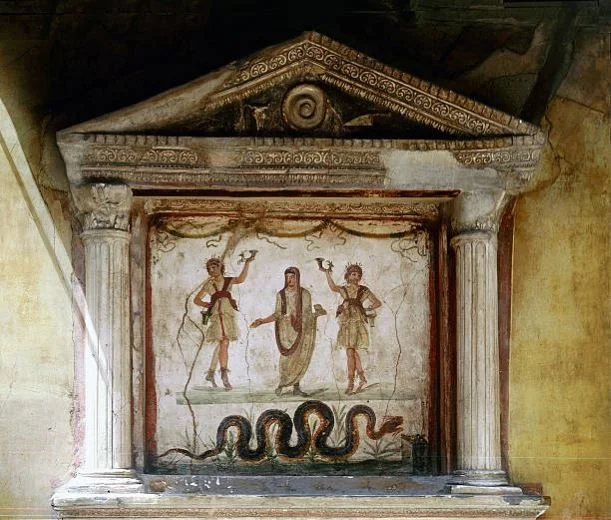
The concept of a domestic shrine offers one possible explanation for certain figurine distributions. In some archaeological settings, small objects appear alongside miniature altars, offering vessels, lamps, incense-related materials, or other features that may indicate household devotion. A figurine repeatedly positioned within such an arrangement could have represented a deity, ancestor, protective figure, or other culturally significant presence. Yet a figurine alone does not establish that a shrine existed. Archaeologists need to evaluate the entire assemblage, including the architectural setting, patterns of deposition, and evidence for repeated activities.
Playspaces offer another possible interpretation. Miniature animals, people, vessels, furniture, and other objects could have supported imaginative play, social learning, or the imitation of adult activities. A small representation of a cooking pot, for example, might have been used in play, but similar objects could also have served symbolic or ritual functions. Evidence of repeated handling, simplified construction, and association with other miniature objects may strengthen an interpretation involving play. Nevertheless, these characteristics are not exclusive to toys, and the distinction between play, learning, and ritual may not have been clear-cut in every society.
Distribution analysis can help reveal patterns that individual objects cannot. By mapping figurine discoveries within houses, courtyards, neighborhoods, and broader settlement areas, researchers can examine whether certain types cluster in particular spaces. A concentration near domestic installations may suggest repeated household use, while a more dispersed distribution could reflect ordinary loss, disposal, or circulation between rooms. Spatial patterns must be interpreted cautiously because excavation coverage, preservation conditions, and collection methods can influence the apparent distribution. A site where only selected rooms were excavated cannot provide a complete picture of how figurines were used throughout the settlement.
Differences in figurine materials may also reveal information about household resources and production. Clay figures might have been made locally from readily available materials, while stone, imported ceramics, or other less accessible substances could indicate broader exchange networks. Petrographic and chemical analyses can sometimes help identify the origin of raw materials or finished objects. Manufacturing marks may reveal whether figurines were produced by specialists or made within households. However, inexpensive materials do not necessarily imply low cultural value, just as costly materials do not automatically indicate religious importance or elite ownership.
Age and social identity are difficult to reconstruct from miniature objects. It can be tempting to assign all small figurines to children or to interpret all human figures as representations of particular social groups. Such conclusions require stronger evidence than size or appearance alone. Archaeologists may investigate the relationship between figurines and age-related burial evidence, domestic activity areas, or other objects associated with learning and play. Even then, the identities of users and the meanings attached to the figures may remain uncertain. The same object could have passed between generations or changed its purpose during its use-life.
The distribution of miniature figurines provides a useful way to investigate the intersection of domestic space, symbolic behavior, and everyday activity. Some objects may have participated in household devotion, while others supported play, teaching, decoration, or several activities at different times. Their interpretation depends on the relationship between material characteristics, spatial context, associated finds, and broader cultural evidence. Rather than forcing every figurine into a single category, archaeologists can use careful comparative analysis to reconstruct the diverse ways small objects contributed to the social and imaginative lives of past households.