
Introduction
Amphorae were among the most widely used transport containers in the ancient Mediterranean. Their shapes, capacities, materials, and manufacturing traditions varied according to regional production systems and the commodities they carried.
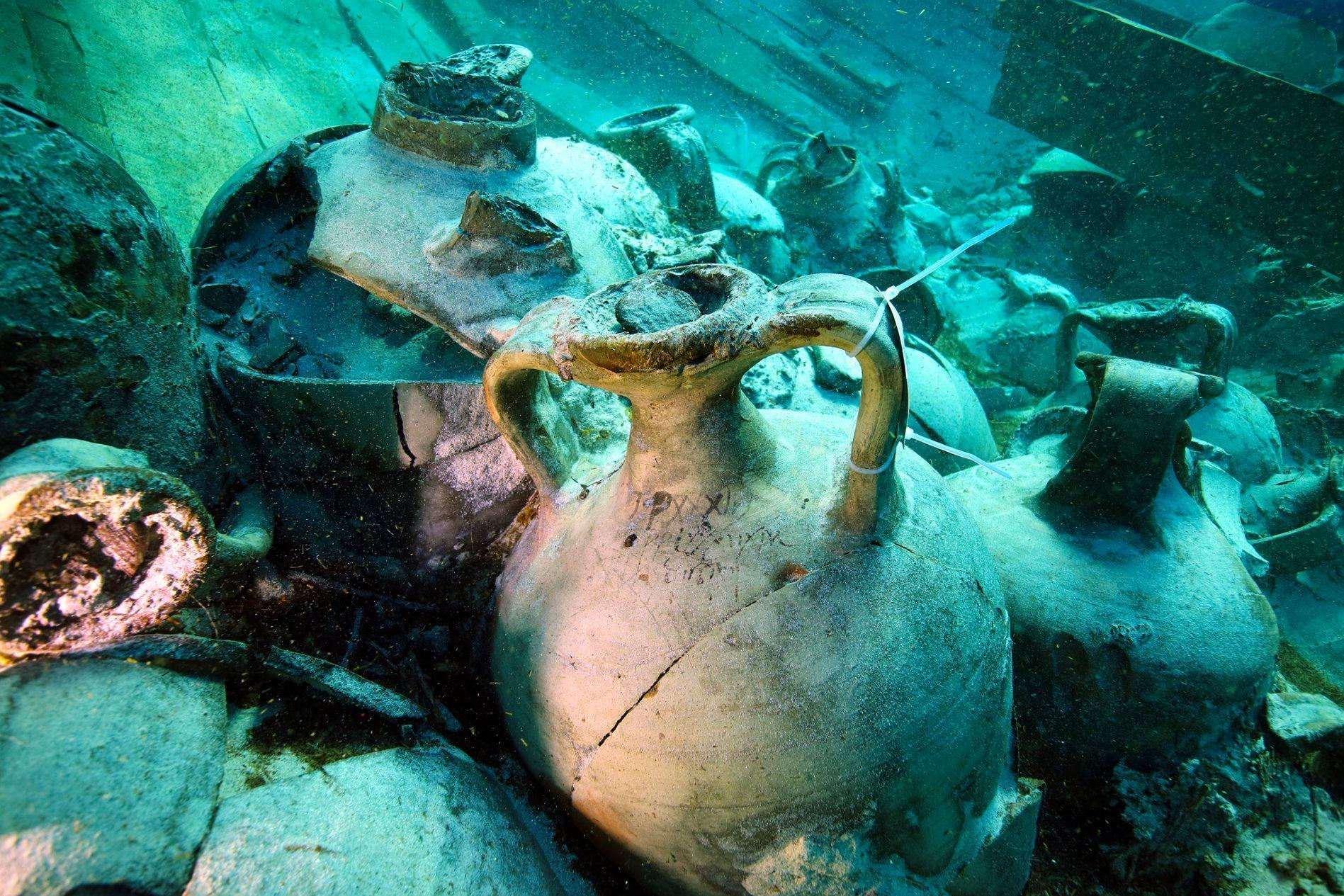
Shipwrecks provide valuable archaeological contexts for studying amphorae because containers may survive in groups associated with a single maritime event. Storms, navigation failures, structural damage, and other accidents could cause vessels to sink, leaving cargoes preserved underwater.
The study of salt-caked amphorae from storm-driven wrecks offers an opportunity to investigate marine preservation, cargo composition, container use, maritime trade, and the archaeological effects of underwater environments.
The specific salt-caked amphora assemblages described in this title are not verified as particular wreck discoveries.
Amphorae and Maritime Trade
Ancient amphorae were generally ceramic vessels designed for the storage and transportation of commodities.
Their forms could be adapted to different products and transportation requirements. Many amphorae had narrow necks, handles, pointed or rounded bases, and bodies designed for stacking or securing within ships.
Cargoes could include:
Wine.
Olive oil.
Fish products.
Other liquid commodities.
Agricultural products.
Some dry goods.
The identification of amphora types may help archaeologists investigate production regions, trade connections, chronology, and cargo composition.
However, amphora shape alone does not always establish the commodity transported. Residue analysis and other evidence may be necessary.
Storm-Driven Shipwrecks
Storms can create dangerous conditions for ancient vessels.
Strong winds, waves, currents, reduced visibility, and changing water conditions may damage ships or force them away from their intended routes.
A storm-driven wreck may contain cargo dispersed by impact, sinking, currents, and subsequent sediment movement.
The archaeological distribution of amphorae may help researchers investigate the wrecking process.
Containers may remain concentrated within the ship's original cargo area or become scattered across the seabed.
The spatial relationship between amphorae, ship timbers, anchors, and other artifacts may provide evidence about how the vessel sank and how the cargo was arranged.
Salt Crusts and Marine Preservation
Salt-caked amphorae may develop deposits through interaction with seawater, sediment, evaporation, mineral precipitation, or later exposure to different environmental conditions.
The composition and formation of salt deposits depend on the chemistry of the surrounding water, the sediment, the vessel's material, and the history of the archaeological object.
Salt crusts may obscure decorative features, inscriptions, surface treatments, or ceramic fabric.
They may also contribute to conservation problems when objects are recovered and exposed to changing conditions.
Salt can crystallize within pores and create stresses that damage ceramic surfaces. The effects depend on the type of salts, moisture conditions, and the structure of the ceramic material.
Cargo Analysis and Commodity Identification
Amphorae from wrecks can be examined through several archaeological and scientific approaches.
Researchers may record:
Vessel dimensions.
Shape and rim characteristics.
Handles and base forms.
Ceramic fabric.
Surface treatments.
Stamps and inscriptions.
Residues.
Salt deposits.
Breakage patterns.
Ceramic fabric analysis may help identify clay composition and production traditions.
Residue analysis may investigate substances preserved within the vessels. Chemical and molecular methods may detect evidence associated with ancient commodities, although preservation and contamination must be considered.
Amphorae may also be compared with reference collections from known production centers.
The combination of typology, inscriptions, chemical analysis, and archaeological context may help reconstruct the cargo and its trade origins.
Salt Deposits and Conservation
Salt deposits are not simply surface contaminants.
They may provide information about the marine environment and the history of an object, but they may also threaten the preservation of ceramics.
When a salt-contaminated amphora is removed from underwater conditions, changes in temperature and humidity may alter the behavior of salts within its pores.
Conservation specialists may conduct controlled desalination, cleaning, stabilization, and monitoring.
The treatment must be adapted to the condition of the object. Aggressive removal of crusts could damage original surfaces or destroy important archaeological evidence.
Before cleaning, documentation should record the distribution and characteristics of deposits.
Maritime Trade and Economic Reconstruction
Amphorae from shipwrecks may reveal commercial connections across the Mediterranean.
A cargo containing containers from several production regions could indicate trade networks, redistribution, or the transport of multiple commodities.
The analysis of amphora assemblages may help researchers investigate:
Maritime routes.
Cargo organization.
Commercial activity.
Regional production.
Ship capacity.
Transportation practices.
Economic relationships.
A wreck represents a particular moment of maritime activity rather than a complete picture of a trade system.
Its cargo may have been assembled through several stages of exchange, and the ship's destination may not always be identifiable.
Conclusion
Salt-caked amphorae from storm-driven wrecks provide an important research opportunity for studying ancient maritime trade and underwater preservation.
The combined analysis of ceramic forms, residues, inscriptions, spatial distribution, and marine deposits can help reconstruct cargoes and commercial connections.
The conservation of these vessels is equally important because salt-related deterioration may continue after recovery. Careful documentation and treatment are necessary to preserve both the physical objects and the archaeological information they contain.





