
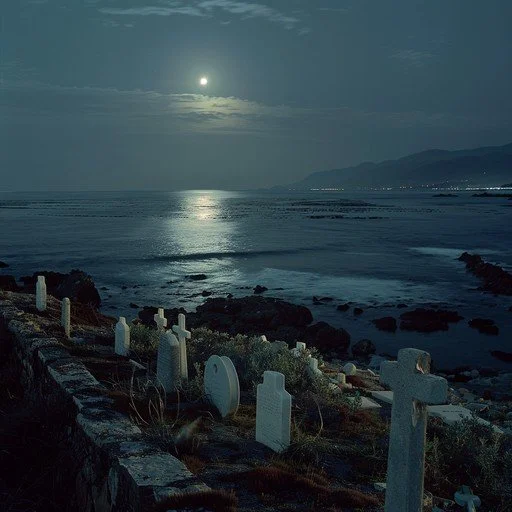
Coastal archaeology, changing sea levels, and the question of whether ancient burial practices followed lunar rhythms.
Burial Places at the Edge of the Sea
Coastal landscapes are dynamic environments. Tides rise and fall, storms reshape beaches, sediment accumulates in sheltered bays, and erosion can expose or destroy archaeological remains. Over longer periods, sea-level changes may transform a burial site that was once inland into a location close to the shore or even beneath the water.
These changes make coastal burial archaeology especially challenging. A tomb found near today's shoreline may originally have stood farther inland, while a burial chamber now reached by the sea may once have occupied a dry landscape.
The title's phrase tidal tombs suggests burial places whose use was connected with the movement of the tides. It also raises the possibility that funerary activities were synchronized with lunar cycles, which influence the timing and magnitude of tides.
Such a connection is an intriguing research hypothesis, but tidal proximity does not establish that a community deliberately scheduled burials according to lunar phases. That interpretation requires independent evidence.
The Moon, Tides, and Coastal Landscapes
The Moon's gravitational influence contributes to the formation of tides, alongside the gravitational effects of the Sun and the physical characteristics of ocean basins and coastlines. The relative positions of the Earth, Moon, and Sun affect tidal patterns.
During new and full moons, the Sun, Earth, and Moon are approximately aligned, producing spring tides with a larger difference between high and low water. During the first and third quarter phases, neap tides generally have a smaller tidal range.
However, the actual timing and height of tides vary by location. Coastline shape, water depth, weather, and local ocean conditions can produce substantial differences between regions.
Ancient communities living beside the sea may have understood practical tidal patterns through experience, especially when fishing, gathering shellfish, navigating shallow waters, or using coastal landing places. Whether they connected these patterns to burial schedules is a separate question.
Why Coastal Burial Sites Can Be Difficult to Interpret
A burial site near the water may have served several purposes. It could have occupied a naturally prominent location, marked a boundary, remained close to a settlement, or held religious significance unrelated to tides.
The sea may also have reached the site only after centuries of environmental change. Changes in sea level, sediment movement, erosion, and land subsidence can alter the relationship between a tomb and the shoreline.
Researchers therefore reconstruct the ancient landscape before interpreting the site's placement. Geological evidence, sediment cores, environmental indicators, and sea-level models can help establish whether the tomb was originally exposed to tidal influence.
Without this reconstruction, a modern tidal relationship may be mistakenly projected into the past.
Burial Practices and Lunar Calendars
The Moon has held symbolic importance in many societies, and lunar calendars have been used to organize festivals, agricultural activities, religious observances, and other events. Yet lunar symbolism varies across cultures, and it should not be assumed that every coastal community used lunar phases to schedule funerary activity.
To establish deliberate synchronization between burial and lunar cycles, researchers would need evidence that goes beyond the location of the tomb. Potential evidence might include a repeated pattern of burial dates that can be securely reconstructed, written records describing the practice, or a strong combination of archaeological and historical indicators.
Such evidence is difficult to obtain because archaeological dating methods rarely determine the exact day or lunar phase of a burial. Radiocarbon dating, for example, generally produces an age range rather than a precise calendar date.
A claim about lunar scheduling therefore requires exceptional care.
What Archaeologists Can Measure
Researchers can investigate the relationship between a tomb and the coast through topographic mapping, geological analysis, sediment studies, and the dating of archaeological deposits. These methods can help reconstruct whether a site was exposed to tides when it was in use.
Excavation may reveal whether water entered the burial chamber, whether sediment accumulated during repeated inundation, and whether the structure was modified to respond to changing environmental conditions.
However, water inside a tomb does not automatically indicate ritual use. It may result from later flooding, groundwater movement, storm damage, or changes in sea level.
Researchers must also distinguish between a tomb deliberately built near the shore and one whose coastal setting developed later.
Testing the Lunar-Synchronization Hypothesis
A rigorous investigation would begin by defining exactly what is meant by synchronization. Does the hypothesis suggest that burials took place during particular lunar phases, that tomb entrances were aligned with lunar events, or that the tide affected access to a burial chamber?
Each possibility requires different evidence.
For a proposed alignment, researchers could measure the orientation of the structure and model whether a lunar event would have been visible from the site during the relevant period. Such an alignment would need to be distinguished from ordinary architectural constraints or coincidental orientation.
For a proposed burial schedule, researchers would need reliable dates for individual burials and a method of comparing those dates with reconstructed lunar phases. In most archaeological settings, the available dating precision may be insufficient to support such a conclusion.
The hypothesis should also be tested against alternative explanations, including seasonal activity, practical access, inherited architectural traditions, and changes in the shoreline.
The Importance of Negative Evidence
Archaeological theories become stronger when researchers consider what evidence would contradict them. If a tomb's orientation does not match the proposed lunar event, or if its original construction predates the shoreline conditions required by the theory, the interpretation may need to be revised.
Likewise, if burial dates show no consistent relationship with lunar phases, that absence of a pattern should be acknowledged rather than ignored.
Not every repeated coincidence indicates deliberate planning. Researchers must consider the number of possible alignments, the flexibility of the hypothesis, and whether the pattern is more likely than chance.
Coastal Tombs as Records of Environmental Change
Even when lunar synchronization cannot be established, coastal tombs can provide valuable information about the relationship between people and changing landscapes. Their construction, orientation, burial contents, and later inundation may reveal how communities used coastal space and how environmental changes affected sacred places.
The specific claim of tombs deliberately synchronized with lunar cycles remains unverified. A credible case would require secure chronology, reconstructed tidal conditions, and evidence that distinguishes deliberate ritual timing from coincidence or later environmental change.
The broader subject remains important because it brings together archaeology, astronomy, geology, and the study of funerary practice. By separating measurable environmental processes from interpretations of ancient belief, researchers can investigate coastal burial traditions without overstating what the evidence reveals.




