
How ancient DNA can illuminate migration, maternal ancestry, and the complex settlement histories of the Pacific Islands.
Introduction: Reconstructing Voyages Through Genetic Evidence
Oceania contains one of the world's most remarkable records of human maritime movement. Over thousands of years, people crossed open water, settled islands, developed distinctive communities, and maintained connections across considerable distances.
The settlement of the Pacific was not a single migration event. It involved multiple populations, different periods of movement, and interactions among communities with diverse histories. Archaeology, linguistics, environmental research, and genetics all contribute to reconstructing these processes.
Mitochondrial DNA offers a particularly useful perspective because it is generally inherited through the maternal line. Certain variations can be grouped into maternal lineages, allowing researchers to investigate relationships among populations and trace aspects of ancient ancestry.
However, mitochondrial DNA represents only one part of a person's genetic history. It cannot independently reconstruct every migration, establish a complete family tree, or explain the cultural identity of an ancient community. Its value is greatest when combined with genome-wide ancient DNA, archaeological chronology, and other evidence of human movement.
What Mitochondrial DNA Reveals
Mitochondria are structures within cells that help produce energy. They contain their own small genome, distinct from the much larger genome housed in the cell nucleus. In most cases, mitochondrial DNA is inherited from the mother, making it useful for studying maternal ancestry across generations.
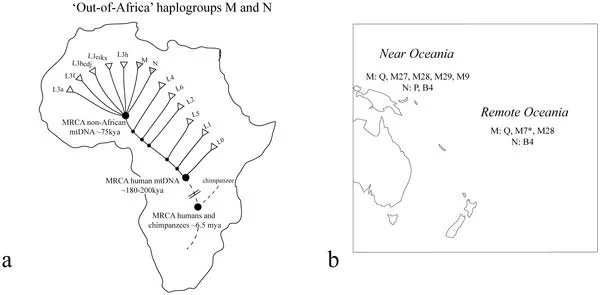
Researchers identify genetic variations that accumulate over time. Groups of related mitochondrial sequences are classified into haplogroups and more specific branches, or sublineages. Their distribution across ancient and modern populations can help investigate shared ancestry and historical movement.
A maternal lineage may be common in several island communities because of a shared ancestral population, later migration, or repeated contact between islands. Its presence does not necessarily mean that the communities descend from one recent migration, and its absence does not prove that no historical contact occurred.
Mitochondrial DNA also follows only one narrow line of ancestry. A person has many genealogical ancestors across successive generations, but their mitochondrial DNA traces just one maternal chain. Other ancestors contribute genetic material through different branches of the family tree that this single marker does not capture.
The Settlement of Oceania
The broad settlement history of Oceania includes different movements through Island Southeast Asia, Near Oceania, and Remote Oceania. These regions encompass distinct environments and archaeological histories, and they should not be treated as one uniform migration zone.
Archaeological evidence documents the expansion of communities associated with the Lapita cultural complex into parts of the western Pacific several thousand years ago. Lapita sites are recognized through distinctive material traditions, including pottery, but the spread of an archaeological culture does not automatically mean that every artifact-bearing community had the same genetic ancestry.
The settlement of Remote Oceania required long-distance voyaging across open ocean to islands that were not always visible from one another. These voyages involved navigational knowledge, maritime technology, and the ability to establish communities in new environments.
Genetic evidence can help investigate the ancestry of people involved in these movements. Yet migration routes must be reconstructed using several kinds of data, because genetic similarity alone does not establish the exact direction, timing, or circumstances of a voyage.
Ancient DNA and the Reconstruction of Maternal Lineages
Ancient DNA can be recovered from suitable human remains, particularly when preservation conditions have limited the degradation of genetic material. Laboratories use specialized methods to extract and sequence DNA while monitoring contamination from modern sources.
Researchers then compare ancient sequences with those from other archaeological individuals and modern populations. These comparisons can reveal whether a lineage was present in a region during a particular period and whether it shares ancestry with lineages found elsewhere.
The quality of evidence depends on sample size and preservation. A single ancient individual can provide an important observation, but cannot represent the full genetic diversity of an entire island population. Larger, chronologically distributed samples are needed to investigate changes in ancestry through time.
Ancient DNA analysis also requires careful ethical practice. Human remains are not simply scientific specimens; they may be connected to descendant communities, cultural traditions, and questions of ancestral stewardship. Research should follow relevant legal requirements, consultation procedures, and community expectations.
Maternal Ancestry, Migration, and Population Interaction
Mitochondrial lineages can provide clues about population movement, especially when changes in their distribution are observed across securely dated samples. For example, a lineage appearing in a region at a later date may indicate migration, but researchers must also consider sampling gaps and the possibility that the lineage was present earlier but has not yet been detected.
Population interaction can produce complex genetic patterns. Communities may exchange marriage partners, move between islands, or become incorporated into larger political and social networks. Over generations, these processes can alter the distribution of maternal lineages.
A change in mitochondrial DNA frequencies does not necessarily imply the replacement of an entire population. It could reflect the movement of a relatively small number of people, differences in reproductive success, demographic changes, or the loss of certain lineages through chance.
The distinction between genetic ancestry and cultural identity is especially important. People may adopt new languages, technologies, social practices, and identities without undergoing complete genetic replacement. Conversely, populations with related ancestry may develop very different cultural traditions.
The Limits of Mitochondrial Evidence
One of the most common interpretive mistakes is to treat a mitochondrial lineage as a precise marker of an ethnic group. Genetic lineages often cross cultural and linguistic boundaries, and their distributions can change substantially over time.
Another difficulty is that maternal inheritance does not capture all forms of migration equally. If movement involved more men than women, or if communities had different patterns of marriage and residence, mitochondrial evidence might record the process differently from genome-wide DNA or paternal-line markers.
Genetic drift can also influence lineage frequencies. In small island populations, random changes across generations may cause certain maternal lineages to become common or disappear. This can produce striking genetic patterns even without repeated large-scale migration.
Finally, the absence of ancient DNA from a particular period or island may reflect poor preservation or limited sampling rather than an absence of people. Genetic reconstructions must account for these gaps and avoid presenting incomplete evidence as a definitive migration map.
Integrating Genetics with Archaeology and Navigation History
The strongest reconstructions combine genetic findings with material and environmental evidence. Archaeological sites establish when people occupied islands, while artifacts, settlement patterns, and food remains help reconstruct how communities lived.
Linguistics can contribute evidence of relationships among languages, although linguistic histories do not always match genetic histories directly. Comparative studies may identify broad patterns of contact and expansion, but they must account for language change, borrowing, and cultural transmission.
Paleoclimate and environmental studies can also clarify the conditions under which voyaging occurred. Island resources, prevailing winds, currents, and changes in coastal environments influenced the practical possibilities of settlement and travel.
When genetic, archaeological, and linguistic evidence converge, a migration hypothesis becomes more persuasive. When they disagree, the differences can be equally informative, potentially revealing multiple movements, uneven population mixing, or distinct histories of cultural and biological change.
Conclusion: A Complex Ancestry Across the Pacific
Ancient mitochondrial DNA provides a valuable perspective on the settlement of Oceania. It helps researchers investigate maternal ancestry, population relationships, and changes in lineage distributions across time.
But mitochondrial DNA cannot independently identify a complete migration route or define an entire community's identity. Its evidence must be interpreted alongside archaeological chronology, genome-wide data, linguistic research, and the history of interactions among island populations.
The genetic history of Oceania is not a simple story of one people moving in one direction. It is a complex record of voyaging, settlement, adaptation, and connection across generations. By combining multiple disciplines, researchers can better understand the human experiences behind those movements while recognizing the diversity and continuing significance of Pacific communities.




