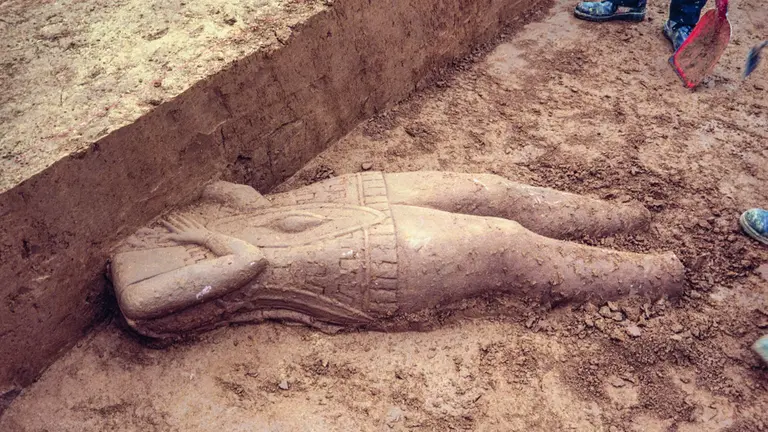
The Glauberg Celtic Prince stands among the most remarkable Iron Age finds in Central Europe. Discovered in 1996 near the Glauberg hill in Hesse, Germany, the burial dates to the early 5th century BCE, placing it in the transition from the Late Hallstatt to the Early La Tène phase of the Celtic Iron Age. The discovery significantly deepened our understanding of early Celtic elite society.
What truly sets this find apart is the life-sized sandstone statue uncovered close to the burial mound. It is one of the earliest known anthropomorphic Celtic sculptures in Europe. The figure wears distinctive leaf-shaped headgear—often interpreted as stylized mistletoe leaves—along with a torc, the rigid neck ring associated with high status and authority. He is also shown carrying a shield and a sword, reinforcing his aristocratic standing and possibly hinting at a ritual or religious role as well as political power.

One of the most eye-catching elements of the Glauberg Celtic Prince statue is its extraordinary headdress. While modern viewers sometimes joke that it looks like “Mickey Mouse ears,” it actually represents a stylized crown of mistletoe leaves. Scholars widely interpret this as a symbol of sacred authority, possibly indicating priestly status within Celtic society. In Celtic belief, mistletoe carried deep spiritual meaning and was closely linked to ritual practice and elite religious power. The distinctive “mistletoe crown” not only makes the sculpture unique among Iron Age finds, but also supports the idea that this figure was more than just a warrior—he may have held both political leadership and spiritual authority.
The burial chamber itself was richly furnished. Grave goods included gold ornaments, finely crafted weapons, and imported objects that point to long-distance trade connections across Iron Age Europe. These items reveal the far-reaching economic and cultural networks of the Celtic world.
The tomb formed part of a larger complex featuring burial mounds, processional avenues, and nearby fortified settlements, suggesting that Glauberg functioned as a major political and ceremonial center. Radiocarbon dating and artifact analysis place the burial between roughly 480 and 450 BCE—a transitional era between the Hallstatt and La Tène cultures, when Celtic art, symbolism, and social hierarchies were becoming increasingly elaborate.