
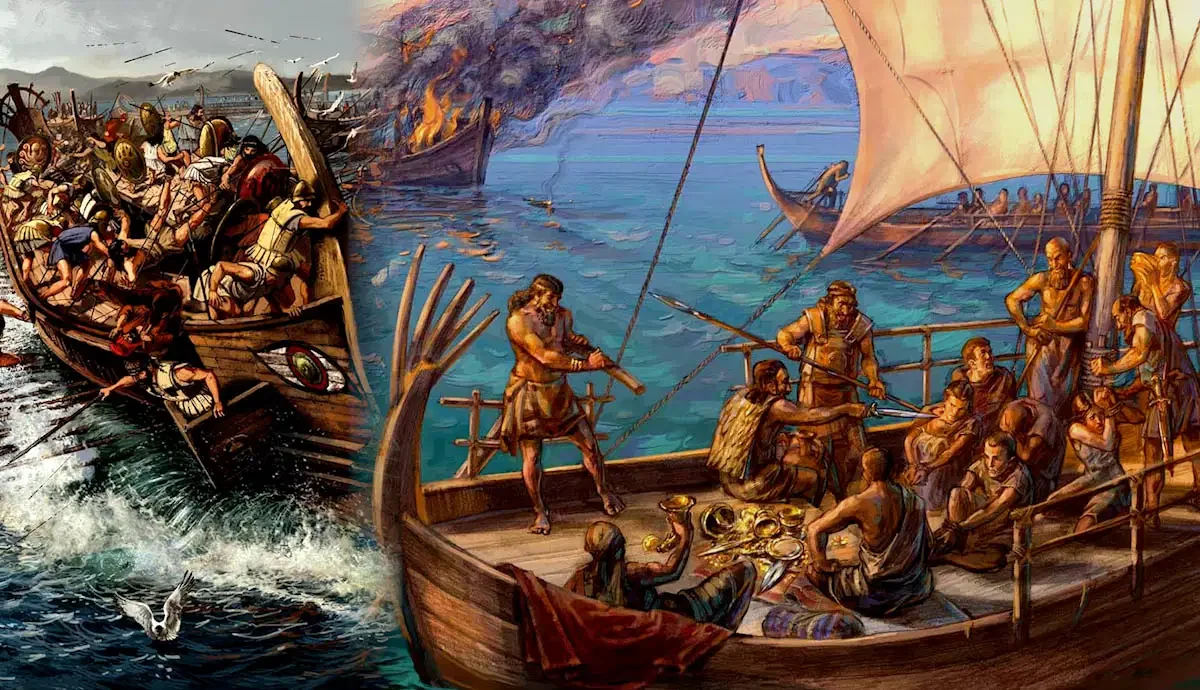
Investigating how minor coastal anchorages may have supported maritime raiding, informal exchange, and the movement of people and goods during the Bronze Age.
Introduction: The Maritime World Beyond Major Ports
The Bronze Age connected many coastal communities through maritime travel. Ships and boats carried metals, pottery, agricultural products, textiles, and other commodities between settlements separated by islands, peninsulas, and stretches of open water.
Not every voyage depended on a major harbor. Small coves, sheltered beaches, river mouths, and natural inlets could provide temporary places to land, repair vessels, obtain water, or transfer cargo. Some of these locations may have supported routine commerce, while others could have been used by people engaged in raiding or unauthorized trade.
Piracy is difficult to reconstruct archaeologically because it is an activity rather than a distinctive type of settlement. A small harbor does not become a pirate base simply because it was isolated or strategically positioned. Evidence of violence, maritime movement, and the handling of goods must be evaluated alongside the site's chronology and regional context.
The most useful approach is to investigate how small harbors functioned within wider maritime networks and whether particular locations could plausibly have supported both legitimate exchange and predatory activity.
What Counts as a Small Harbor?
A small harbor may be a natural anchorage with limited construction or a more developed facility containing landing places, storage buildings, quays, or protective structures. In the Bronze Age, many coastal landing sites may have relied on the natural shape of the shoreline rather than elaborate engineering.
Researchers examine sheltered water, beach gradients, access to freshwater, visibility from the sea, and connections with inland routes. These features help establish whether a location was suitable for anchoring and landing vessels.
Coastal landscapes have changed substantially since the Bronze Age. Sea-level fluctuations, tectonic movement, sediment accumulation, erosion, and harbor silting can alter the relationship between an archaeological site and the modern shoreline. A place that now lies inland may once have stood beside navigable water.
Marine geophysics, sediment cores, underwater survey, and coastal geomorphology can help reconstruct these changes. Without this environmental context, the original maritime function of a small site may be difficult to determine.
Piracy and the Limits of Archaeological Evidence
Piracy generally involves unauthorized seizure or predation at sea, but ancient maritime violence did not always fit a clear distinction between pirates, raiders, private armed groups, and political authorities. The same community might engage in trade during one period and violent appropriation during another.
Archaeology rarely identifies piracy through a single artifact. Weapons, burned buildings, imported goods, or defensive structures may indicate conflict, but they can also result from warfare, local disputes, or ordinary settlement activity.
Evidence becomes more informative when several indicators occur together. A harbor associated with repeated destruction, unusual concentrations of valuable cargo, defensive modifications, and contemporary evidence of maritime conflict may warrant closer investigation.
Even then, the interpretation should remain cautious. Looted cargo can be difficult to distinguish from ordinary trade, and the absence of defensive architecture does not prove that a harbor was peaceful. The evidence must support the specific claim being made.
Geography, Concealment, and Maritime Strategy
Small anchorages may have offered practical advantages to people seeking to avoid larger ports. Sheltered coves could provide temporary protection from weather, while nearby inlets and islands might create alternative routes along a coastline.
Geographic information systems can help researchers examine the relationship between anchorages, navigable channels, settlements, and major trade corridors. Visibility analysis may indicate which locations could be observed from nearby high ground or from the sea.
However, modern visibility does not necessarily reproduce Bronze Age conditions. Vegetation, coastal erosion, and changing sea levels can alter what was visible to sailors and people on land. Archaeologists must reconstruct the landscape before drawing conclusions about concealment or surveillance.
A harbor's location may also have supported peaceful functions. The same secluded cove could shelter fishing boats, provide access to a small agricultural settlement, or serve as a seasonal anchorage for traders. Geography establishes possibility, not criminal identity.
Trade Goods, Cargo, and Maritime Exchange
Small harbors can preserve evidence of maritime exchange through pottery, metal objects, stone materials, storage vessels, and other transported goods. Their composition may reveal connections between coastal communities and more distant production centers.
The distribution of artifacts can help reconstruct movement, but objects do not always travel with the people who originally produced them. A vessel may have been traded repeatedly, while a metal object could have been recycled or transported far from its place of manufacture.
Underwater archaeology can provide additional evidence where shipwrecks or submerged deposits survive. Cargo assemblages, ship construction, and associated objects may clarify the nature of a voyage, although identifying a wreck as the result of piracy requires more than finding valuable goods.
A cargo could have been lost in a storm, abandoned during an emergency, or transported for ordinary commercial purposes. The interpretation must account for these alternatives.
Small Harbors and Regional Political Change
Maritime violence can influence the organization of trade, settlement, and political authority. Communities exposed to raiding might alter their routes, fortify coastal locations, or concentrate goods in more secure settlements.
Archaeologists can investigate such changes through the chronology of harbor use, settlement abandonment, defensive construction, and shifts in the distribution of imported materials. A decline in activity at one anchorage alongside the growth of another might indicate changing patterns of movement, although environmental and economic factors must also be considered.
Small harbors may also reveal the limits of political control. A state or regional authority might supervise major ports while exercising less direct influence over minor coastal locations. Yet this possibility must be tested against the specific political and archaeological context.
Conclusion: Small Anchorages Within a Complex Maritime World
Small harbors were potentially important components of Bronze Age maritime networks. They could provide shelter, support local exchange, connect inland settlements to the sea, and offer temporary stopping points along longer voyages.
Some may have been used by raiders or other groups involved in maritime violence, but a secluded anchorage is not evidence of piracy by itself. Archaeologists need converging evidence from settlement history, cargo remains, conflict indicators, and environmental reconstruction.
Studying these smaller coastal locations broadens our understanding of Bronze Age seafaring beyond monumental ports and well-documented trade centers. It also highlights the complexity of maritime life, where commerce, travel, political authority, and violence could overlap within the same coastal landscape.




