
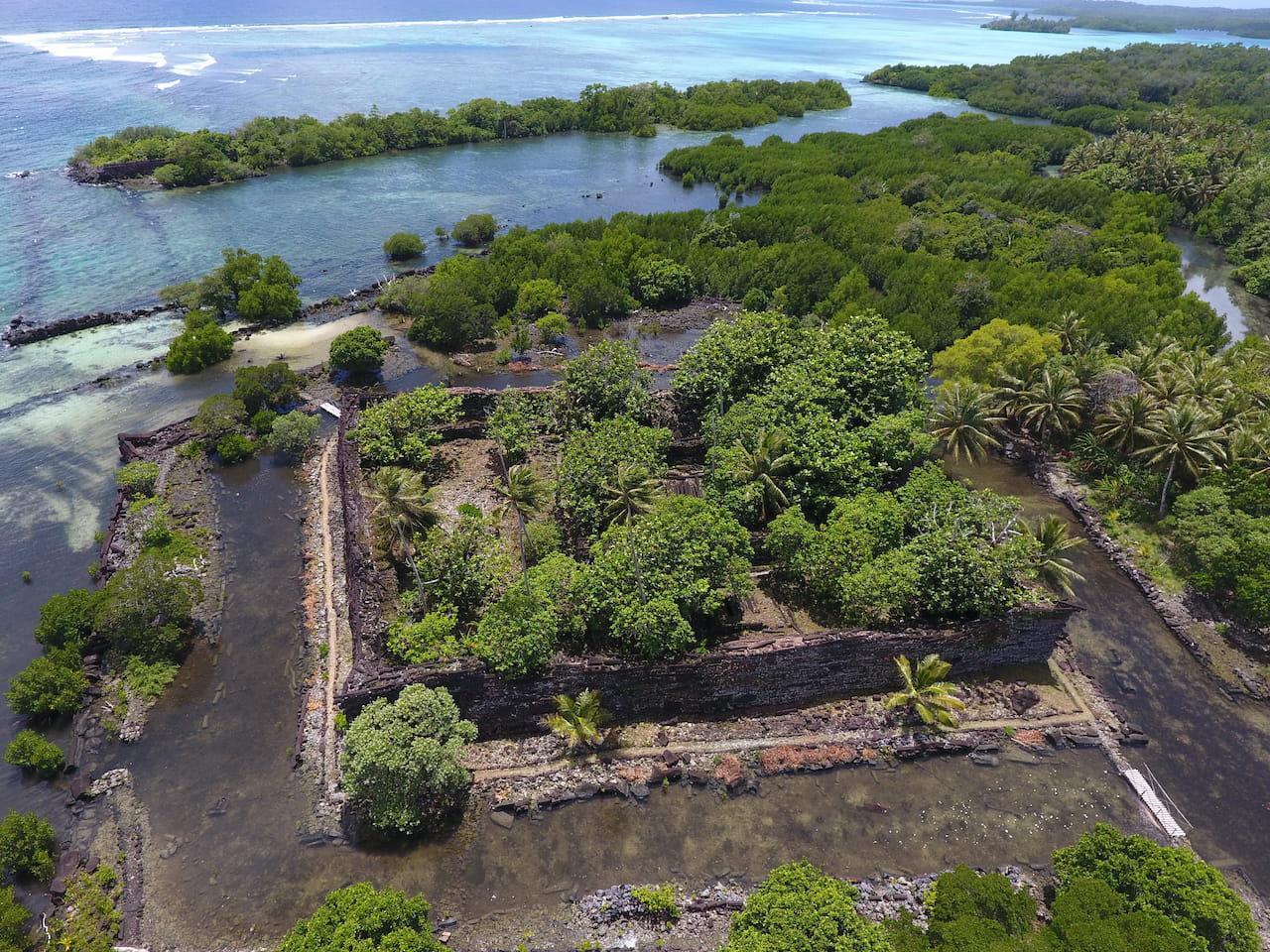
Introduction
Small islands have played important roles in human settlement, navigation, trade, defense, and political organization across the Pacific. Their geography could provide advantages during periods of conflict, particularly where communities could control access to shorelines, freshwater, food supplies, and maritime routes.
The concept of small islands functioning as refuge cities during precolonial Pacific wars raises questions about defensive settlement patterns, population movement, strategic geography, and community resilience.
The specific refuge cities described in the title are not verified as particular archaeological discoveries. However, island refuge settlements are a meaningful subject within Pacific archaeology, historical geography, and research on conflict and settlement adaptation.
Island Geography and Defensive Advantages
Small islands often have geographical characteristics that influence settlement and defense.
Depending on their location and physical form, they may provide:
Restricted access points.
Natural barriers.
Elevated defensive positions.
Visibility across surrounding waters.
Protection from land-based attacks.
Access to maritime transportation.
Opportunities for controlled movement.
A small island may be easier to defend than a large settlement distributed across open terrain, particularly when its shoreline contains narrow landing areas or steep slopes.
However, not all islands provide strong defensive advantages. Low-lying islands, coral atolls, and exposed coastal settlements may be vulnerable to storms, shortages of water, and attacks from the sea.
The effectiveness of an island refuge would depend on local geography, available resources, settlement organization, and the nature of the conflict.
Refuge Settlement and Population Movement
During periods of warfare, communities may relocate to settlements perceived as safer.
Such movement could involve temporary refuge, seasonal relocation, permanent migration, or the concentration of people into fortified settlements.
Archaeological evidence might include changes in settlement density, the construction of defensive structures, the abandonment of vulnerable locations, or the development of new settlement patterns.
In the Pacific, migration and settlement were already closely connected to maritime mobility. Communities possessed knowledge of navigation, island geography, and sea travel that could facilitate relocation.
However, the presence of a settlement on a small island does not automatically indicate a refuge function. It may have been occupied for agricultural, fishing, trading, ritual, or political reasons.
Defensive Architecture and Settlement Organization
Archaeologists may investigate whether island settlements incorporated defensive features.
Possible evidence includes:
Palisades.
Earthworks.
Stone walls.
Terraced slopes.
Restricted entrances.
Elevated lookout positions.
Concentrated residential areas.
Defensive platforms.
The interpretation of such structures requires care because walls and terraces may also serve agricultural, residential, or ceremonial functions.
A settlement's spatial organization may reveal how people adapted to limited space. Houses, storage areas, communal structures, and water sources could be arranged to support concentrated populations.
If an island served as a refuge, researchers might investigate whether the settlement's infrastructure could accommodate larger populations than its usual inhabitants.
Food Security and Water Management
Refuge settlements must support people for extended periods.
Small islands may have limited agricultural land and freshwater supplies. During conflict, these limitations could become serious problems.
Communities might rely on stored food, fishing, shellfish collection, cultivation, transported supplies, and shared resources.
Archaeological investigations could examine storage facilities, plant remains, animal bones, fish remains, and water-management structures.
Evidence of increased food storage or changes in dietary patterns may provide clues about settlement adaptation, although these changes could also reflect broader economic or environmental circumstances.
Warfare and Social Organization
Precolonial Pacific conflict varied across regions and historical periods. Warfare could involve disputes over territory, resources, leadership, alliances, social status, or political authority.
Island refuge settlements may have been connected to changing relationships between communities.
A defensive settlement could represent temporary cooperation among different groups, a political center, a fortified community, or a place of refuge for families displaced by conflict.
Researchers should avoid treating Pacific societies as culturally uniform. Political organization, military practices, settlement patterns, and conflict traditions differed across island groups.
Archaeological interpretation must be grounded in regional evidence and local historical knowledge.
Archaeological Evidence for Refuge Function
Identifying an island refuge requires more than evidence of fortification.
Researchers may investigate:
Settlement chronology.
Changes in population density.
Defensive structures.
Abandoned settlements nearby.
Food-storage infrastructure.
Evidence of trauma or conflict.
Material changes associated with migration.
Historical and oral traditions.
The combination of these sources may help determine whether a settlement experienced periods of refuge or defensive occupation.
Oral histories and community traditions may provide valuable context, but their interpretation should be collaborative and respectful, particularly where they relate to conflict, displacement, ancestry, and community identity.
Conclusion
Small islands may have served as refuge settlements during precolonial Pacific conflicts because of their geographical advantages, maritime accessibility, and potential for defensive organization.
Their archaeological investigation can contribute to understanding warfare, population movement, settlement resilience, food security, and social cooperation.
The concept of refuge cities also emphasizes that conflict did not only produce destruction. It could reshape settlement patterns, encourage community reorganization, and influence how people adapted to changing political and environmental conditions.





