The Roman City Buried for Centuries: How Timgad Preserved an Entire Ancient World
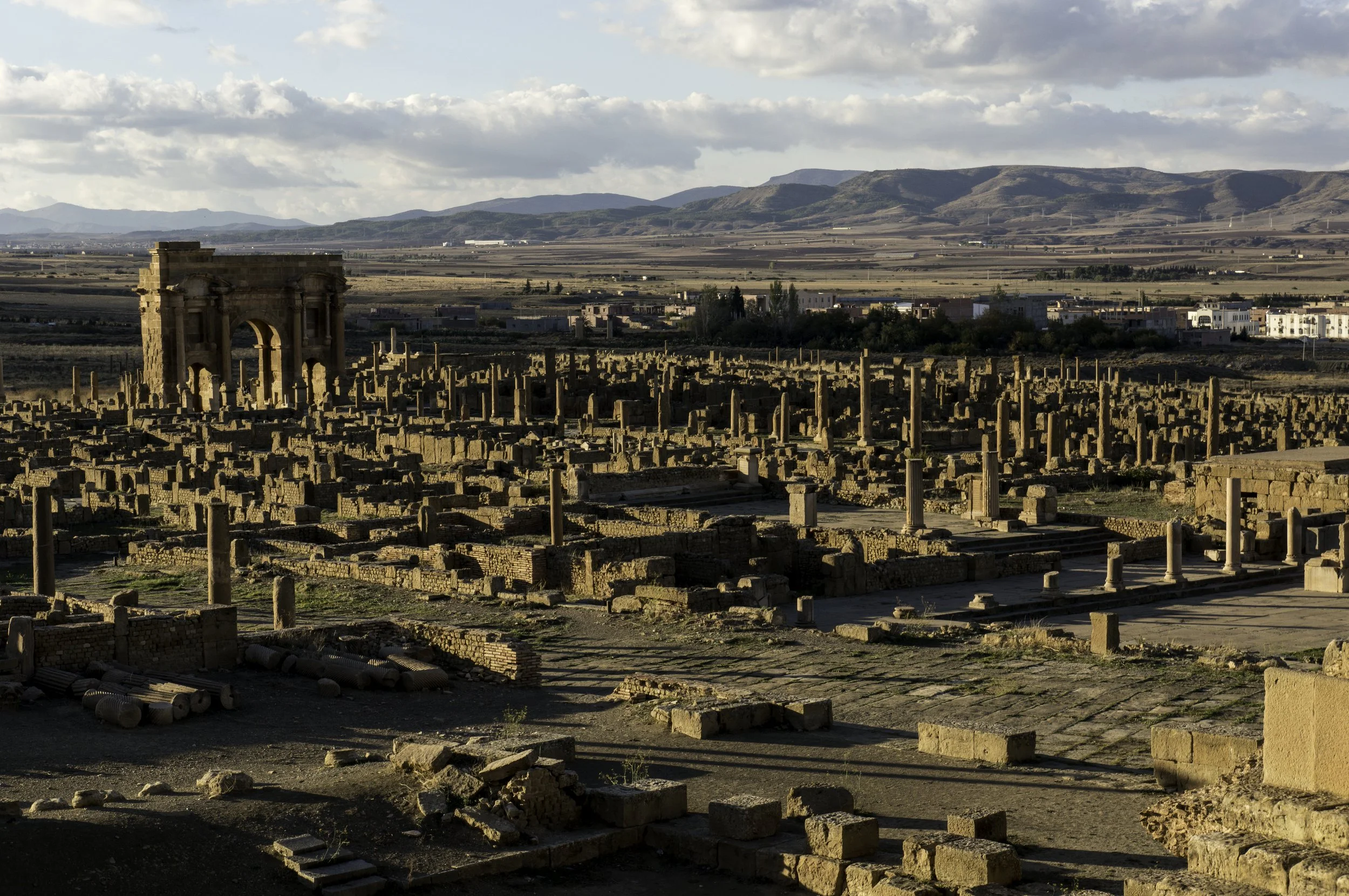
Few archaeological sites demonstrate Roman urban planning as clearly as Timgad, the ancient city of Thamugadi in present-day Algeria.
From above, its streets reveal a strikingly organized pattern.
A central avenue cuts through the city.
Perpendicular roads divide neighborhoods.
Public buildings occupy important locations.
A forum formed the political heart.
Temples, baths, theaters, and houses served the population.
For centuries after its abandonment, much of the city was covered by sand and sediment.
This burial helped preserve portions of its ancient urban layout.
Today, Timgad is often described as one of the best examples of a Roman colonial city in North Africa.
The Foundation Under Emperor Trajan
Timgad was founded around 100 CE during the reign of Emperor Trajan.
The Roman Empire at this time was approaching the height of its territorial expansion.
North Africa was already deeply integrated into the Roman world.
Roman administration, roads, military infrastructure, and cities transformed the region.
Timgad was established as a colony, originally associated with the settlement of Roman veterans.
This was an important imperial strategy.
Retired soldiers could receive land.
Their settlement strengthened Roman presence in strategically important regions.
Why Build a City Here?
The location was not chosen randomly.
The Roman government needed to consolidate control in North Africa.
A colony could serve several purposes:
Settlement of veterans.
Expansion of agriculture.
Administrative control.
Cultural integration.
Support for military operations.
The city became part of a wider Roman network.
Roads connected settlements.
Military installations protected frontier regions.
Trade linked rural producers with urban markets.
The Roman Grid
Timgad is famous for its relatively clear street plan.
Roman urban planning often relied on a grid.
Two major streets commonly formed the central axes:
The cardo maximus, generally oriented north-south.
The decumanus maximus, generally oriented east-west.
The intersection of these roads created an important urban center.
The layout made movement and administration more organized.
However, cities were not permanently frozen in their original designs.
As populations grew, buildings expanded beyond original limits.
Timgad eventually developed beyond its earliest grid.
The Arch of Trajan
One of the most recognizable monuments of Timgad is the monumental arch traditionally associated with Trajan.
The arch stood near a major entrance to the city.
Roman monumental arches were not merely decorative.
They communicated imperial power.
A person entering the city encountered a visible symbol of Roman authority.
Architecture therefore participated in propaganda.
The empire was present not only through soldiers and officials but also through stone.
The Forum
The forum was the civic heart of the Roman city.
Public life could involve:
Political announcements.
Commercial activity.
Religious ceremonies.
Legal affairs.
Social interaction.
Important buildings surrounded or stood near the forum.
For archaeologists, these spaces reveal how Roman urban communities were organized.
The Theater
Timgad contains the remains of a theater capable of accommodating a substantial audience.
The presence of a theater demonstrates that entertainment was an important part of urban life.
Performances could include:
Drama.
Music.
Public events.
The theater also reveals something about the Romanization of the city.
Roman cultural forms were reproduced far from Italy.
A citizen in North Africa could participate in institutions and entertainments associated with the broader empire.
Baths: More Than Places to Wash
Roman bathhouses were among the most important social institutions in urban life.
A bath complex could contain rooms with different temperatures.
These commonly included:
Cold rooms.
Warm rooms.
Hot rooms.
Heating systems such as the hypocaust circulated hot air beneath floors and sometimes through walls.
But baths were not simply about hygiene.
They were social spaces.
People met.
Discussed business.
Relaxed.
Exercised.
Roman urban life was deeply connected with the bathhouse.
Religion in Timgad
The population of Timgad did not worship a single god.
The Roman religious world included numerous deities and cults.
Public temples could be dedicated to Roman gods.
Local traditions could continue.
Foreign religious ideas could arrive through trade and migration.
Later, Christianity became increasingly important.
This demonstrates that Timgad's religious history changed over time.
The Library and Education
One of Timgad's most fascinating discoveries is a building interpreted as a library.
The identification and function of ancient buildings can be debated, but the structure is associated with the intellectual life of the city.
If correctly interpreted, it provides remarkable evidence for literacy and the preservation of texts in a provincial Roman community.
Books in the Roman world existed primarily as scrolls and later codices.
A library required organization, storage, and access.
The possibility of such an institution at Timgad demonstrates that Roman provincial cities could support sophisticated cultural life.
The Population Beyond Rome
It would be inaccurate to imagine that Timgad was inhabited only by people from Italy.
Roman North Africa was ethnically and culturally diverse.
The city included populations connected with:
Roman settlers.
Local Amazigh communities.
Merchants.
Officials.
Soldiers.
Migrants from other parts of the empire.
Roman identity itself could be complex.
A person could participate in Roman political and urban institutions while maintaining local cultural connections.
Christianity and Late Antiquity
As Christianity expanded across the Roman Empire, North Africa became one of its most important regions.
Christian communities established churches and religious institutions.
Theological debates became politically significant.
North Africa produced major Christian intellectual figures.
Timgad itself reflects the transformation of urban life during Late Antiquity.
Decline and Abandonment
Like many Roman cities, Timgad experienced political and economic changes.
The collapse of Roman imperial authority in western regions did not happen overnight.
Instead, different areas experienced gradual transformation.
The city passed through periods associated with Vandal and Byzantine control.
Eventually, population and urban activity declined.
Parts of the city were abandoned.
Sand and sediment accumulated.
The once-busy streets disappeared.
Rediscovery
The burial of Timgad contributed to its preservation.
When archaeological excavation began in the modern era, researchers uncovered an unusually visible Roman urban plan.
This created the impression that an entire city had been “frozen in time.”
Of course, excavation also transforms a site.
Once structures are exposed, they become vulnerable to weather.
Therefore, archaeology and conservation must work together.
Why Timgad Matters
Timgad is more than a collection of ruins.
It provides a physical map of Roman urban civilization.
Walking through its streets reveals how a Roman city was organized.
The forum demonstrates civic life.
The baths reveal social habits.
The theater reveals entertainment.
The temples reveal religion.
The streets reveal planning.
And the expansion beyond the original grid reveals that even the most carefully designed city eventually changed.
Timgad's greatest lesson may be that the Roman Empire was not confined to Rome.
Its cities stretched across continents.
And in the mountains of Algeria, one of those cities still survives—its streets silently preserving the blueprint of an ancient world.