Rome Built a City in the Mountains of Algeria—and Its Ruins Still Defy the Landscape
Djemila, known in antiquity as Cuicul, is one of the most spectacular surviving Roman archaeological sites in North Africa.
Its location is immediately striking.
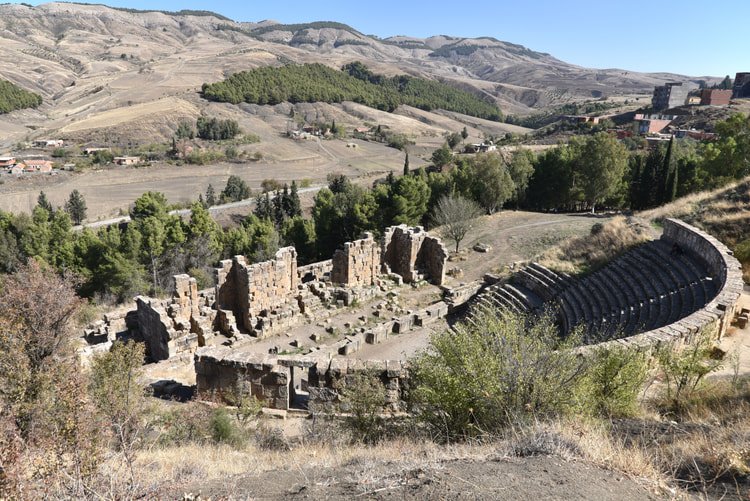
Unlike many Roman cities built on broad plains, Cuicul developed in a mountainous environment at a significant elevation.
The terrain presented enormous challenges.
Yet Roman planners built streets, forums, temples, houses, markets, baths, and churches into the landscape.
The result is a city that demonstrates both the ambition and adaptability of Roman urban civilization.
Cuicul and Djemila: Understanding the Name
The modern name is Djemila.
The ancient Roman name was Cuicul.
This distinction is important because historical site lists sometimes treat the two as separate ancient cities when they are actually different names associated with the same archaeological location.
Cuicul became the Roman settlement.
Djemila is the modern name connected with the site.
Foundation Under Roman Expansion
The city was founded during the period of Roman imperial expansion in North Africa.
Traditionally, its establishment is associated with the reign of Emperor Nerva, around the late first century CE, although its major development continued under later emperors.
The city became part of the Roman province of Numidia.
Roman settlement in the region was supported by military infrastructure and agricultural development.
Building Against the Terrain
The most remarkable aspect of Cuicul is its geography.
Roman urban planning is often associated with straight streets and rectangular grids.
But Cuicul demonstrates that Roman planners could adapt when the environment required flexibility.
The terrain prevented a perfectly regular city plan.
Therefore, streets and buildings followed the available land.
This produced a city with a distinctive architectural character.
The Forum and Civic Life
The original forum formed the center of civic activity.
Here, inhabitants could encounter:
Public monuments.
Administrative institutions.
Religious structures.
Commercial activity.
Roman cities depended on public space.
The forum was not simply an open square.
It represented urban citizenship.
The Growth of the City
Cuicul did not remain within its original boundaries.
As the population and economy developed, new areas were added.
This expansion demonstrates a fundamental archaeological principle:
Cities are processes, not finished objects.
The original Roman plan changed.
New neighborhoods appeared.
Public buildings were expanded.
Later generations reshaped the city.
The Arch of Caracalla
One of the most famous monuments at Djemila is the triumphal arch associated with Emperor Caracalla and his family.
Like other Roman arches, the structure communicated imperial authority.
The emperor's image and name could be physically embedded in the urban environment.
Monuments reminded provincial populations that their city existed within a much larger imperial system.
The Market and the Economy
Urban life depended on trade.
Markets brought agricultural products and manufactured goods into the city.
The surrounding countryside supported urban populations.
Roman North Africa became one of the empire's most economically productive regions.
Agricultural products, especially grain and olive oil, became important within Mediterranean trade.
Baths and Social Life
Djemila contained multiple bathing facilities.
The Roman bathhouse was a technological achievement.
Heating systems circulated warmth through specialized spaces.
Water had to be collected and distributed.
Architects designed rooms for different temperatures.
But the baths also functioned socially.
They created spaces where citizens and residents interacted.
Christianity Arrives
During Late Antiquity, Christianity transformed the urban landscape.
Churches and basilicas were constructed.
Christian communities developed institutions.
Older religious buildings could be abandoned or repurposed.
The city therefore provides evidence of the transition from the classical Roman religious world to a Christian urban environment.
North Africa and Early Christianity
North Africa was one of the intellectual centers of early Christianity.
The region produced major theologians and religious writers.
Christianity was not simply imported into North Africa.
African Christian communities played an important role in shaping the religion itself.
The churches of Cuicul form part of this larger historical story.
Decline
Changing political conditions affected the city.
The region passed through periods of Roman, Vandal, and Byzantine influence.
Economic patterns changed.
Some urban institutions weakened.
Eventually, Cuicul declined as a major urban center.
The mountain city became a ruin.
Why Djemila Matters
Djemila demonstrates the flexibility of Roman civilization.
Rome did not simply copy the same city everywhere.
Builders adapted.
Administrators responded to local conditions.
Urban life changed over centuries.
Today, the ruins show what happened when one of history's greatest imperial systems encountered a difficult mountain landscape—and refused to give up.
The result was a city that should have been difficult to build but became one of the most impressive Roman settlements in Africa.