In the video below we will be talking about the weirdest archaeological discoveries that have ever been made. Enjoy!
The End Of The 12 Apostles
In the following video we will be explaining how the 12 Apostles passed away. Watch the video for more!
Decoding Angkor Wat: The Spiritual and Symbolic Heart of the Khmer Empire
Angkor Wat, a UNESCO World Heritage Site located in modern-day Cambodia, is more than just the world's largest religious monument. It's a testament to the ingenuity, vision, and spiritual depth of the Khmer Empire, which held sway over much of Southeast Asia from the 9th to the 15th centuries.
Join us on this breathtaking journey as we delve deep into the architectural marvel and spiritual heart of the Khmer civilization. We'll explore the intricate bas-reliefs, the iconic lotus bud towers, the celestial alignments, and the extensive network of moats and causeways, all of which carry layers of symbolic meaning tied to Hindu and later, Buddhist cosmology.
Our exploration isn't limited to stone and artistry alone. We'll also delve into the socio-political significance of Angkor Wat, reflecting on its role as the epicenter of the Khmer Empire and its transformation over the centuries. From the sacred abode of gods to a Buddhist temple, Angkor Wat's evolution mirrors the shifting cultural and religious landscape of the region.
We'll also hear from experts in the fields of archaeology, architecture, and Southeast Asian history, who will enrich our understanding of this extraordinary monument and its people.
Angkor Wat is not just a testament to the past; it's a symbol of national pride and resilience for the people of Cambodia. Come, uncover its symbolic meanings and its enduring relevance with us!
Unearthing Troy: The Mystery of Priam's Fabled City
For centuries, the city of Troy, as immortalized in Homer's epic, the Iliad, has captured the imagination of historians, archaeologists, and mythology enthusiasts. The city, ruled by King Priam during the legendary Trojan War, has long been thought of as a mere myth. But could the traces of this fabled city actually lie buried beneath the mound of Hissarlik in modern-day Turkey?
Join us as we embark on a thrilling journey of discovery, exploring the archaeological findings at Hissarlik, the intriguing evidence, and the ongoing debates among scholars. We'll hear from leading archaeologists, historians, and classicists who are at the forefront of this fascinating investigation.
We'll examine the pioneering work of Heinrich Schliemann, the 19th-century archaeologist who first proposed that Hissarlik was the site of Troy. We will scrutinize the artifacts, the architectural remnants, and the geographical congruences that seem to support this theory, and weigh them against the counter-arguments.
Is the Hissarlik Hill the site of the legendary city of Troy? Or are we still far from solving this ancient mystery? Uncover the clues with us, and form your own conclusions!
Elon Musk Tells Us What The Navy Saw While Diving in the Arctic
In the following video we will see Elon Musk explaining what the navy saw while diving in the Arctic. Watch the video to find out more!
The Truth about the Ultimasaurus - Invincible or Epic Fail?
The Ultimasaurus is portrayed as an invincible force of nature put together using no other than the strongest hervibores and most fierce carnivores. But was this animal actually the menace it was portrayed to be? or was this animal too overrated? In this video we will break down this hybrid and uncover how it would use its plethora of weapons to maximum power... or minimum effectiveness. Enjoy!
Story of the first successful ascent of Ball's Pyramid in the Pacific Ocean
Ball’s Pyramid lies about twelve miles southeast of Lord Howe Island in the Pacific Ocean. The formation is a remnant of a shield volcano and caldera that formed about 7 million years ago. Ball’s Pyramid is based on the Lord Howe Rise, part of the submerged continent of Zealandia.
The Ball’s Pyramid is 1,843 feet high, while measuring only 3,609 feet in length and 984 feet across, making it the tallest volcanic stack in the world. Ball’s Pyramid has a few satellite islets. On the west side about 2,600 feet away is Observatory Rock and Wheatsheaf Islet. On the southeast side of Ball’s Pyramid about 2 miles away is a pinnacle called Southeast Rock.
The pyramid was named after Lieutenant Henry Lidgbird Ball, who discovered it in 1788. The first person to go ashore is believed to have been Henry Wilkinson in 1882, who was a geologist at the New South Wales Department of Mines.
Steep, eroded, and formed about seven million years ago, the Ball’s Pyramid is positioned in the center of a submarine shelf and is surrounded by rough seas, making any approach difficult. It sits off Australia, in the South Pacific Ocean approximately 400 miles northeast of Sydney, New South Wales.
It was first successfully climbed by a party from Sydney Rockclimbing Club in 1965 led by Bryden Allen.
20 Cats That Are Born Only Once In a Thousand Years
In the following video we will analyze 20 cats that are born only once in a thousand years. Watch the video to find out more!
Russia's Terrifying New Underwater Discovery That Changes Everything
In today’s video we will be exploring a terrifying new underwater discovery made by Russia that changes everything. Watch the video below to find out more!
This Is What Lived On Earth Before Dinosaur
We all know about dinosaurs. They’re almost as familiar as the animals that are still around today. But in the long history of life on earth there have been a ton of other weird and wonderful species roaming around, many of which just do not get the credit they deserve. So we’re going to set the record straight in this video. From the crazy pot bellied lizard to the beast with an enormous neck, here’s 20 Bizarre Looking Prehistoric Animals.
Unraveling the Epic of Gilgamesh: A Journey Through Ancient Mesopotamian Lore
In today's episode, we're taking a deep dive into one of the oldest known pieces of literature, "The Epic of Gilgamesh"
Born from the cradle of civilization, this ancient Mesopotamian epic tells the tale of Gilgamesh, a legendary king of Uruk, his friendship with the wild man Enkidu, and their heroic quests that range from battling mythical creatures to seeking the secret of eternal life.
Our journey will take us through the vivid narrative of this epic, exploring its themes of friendship, the human condition, mortality, and the quest for immortality.
We'll also delve into the historical and cultural context of the story, revealing its significance in the ancient world and its continued relevance today.
We'll be joined by experts in ancient literature and Mesopotamian history, who will help us explore the clay tablets on which this epic was inscribed and the intriguing cuneiform script used to record it.
We'll trace the epic's journey from its creation around 2100 BCE to its rediscovery in the 19th century CE, and its enduring legacy in modern literature and thought.
Whether you're a literature enthusiast, a history buff, or someone who appreciates the timeless narratives of human experience, this episode is a must-watch!
If you enjoy this deep dive into the Epic of Gilgamesh, don't forget to hit the like button, share it with friends, and subscribe to "Literary Lore" for more explorations into the great works of literature.
Let's uncover the power of ancient storytelling together!
Ice Age: Quaternary glaciation and Habitats of Hominin
In this video, the ice sheet's change process in the Northern Hemisphere during the Ice Age and the relationship with Hominin habitats at each period are displayed on a map and introduced. In addition, this video provides information about the Glacial and Interglacial periods during the Quaternary Ice Age. You can also check the ice sheet size in the northern hemisphere during the glacial period.
Joe Rogan Reveals The Most Horrific Method Of Execution
In today’s video we will see Joe Rogan talking about the victims of human sacrifice by Mexico’s ancient Mayans. Watch the video for more!
Most Mysterious Discoveries Ever Made
In today’s video we will analyze the most mysterious discoveries ever made. Watch the video below to find out more!
Beak Size Comparison
In this video we will be comparing beaks from different birds. Watch the video below and enjoy!
700,000-Year-Old Skull Found In Greece Completely Shatters ‘Out Of Africa Theory’
Nature has always been a random architect. Entering Petralona Cave, which was formed in the limestone of Katsika Hill about a million years ago, makes this very clear. The cavern, which is known as "the red-rock cave" because of the color the bauxite deposits give the stone, spans a surface area of 10,400 m2, and it is filled with stalactites, stalagmites, curtains and shields, columns, and other formations. A window into the prehistoric period was created by its discovery in 1959. It is currently the most significant of Greece's 12,000 caves because to its abundance of fossils (one of the richest collections in Europe) and the finding of the oldest human remains ever unearthed in Greece about 50 years ago.

The discovery of a fossilized human skull plus many other object led to the Petralona Cave being called the Parthenon of paleontology
The strange hole at the base of Katsika Hill was initially discovered by residents of the settlement of Petralona. They made a small entry, down by a rope, and then resurfaced carrying petrified animal teeth and bones that they presented to Professor Petros Kokkoros of Thessaloniki's Aristotle University. Greek scientists began excavating the site, revealing passages, and gathering artifacts after the discovery inspired the scientific community. The cave quickly became known outside of Greece as a treasure mine of geological and anthropological artifacts. Scientists made their most important find in September 1960 when they discovered a fossilized human skull among hundreds of other animal fossils from 22 different species, including extinct bears, lions, and hyenas.

The Geology and Paleontology Laboratory, 1963: the first of fossils from the Petralona Cave.From left: E. Tsorlinis, L. Sotiriadis, G. Marinos (director), Otto Sickenberg and H. Sakellariou-Mane
The physical features of the skull suggest that it belonged to a person evolving from Homo erectus to Homo sapiens. After much investigation and discussion, it is now thought to be 200,000 years old. An essential component of the human evolutionary puzzle was the skull. The "Parthenon of paleontology" has been researched by some of the top paleoanthropologists in the world.
Although the cave has not yet been fully explored, a man-made tunnel provides convenient access for tourists to appreciate the intricate formations and two examples of cave art. A bear is shown in one, which is near the cave's original entrance, and people are seen eating in the other.
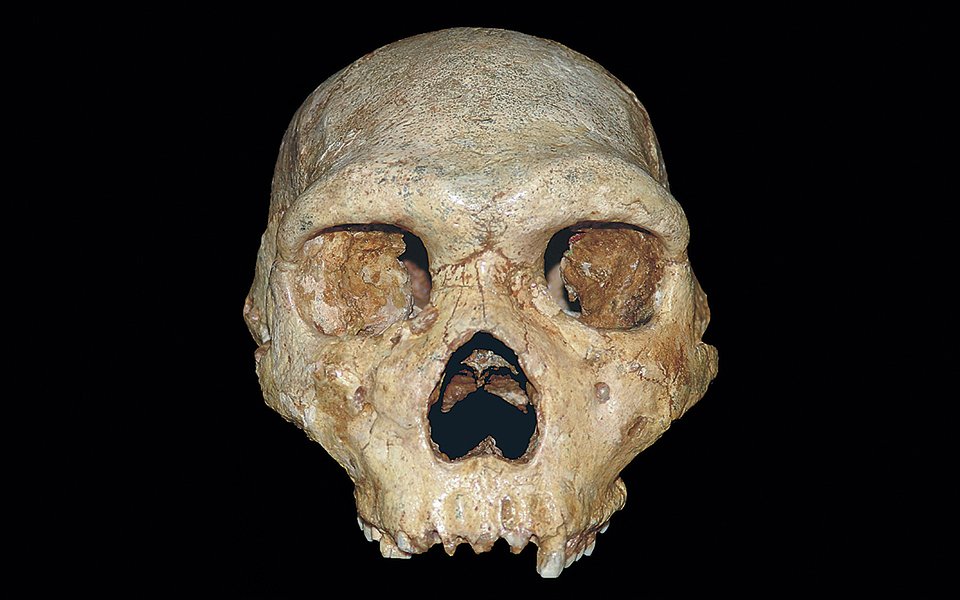
The Petralona skull after the cleaning of its facial area by Prof. J. Melentis. Facial view.
However, it has not yet been established that people originally resided in the cave. There could have been an accident with the skull. Paleontologist Dr. Evangelia Tsoukala, a professor at Aristotle University of Thessaloniki, and one of the researchers who examined the items recovered from the cave, says that future research involving international collaboration and new techniques will inform us of precisely what happened.
She says, "Halkidiki is continually producing fossils." "In Kryopigi, we found a giraffe, a wild boar, tiny mammals, large and small carnivores, and three different species of prehistoric horses. The most significant fossil we discovered was one of the best-preserved skulls of an Old World monkey called Mesopithecus pentelicus.
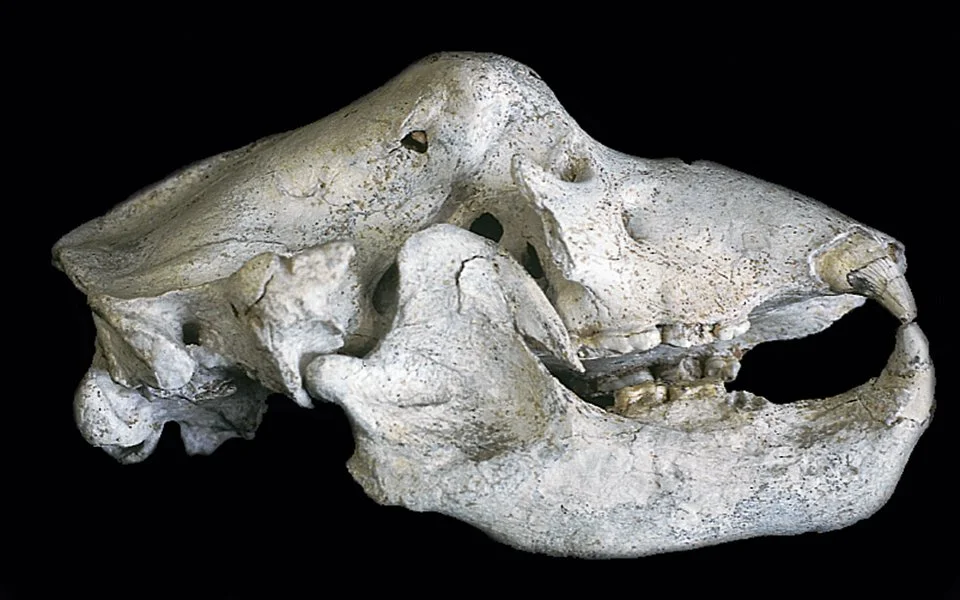
Ursus spelaeus, cave bear: Skull, mandible and a strongly vaulted forehead.
Researchers discovered a set of teeth from the upper jaw of a Deinotherium, a trunked animal with tusks that wandered the world between 5 and 10 million years ago, in another location called Aghia Paraskevi. They found numerous fossilized tree trunks in Kassandra and evidence of enormous turtles on the Halkidiki coast.
Next to the cave is an Anthropological Museum, a 1,000m2 structure with 400 exhibit cases and more than 2,500 findings from not just Halkidiki but also from other sites investigated by the Anthropological Association of Greece. Large mammal fossils discovered in Petralona Cave, stone and bone tools, and fossils from various locations of northern Greece are all on display.

Bone splinters, typical food remains left by hyenas, which few researchers had mistaken for bone artifacts.
The well-known human skull is on display at the Geology-Paleontology Museum at Aristotle University, along with a sizable number of casts and other global finds. The museum's collection also includes petrified mammals, including some predators from Petralona Cave. These artifacts, especially the Petralona Skull, provide us with priceless insight into not only our past but also—possibly—our future.

The Nychteridon (Bat) Chamber: Decoration with stalagmites covered with cave corals.
Randall Carlson's Take on Atlantis
In the video below Randall Carlson will be explaining his take on Atlantis. Watch the video to find out more!
Bizarre Archaeological Discoveries
In today’s video we will analyze bizarre archaeological discoveries. Watch the video below to find out more!
10 Stone Age Mysteries
More than 98% of our recorded history can be attributed to the Stone Age, which lasted from roughly 2.6 million years ago until 3000 BC. The time period is so distant that it includes the dawn of human man and several ice ages. It's vital to remember that during this time, nine different human species coexisted on Earth at one point (about 300,000 years ago), with just Homo sapiens remaining today.
The period is cloaked in mystery, and fresh archeological findings keep expanding the bounds of what we currently believe and understand about the cultural progress, technological advancements, and other achievements of mankind. But with each new discovery, we seem to unearth a plethora of mysteries that force us to reevaluate both our current worldviews and our capacity as a society.
10 The Red Deer Cave People
The scientific community was electrified in 2012 by the discovery of bones dating back 14,000 years that belonged to several members of an odd pre-modern human species in China's Maludong (Red Deer Cave). When the bones were discovered, archaeologists postulated that they might be those of a previously unknown new species or a very early and primitive-appearing population of modern humans that had come to the region more than 100,000 years earlier. Since it was previously believed that the earliest pre-modern humans on mainland Eurasia—the Denisovans of Siberia and the Neanderthals of Europe and West Asia—died out around 40,000 years ago, shortly after modern humans arrived in the region, their mystery, known as the "Red Deer Cave People," continues to this day.
This finding raises the possibility that current humans and an ancient species formerly coexisted on the continent of East Asia. Given that these ancient humans, or more precisely, their remains, are so close to us but so physically different from our Neanderthal forebears, it begs some crucial concerns. They appeared to be a distinct human species, nevertheless. If so, what happened to them after that? What caused them to go extinct? What did they actually do for a living? How did they interact with our forefathers?
9 The Shigir Idol
The Shigir Idol was discovered in 1894 in Russia's Ural Mountains, where it had been hidden deep below a peat swamp. It is twice as old as Egypt's well-known pyramids, dating to the early Holocene period, sometimes known as the "Age of Man," and is 12,500 years old. The idol's preservation alone is a marvel. It was discovered in pieces and, after being rebuilt, stood around 9 feet (2.75 meters) tall. It was carved from a 156-year-old Larch tree. Drawings by the archaeologist Vladimir Tolmachev reveal that it was once more than twice that tall.
The enormous work of art features seven faces—one of which is three-dimensional and six of which are carved on the idol's torso. Alongside the meticulously carved faces are a series of abstract shapes, such as chevrons, herringbone, and diagonal and horizontal lines. The inscription that was so painstakingly carved into the sculpture's surface remains a mystery to specialists. The geometric patterns created by the sculptor are said to have had a very clear purpose, nevertheless. According to certain interpretations, the lines mark the boundaries between the spiritual and material worlds, and they may resemble a visual map or bear some connection to the gods of the time.
8 Stonehenge
The Stone Age engineering marvel Stonehenge, built before the pyramids, has endured the test of time for millennia. Each of the 80 megaliths weights more than 20 tons, and some of them are over 23 feet (7 meters) tall. Around 3100 BC, work on Stonehenge's construction began. Only a small portion of Stonehenge's original site is visible today. But why did the ancient inhabitants of the United Kingdom choose to create these enormous boulders in the midst of nowhere? Up to 10% of the population of what is now the island of Great Britain visited the location to worship the gods, said London archaeologist Mike Parker Pearson. This idea is supported by the discovery of 80,000 animal bones that may have been utilized as sustenance or perhaps as sacrifices to the gods.
There are a number of theories, but the one that has gained the most traction is the idea that Stonehenge served as an observatory, with the rising sun shining directly through the center of the complex at equinox. Others assert that it served as a burial place and a site for paganic ceremonies. But the only thing we can be certain of is that this was a place of immense importance. The enormous amount of work that went into building the magnificent structure can simply not be explained by any other means.
7 The Carnac Stones
The region surrounding Carnac, which is located on the southern coast of Brittany, France, is home to hundreds of megalithic structures. These megaliths were first built by locals in the Carnac region around 5000 BC. They did so over the following 2000 years, which led archaeologists to surmise that the region must have been home to a massive, prosperous, and well-organized civilisation based on the size and quantity of stones. It was shielded by the Quiberon Peninsula and had multiple fresh-water springs, making it the ideal place to hunt, fish, and harvest shellfish and berries. The emergence of agriculture, which included tending to domestic animals and growing crops, is supposed to have liberated people and given them the leisure to construct these enormous complexes. However, why did they build it?
Megaliths, dolmen (stone tunnels), tumuli (dolmen buried by huge mounds), as well as single-standing stones (menhirs), have all been identified as burials or may be related with graves. However, the lengthy stone lines (alignments), stone circles (cromlechs), and the majority of menhirs have lost their significance through time. Some people think these were ancient farmers' observatories or calendars, used to determine when to plant or harvest crops based on the seasons. Priests may have also utilized them to foretell awful occurrences like solar and lunar eclipses.
6 The Megalithic Menhirs of Mzora

In a remote and unwelcoming region of Morocco, close to the Atlantic coast, far from popular tourist attractions and good highways, is a mysterious and intriguing megalithic building. The largest stone ellipse in the entire globe is the Mzora stone ring, also called Msoura or Mezorah. It is around 6.7 miles (27 kilometers) from the spectacular, overgrown ruins of ancient Lixus and 6.8 miles (11 kilometers) from Asilah. Though Plutarch may have mentioned Mzora in his Life of Sertorius in the first century A.D., it is essentially unknown in historical accounts.
There are 168 still standing stones at the 10,000-year-old site, compared to the 175 that were initially believed to remain. One of these stones is nearly 16.5 feet (5 meters) tall, which is the tallest. The only professional assessment of the location was conducted in the 1970s by the Massachusetts-based Woods Hole Oceanographic Institute. In addition to being unusual in and of itself, Mzora was found to have implications for the history of megalithic sites in Britain as a result of that survey.
Surprisingly, Mzora seems to have been constructed by the same civilisation that created the megalithic monuments in Ireland, France, and Britain because it is aligned with the stones in Stonehenge and Carnac and has a strong European feel to it. The ellipse was made using a Pythagorean right-angled triangle with the ratio 12-35-37. The Sands of Forvie and the Daviot rings, two of the 30 well-preserved British stone ellipses, were both made using the same method.
5 Malta’s Megalithic Mysteries
Around 7,000 years ago, people first came to the Maltese islands, perhaps from Sicily. The travels of prehistoric peoples in and around the Mediterranean, however, are little understood. Then, at about 3,400 BC, megalithic temple construction that predates both Stonehenge and the Great Pyramid began. These temples are unlike any other in the world. Thirty sites still exist from the over a thousand years that the temples were constructed, each with distinct stylistic stages.
Malta is also home to the Hal Saflieni Hypogeum, one of the best preserved in the world. An underground chamber network made of rock is called a hypogeum. There may have been such buildings beneath some of the temples, but they haven't yet been found. There are three primary strata of underground chambers, pits, and galleries in the Hal Saflieni Hypogeum. There are rough-hewn parts and finely finished exteriors, depending on the quality of the rock-cutting.
The hypogeum also possesses peculiar acoustic characteristics, as sound echoes rebound throughout the entire building for a remarkable length of time. Over the years, a number of acoustic investigations have been focused on the "oracle room," which has an oval wall niche that emits a very loud echoing sound. It's interesting to note that as one walks deeper into the oracle room, the painted "disks" get bigger and reach their largest size at the wall niche, where the ceiling painting abruptly terminates. This is likely evidence that chanting was used during the site's ancient ceremonies, but it is still a mystery from Malta's prehistoric past.
4 The Tower of Jericho
Since its discovery by archaeologists some 60 years ago, one of the first stone structures in human history—a tower discovered within the ancient city of Tel Jericho—has given rise to a number of theories regarding why it was built. The Tower of Jericho was built near to the Wall of Jericho around 8000 BC. While the wall was found in 1907, it took until 1952 to find the tower.
This tower was built by established hunter-gatherers who were about to switch to agriculture about 11,000 years ago. In times of trouble or uncertainty, they couldn't simply pack up and leave like their forebears could. Some archaeologists suggest that the tower's construction may have been motivated by the people' prehistoric worries and cosmic ideas. Others have speculated that the tower and the wall next to it were constructed as fortifications, a topographical landmark, or even a sign of affluence.
Recently, two Tel Aviv University archaeologists proposed a brand-new hypothesis. After analyzing how the summer solstice, the longest day of the year, sunset interacts with the tower and the surroundings, they come to the conclusion that the 28-foot (8.5-meter) tower represents power and might. The Jericho Tower was perfectly shaded by a hill to the west as the solstice sun sunk before swallowing the town, suggesting a connection between the monument and the onset of longer nights.
3 Nabta Playa
In the Nubian Desert, some 62 miles (100 kilometers) west of Abu Simbel in southern Egypt, is a special location known as Nabta Playa. There are hundreds of megalithic and prehistoric tumuli, stelae, and other structures there. These are the ruins of a sophisticated urban settlement that first appeared some 11,000 years ago. In addition to underground tombs, stone circles, enormous stone slabs, and extended rows of stelae measuring 8,200 feet (2,500 meters), the community constructed a series of megalithic monuments. The megalithic structures at Nabta Playa are among the oldest in the world, dating back several millennia before Stonehenge.
One of Nabta Playa's most significant structures is a stone circle, which researchers have determined to be the earliest megalithic astronomical alignment in existence. The prehistoric stone circle, which is at least 7,000 years old, was erected as a calendar to commemorate two important celestial occurrences: the summer solstice, which is connected to the beginning of the summer rains, and the constellations in the night sky, which they used to navigate through the desert.
It is still unknown what happened to the residents of Nabta Playa. Some individuals think that the local environment's changing climate is what drove the inhabitants of Nabta Playa to disperse. They probably moved north into Egypt and south into Nubia, which is modern-day Sudan. In light of the fact that their migration would have taken place in the years before to the ascent of the first pharaohs, some have proposed Nabta Playa as the actual birthplace of Ancient Egyptian civilisation.
2 The Age of the Great Sphinx
Egypt's national symbol and one of the most famous sights in the world is the Great Sphinx of Giza, a huge statue made of stone that has the body of a lion and the head of a man wearing the pharaoh's crown. Egyptologists, archeologists, geologists, and many others continue to discuss the Sphinx's enduring "riddle" despite its fame: How old is it exactly? The monolith, which is said to be 4,500 years old, was built for Khafre, a Fourth Dynasty pharaoh who ruled between 2603 and 2578 BC, according to common mythology.
But not everyone agrees that Khafre was the intended recipient of the Sphinx. Even though the Sphinx is located inside the pyramid complex that is traditionally thought to belong to Khafre, several Egyptologists have recognized as early as the middle of the eighteenth century that there are no modern inscriptions that link him to the statue. Over time, numerous scholars have credited Khafre's father Khufu and another of Khufu's sons, Djedefre, with creating the Sphinx. Recently, a fresh notion that dates the statue's beginnings to roughly 9,000 years ago has surfaced. According to proponents of this idea, the last time the area had enough rainfall to cause this level of damage was 7000 BC. They point to the significant limestone erosion near the top of the Great Sphinx as evidence.
1 Göbekli Tepe
Without at least one mention of Göbekli Tepe, commonly regarded as the world's first temple, no list of the Stone Age would be complete. Southeast Turkey's Göbekli Tepe is situated 88 kilometers (55 miles) east of the upper Euphrates. A long-held belief that organized religion didn't emerge until societies had adopted agriculture was called into question by the 1994 discovery of the 12,000-year-old site. Early investigations led archaeologists to believe that the location was a ceremonial hub, possibly a complex for a burial or death cult, rather than a community.
Recent finds, however, are once again rewriting prehistory. These include evidence of homes, a sizable container and canals for collecting rainfall, and hundreds of milling tools. A computer method was developed by researchers to trace the site's architectural layout, in particular the three incredibly large spherical structures that make up the complex. They discovered that the pillars' precise locations were chosen on purpose. They especially found that the design of the site is defined by symbolic and geographical hierarchical levels that correspond to shifts in the social structures of the time as well as the spiritual realm.
This finding is significant since it was previously believed that architectural design concepts like floor layouts and geometry were relatively recent inventions. For context, it should be noted that Göbleki Tepe was built 6,000 years before Stonehenge, and it is still unknown what its sculptures, architecture, and final function actually represent. Naturally, this heightens the mystery and appeal of the Göbekli Tepe. Every new discovery modifies how we view the location and the evolution of humanity.
Everything You Have To Know About Ancient Greece: Unknown History
Are you ready for adventures in the past? Then join us to learn twelve interesting facts about Ancient Greece! And after you learn about the emergence of the states of ancient Greece, the holidays of the ancient Greeks, the life of the ancient Greeks, be sure to like and subscribe to our channel right now, because we are working hard to please you.