Who Were the First Humans on British Shores? | The Story of 'Cheddar Man'

If the words British history conjure up images of Elizabeth I, Shakespeare, Boudica, Mary Seacole, The Beatles and the Blitz, you’re squinting at a small spec of the history of humanity of these Isles. Even if you go back to the Roman invasion of Britain in 43 AD, or even further to the Iron Age or the Bronze Age, you’re still only looking at 1% of humankind’s story in this land.

This is a 900,000 year old story of ice ages, glaciers and hunter gatherers. Of lions, hyenas, hippos, rhinos and woolly mammoths. Of archaeological discoveries like Cheddar Man, who was once thought to be the oldest Englishman who ever lived.

The story of the First Britons is a story of a species that would come and go many times before calling this land home. A story that has travel, and the movement of people, at its heart.

So what do we know about these early migrants to Britain’s shores? Travel writer Noo Saro-Wiwa talks us through the story of the First Britons, while Dr Selina Brace explains how her team at the Natural History Museum were able to extract DNA from Cheddar Man.

The Bizarre Lifestyle of Ottoman Empire's Male Concubines

Male concubinage, the practice of keeping young boys and men as sexual companions in the court, was a longstanding tradition in many ancient cultures. In the Ottoman Empire, male concubinage was accepted and celebrated as a symbol of wealth, power, and masculinity. Watch the video below to find out more!

The Next Pompeii

In the shadow of Vesuvius, a lesser-known volcano rumbles: Campi Flegrei. If it erupts, millions of lives could be at risk. Scientists explore its geology and develop a warning system that could prevent Naples becoming the next Pompeii.

What Was The Maya Religion really like?

The Maya civilization, which once thrived in Central America, was deeply rooted in religion. The spiritual beliefs of the Maya people greatly influenced their culture, architecture, and way of life. This ancient society believed in a vast pantheon of gods and a complex cosmology that shaped their understanding of the world. Let's delve into the intricacies of the Maya religion and its profound impact on their civilization.

The Evolution of Rhinos

There are currently only 5 living rhino species and four of them are endangered. However turn the clock back 5-35 million years ago and the rhino super family was considerably more diverse and widespread spreading to continents where they no longer live.

Newly Found Cave Drawings Are Rewriting Our Knowledge Of An Ancient Culture

While relics of ancient peoples can be found scattered all across Scotland, one of their greatest concentrations is in Kilmartin Glen. This site near the country’s western coast has a reputation as a historical hotbed, and it has been studied by multitudes of archaeologists, historians, and other scientists. Because the area is so heavily scrutinized, there was widespread shock when a local stumbled across one of the most significant archaeological finds in recent Scottish history. The uncovered cave drawings brought a new understanding of the civilization which once populated the area.

12 Most Mysterious Archaeological Finds Scientists Still Can't Explain

From ancient treasures to lost cities, the past continues to surprise us with the secrets it reveals. When we say “us,” we include the world’s greatest experts in that statement. There are plenty of archaeological mysteries that have left our most learned minds scratching their heads in puzzlement, and you’re going to see them in this video.

Experts Uncovered A Giant 2300-Year-Old Structure In The Desert — And It’s Causing Quite A Stir

Archaeologists amazed by Peru's 'mind-blowing' ancient solar calendar built into desert. Thirteen striking stone towers. Two observation platforms. One temple with a mysterious purpose. And defensive walls to ward off unwanted guests… We’re talking about the archaeological site at Chankillo in Peru, which baffled experts for more than a hundred years. Their first thought was that the awe-inspiring complex was a place for cult rituals. When researchers finally uncovered the truth, though, they realized they couldn’t have been more wrong.

History of Haiti: Civilizations of the ancestors of Haitians

After the arrival of the Spaniards in 1492, the native Taino population dwindled due to the hard work and diseases brought by the Europeans. To exploit the island's resources, the Spanish and French forcibly brought African slaves to Haiti. The slaves rebelled and in 1804 declared their independence, founding the world's first black republic. The majority of black Haitians today are of West African descent, with significant roots among the Fon, Akan, Yoruba, Igbo, Kongo, and Mandinka peoples.

In this video, we will take a detour through Africa to better understand the ethnic origins and history of the Africans who will take possession of the island of Haiti after the Battle of Vertière.

Unearthing a Hidden Corridor in the Great Pyramid of Egypt

The Pyramids are some of the most magnificent structures in the world. But how were they built? In this video, we explore the entrance vault to the Great Pyramid and the Scan Pyramids corridor to try to understand how these ancient Egyptians engineers constructed such an incredible monument. So sit back, relax, and enjoy this exploration of one of the Seven Wonders of the World.

The Roman City of Herculaneum, Buried Like Pompeii by The Eruption of Mount Vesuvius

Herculaneum was an ancient Roman town, located in the modern-day comune of Ercolano, Campania, Italy. Herculaneum was buried under volcanic ash and pumice in the Eruption of Mount Vesuvius in 79 AD.

Like the nearby city of Pompeii, Herculaneum is famous as one of the few ancient cities to be preserved nearly intact, as the ash that blanketed the town protected it against looting and the elements. Although less known than Pompeii today, it was the first and, for a long time, the only discovered Vesuvian city in 1709. Pompeii was revealed in 1748 and identified in 1763. Unlike Pompeii, the mainly pyroclastic material that covered Herculaneum carbonized and preserved more wooden objects such as roofs, beds, and doors, as well as other organic-based materials such as food and papyrus.

According to the traditional tale, the city was rediscovered by chance in 1709, during the drilling of a well. Remnants of the city, however, were already found during earlier earthworks. In the years following the site's uncovering, treasure seekers excavated tunnels and took artifacts. Regular excavations commenced in 1738 and have continued irregularly since. Today, only a fraction of the ancient site has been excavated. The focus has shifted to preserving the already-excavated portions of the city rather than exposing more.

Homo Heidelbergensis - Ancient Human

In the following video we will be explaining everything about Homo heidelbergensis, an extinct species or subspecies of archaic human which existed during the Middle Pleistocene. Watch the video to find out more!

A swimmer discovers 1,800-year-old marble columns from a shipwreck off the coast of Israel

A few weeks ago, Gideon Harris dived into the Mediterranean Sea off the coast of Israel. 13 feet below the surface, he discovered marble columns that were 1,800 years old.

One of the marble capitals found by swimmer Gideon Harris Israel Antiquities Authority

The Israel Antiquities Authority said in a statement last week that the Roman-era artifacts that perished with the merchant ship carrying them have been discovered. Despite the agency's knowledge of the shipwreck's existence, its location was previously a mystery.

According to Koby Sharvit, head of the IAA's underwater archaeological team, "recent storms must have exposed the cargo, and thanks to Gideon's vital report, we have been able to register its location.

The rich hoard may have been headed to a port in Ashkelon, Gaza, or Alexandria when it was discovered, according to Sharvit, who believes that it most likely originated in a location adjacent to Greece or Turkey. When the ship was engulfed in a storm, the crew probably let go of the anchor to keep it from grounding on the shoals.

Among the artifacts are partially carved capitals, which are the decorative caps of columns. Some people are huge and heavy, while others are tiny.

It's possible, perhaps even likely, that we have duplicate cargo: one ship carrying goods for two separate constructions or destinations, Sharvit told Haaretz's Ruth Schuster.

The carving on the little capitals hints that they might have been for a more compact structure. Major cities still need a lot of development. The shape is there even though it hasn't been finalized.

Divers measuring one of the columns in the shallow waters off the beach of Beit Yanai, Israel Israel Antiquities Authority

The discovery is remarkable in large part because of the material. Sharvit claims that the objects were presumably intended for a "large-scale, majestic public structure" because they are made of marble.

According to Sharvit in the statement, such architectural elements were created from local stone and plastered in white plaster to mimic marble "even in Roman Caesarea," a nearby ancient port city. Here, we're talking about actual marble.

Additionally, he asserts that the discovery provides an answer to the question of whether architectural components like columns were completed at their final places or at their original locations. This revelation makes clear the latter because numerous columns were lacking.

Roman rule over the region was formally established when Pompey the Great seized and overthrew the king of Judea in 63 BCE. Experts assigned the recently discovered columns a date around the middle of the second century C.E.

Researchers were excited to find that the columns were made from genuine marble. Israel Antiquities Authority

Scientists have long been interested in Israel's Mediterranean Sea shoreline. For instance, in the waters of Caesarea National Park, some 35 miles north of Tel Aviv, divers unintentionally discovered a 1,600-year-old shipwreck crammed with bronze artifacts in 2016. This summer, a 2,000-year-old Roman coin with zodiac signs was found in the waters near Haifa.

In collaboration with students from the University of Rhode Island, the IAA will soon begin an excavation of the site, according to Sharvit, writes Amanda Borschel-Dan for the Times of Israel. He anticipates finding more ancient objects, such as coins. It would be considerably more fascinating to find the boat's actual wreckage, which researchers have not yet discovered.

Harris, who alerted the IAA to the discovery, received a certificate of appreciation for his civic virtue.

In North America, 100 million years ago, prehistoric moths gave rise to all butterflies

In a new tree of life, researchers have explained how butterflies developed and colonized the planet.

The world's largest butterfly tree of life was meticulously built by scientists, who found that the first butterflies appeared 100 million years ago in Central and North America.

North America was divided in two at this time by a seaway dividing the east and west as the supercontinent Pangaea was disintegrating. On this portion of the continent's western side, butterflies first appeared.

Currently, there are thought to be 20,000 different species of butterflies, and they can be found everywhere but Antarctica.

Although scientists were aware of when butterflies first appeared, they were still unaware of where they came from and what they initially ate.

Akito Kawahara, curator of lepidoptera (butterflies and moths) at the Florida Museum of Natural History, led the team of researchers who sequenced 391 genes from roughly 2,300 butterfly species from 90 nations, or 92% of known genuses, to create the new butterfly tree of life.

Data from many sources was combined by the researchers into a single publicly accessible database. To ensure that the branching points of their tree of life matched the time period of branching revealed by fossils, they selected 11 rare butterfly fossils as a benchmark. In a statement, Kawahara stated, "It's the most challenging study I've ever been a part of, and it took a massive effort from people all over the world to complete."

The research, which was published on May 15 in the journal Nature Ecology & Evolution, revealed that butterflies descended from nocturnal herbivorous moths approximately 101.4 million years ago. According to this, the first butterflies appeared in the middle of the Cretaceous, alongside dinosaurs.

Butterflies spread across what is now South America once they evolved. Some of them relocated to Antarctica, which at the time was still connected to Australia and significantly warmer. The two landmasses divided as they reached Australia's northernmost point, a process that started some 85 million years ago.

The butterflies then traveled through what is now Russia 75–60 million years ago, across the Bering Land Bridge, a land link that previously connected Russia and North America. The Middle East, Southeast Asia, and the Horn of Africa were next on their list of destinations. Around 60 million years ago, they even traveled to India, a remote island at the time. Surprisingly, for 45 million years at the edge of the Middle East, the expansion of butterflies stalled for unidentified reasons until eventually moving into Europe at 45–30 million years ago. According to Kawahara, the fact that there are fewer butterfly species in Europe today than in other regions of the world is a reflection of this hiatus.

Butterfly tree of life traced back to North America 100 million years ago. (Image credit: Kawahara et al)

According to an examination of 31,456 records of host plants for butterflies, the earliest insects consumed plants in the legume family. Nearly every ecosystem has legumes, but the majority of them lack strong compounds that protect them against insect feeding. These characteristics, according to scientists, may have led the butterflies to continue eating legumes for millions of years.

Although butterflies now consume multiple plant families, the majority still only consume one plant family. The majority of the species today eat only one plant family, primarily the wheat and legume families. Interestingly, the genesis of butterflies and the most recent common ancestor of legumes both occur around 98 million years ago.

According to a statement from co-author Pamela Soltis, a curator at the Florida Museum, "the evolution of butterflies and flowering plants has been inextricably intertwined since the origin of the former, and the close relationship between them has resulted in remarkable diversification events in both lineages."

Source: https://www.livescience.com/animals/butter...

At the bottom of the sea, archaeologists unearthed the remains of an ancient temple

Archaeologists have unearthed two altars from a Nabatean temple that were discovered submerged on Pozzuoli's seafloor. It is believed that Puteoli, a commercial port in this region of southern Italy, once had its center at the now submerged temple.

Archaeologists have determined that the submerged temple's remnants date to the first fifty years after its construction. Similar to a larger, huge altar that was found in the same area in 1965, the altars are similar to that altar. The foundation of the altar is claimed to be inscribed with the words DVSARI SACRVM, which translate as "holy to Dusares."

This inscription refers to Dushara, the chief deity of the Nabatean pantheon and a deity unique to this religion. The researchers claim that votive niches on the tops of the altars found in the drowned temple once held betyls, tiny sacred stones used as deity effigies.

The Nabatean pantheon was aniconic, as are all monotheistic religions.

Instead, the submerged temple shows how the pantheon represented the gods that were worshipped there using standing stones and other cultic stelae. With the discovery of this collection of altars, the total number of Nabatean-related discoveries in this area of the buried city now stands at five. There might be other relics dispersed throughout the seafloor.

The existence of this Nabatean temple has long been known. Archaeologists haven't yet been able to locate it precisely, though. Researchers will now be able to locate the exact site of the temple and possibly gain additional insight into how the Nabateans interacted with locals and business owners.

Discovering these kinds of discoveries is always exciting, especially as archaeologists continue their search for the Atlantis passage, which is still believed to exist. Simply simply, this submerged temple acts as another relic of prior human existence.

In Germany, a 2,300-year-old Celtic tomb was found

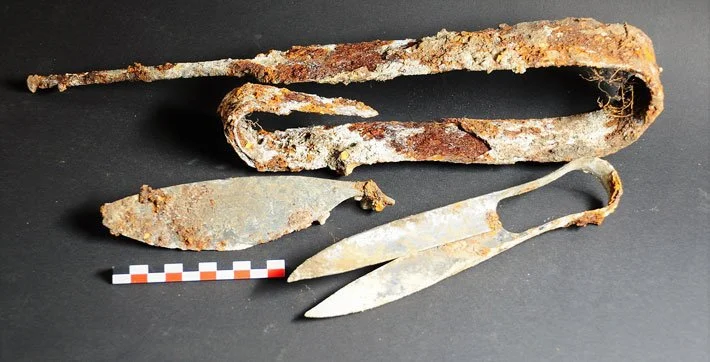
Several items have been found in a 2,300-year-old Celtic cremation tomb in Germany, including a folded sword that may have been used in combat, a five-inch pair of scissors, a piece of a shield, a razor, a fibula, a belt chain, and a spearhead.

The objects were found while looking for lost munitions from World War II. According to archaeologist Martina Pauli of the Bavarian State Office for the Preservation of Monuments, "the scissors in particular are in exceptional good condition." Such scissors might have been employed when shearing sheep or preparing leather.

The sword was around 30 inches long before it was heated and folded to make it useless, she claimed. Pauli came to the conclusion that while the fibula and belt chain may have belonged to a woman, the weapons may have belonged to a male warrior. Visit "Golden Lucky Charms" to learn more about the Celtic concave gold coins discovered in northeastern Germany.

Source: https://www.archaeology.org/news/11442-230...

The earliest cross ever discovered was uncovered in Peru among a temple's ruins

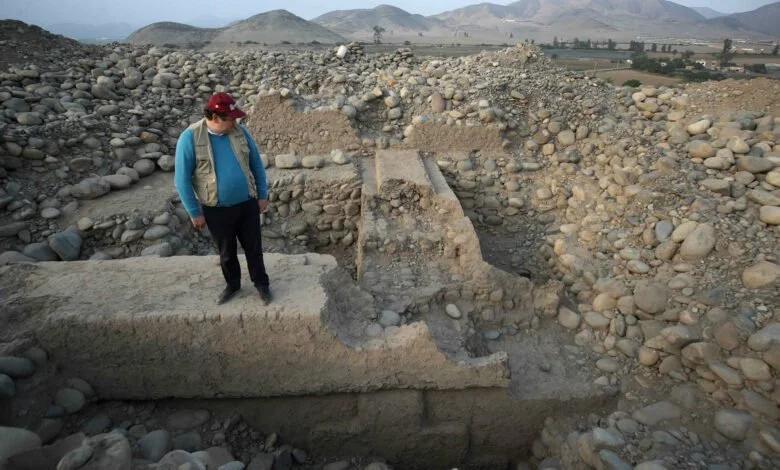
On the central coast of Peru, a group of archaeologists have found a roughly 4,000-year-old temple complex that may have the oldest "Chakana" (Andean cross) in all of South America carved into one of its friezes.

This U-shaped ceremonial structure, which is a component of the Miraflores archaeological site in the coastal province of Huaral, is situated 95 kilometers (60 miles) north of Lima in the lower Chancay River Valley.

The temple compound, which spans approximately 70 hectares (170 acres) and is made up of a pyramidal building and two elongated mounds that form a sizable ceremonial plaza in its middle, is now buried beneath masses of rocks and is surrounded by farmland.

The temple was most likely one of the largest, "if not the largest," of Peru's central coast and was most likely constructed during the Formative Period of pre-Columbian Peru (also known as the Initial Period and lasting from roughly 1,800 BCE to 900 BCE). The team of archaeologists was led by Dr. Pieter Van Dalen Luna of the National University of San Marcos.

According to Van Dalen, "We've found walls, corridors, staircases... elements of worship, artifacts used in funerary rituals, and very early style ceramics."

Most astonishingly, however, the team of archaeologists uncovered an enclosure in the upper and rear area of the main pyramid while working on excavations on a three-meter-high (10-foot-high) stone and adobe wall a few weeks ago.

Among its contents, they discovered a "geometrically shaped frieze (with a carving of an Andean Cross, which would be the oldest example of a complete Chakana found in the Andes," according to Van Dalen.

In both Incan and pre-Incan Andean societies, the Chakana is a repeating sign that has the appearance of a square, stepped, 12-cornered cross with a circular center.

The frieze has only been partially excavated by Miraflores archaeologists so far, but they anticipate finishing the cross. If true, it would be the oldest artifact ever discovered in Peru and the entire Andes.

Additionally, it's the first time a Chakana has been discovered at an archaeological site on Peru's central coast, demonstrating the reverence this sacred object received not only in southern Peru but also throughout the Andes, according to Van Dalen.

According to experts, this temple was used throughout the Formative Period as a ceremonial center for the worship of water. As a result, its structure was oriented toward the Chancay River's source and away from the Pacific Ocean's waters.

Invoking water and rain for agricultural output, individuals engaged in a number of religious acts at specific periods of the year, according to Van Dalen.

"The whole population" took part in the rites, contributing their "excess output for the sustenance of the priestly class" that ruled the valley and lived in various areas of the temple.

This religious complex was later abandoned and forgotten due to "social processes possibly driven by climate change or other factors," yet it was occassionally used by other pre-Inca societies, such as the Chancay of the Late Intermediate period (1000 CE - 1476 CE).

The Andean cross was preserved by the Chancay and other later pre-Columbian tribes in Peru, and it is being used as a symbol today.

Source: https://www.laprensalatina.com/andean-cros...

"A little mysterious" In Germany, a 1,050-year-old building was discovered. What is it?

What is today Germany was dominated by the mighty Ottonian dynasty approximately 1,000 years ago.

Excavations of the site took place during the summer of 2022 and in April and May of 2023, officials said. ROBERT PRUST Landesamt für Denkmalpflege und Archäologie Sachsen-Anhalt

The Ottonians, especially the powerful ones, originated from a territory that is currently a portion of the state of Saxony-Anhalt.

The dynasty oversaw the building of churches, monasteries, and castles throughout the area, many of which served as bases for itinerant kings and political leaders.

Now, through a series of excavation initiatives, archaeologists and specialists with the State Office for the Preservation of Monuments and Archeology in Saxony-Anhalt are attempting to discover more about the dynasty and its rule.

The excavations in the Altenburg of Großwangen were overseen by Felix Biermann, who told McClatchy News that one such expedition there yielded startling outcomes.

Part of the “unusual” mortar wall that was excavated. Felix Biermann Landesamt für Denkmalpflege und Archäologie Sachsen-Anhalt

'Rather Mysterious' Finding

Archaeologists discovered two eminent buildings at the location: an outer castle and a rectangular core castle. Experts claim that the ramparts and ditches that encircle the castles are remnants of Ottonian defences.

When specialists analyzed their findings, they were shocked to learn that the main castle was extraordinarily well-protected, according to Biermann.

Archaeologists discovered a significantly more intricate free-standing mortar wall dating back around 1,050 years, as opposed to comparable constructions reinforced with wood-and-earth ramparts capped by stone walls, according to Biermann. The most significant castles and complexes from the period contain the only other comparable buildings.

As a result, the Altenburg is unusual and rather enigmatic, according to Biermann. There is currently strong evidence that the Ottonian emperor's ambitious ambition to establish a new capital here was a failure.

The planned constructions may not have been the most significant for monarchs, but they could have provided security for a nearby, more significant castle.

Stone and clay domes were found at the site. Felix Biermann Landesamt für Denkmalpflege und Archäologie Sachsen-Anhalt

Powerful leaders are undoubtedly engaged in their building, according to experts.

The Altenburg was unquestionably a key component of Ottonian rule, according to Biermann. One of the Ottonian kings undoubtedly had grand ambitions for the Altenburg and Memleben dominion complex that were never realized.

Additional Medieval Artifacts Found

Archaeologists also unearthed a number of early Middle Ages relics in addition to the wall.

Numerous small homes, stone and clay dome ovens, ceramics, animal bones, knives, and lances were discovered, according to specialists.

Archaeologists unearthed pieces of Ottonian pottery at the site. Felix Biermann Landesamt für Denkmalpflege und Archäologie Sachsen-Anhalt

These discoveries, according to Biermann, were predicted. "We had preconceived notions about the anticipated results. On the basis of its structural characteristics, it was assumed that the Altenburg belonged to the early Middle Ages, he added. The enormous size and strength of the free-standing mortar wall, on the other hand, as well as the low level of use of the castle, which did not match this construction effort, came as a big surprise.

Berlin is located roughly 150 kilometers southwest of The Altenburg.

Source: https://www.bellinghamherald.com/news/nati...

The Most Expensive Artifacts and Antiques Ever Sold

Have you ever wondered what the most expensive artifacts and antiques in history are? From diamond-studded tiaras to ancient sculptures, some of these items are worth more than most of us could ever dream of. Join us as we explore the fascinating stories behind the ten most expensive artifacts and antiques ever sold.

In this video, we'll take a closer look at some of the most rare and valuable objects in the world, including the famous Pink Star diamond, the Qing Dynasty Jadeite Cabbage, and the Habsburg Tiara. We'll also explore the history and significance of each item, and discuss why they fetched such enormous prices at auction.