Africa is the second largest continent in the world, home to around 18% of the world’s population. So, if there’s a chance you’ll make any weird finds, there’s a good chance they’ll be in Africa. From mysterious elephant deaths to old rock art, here are 20 unsettling discoveries in Africa nobody can explain!
65 Sailors Eaten By Cannibals | The Boyd Massacre
This is the dark story of the HMS Boyd, a tale of cannibals and retribution. Sailing to New Zealand in 1809, Boyd's crew were attacked Māori cannibals in the worst act of violence against Europeans in New Zealand's history. Watch the video to find out more!
Why did it take so long for France to conquer Brittany? (Short Animated Documentary)
The small Duchy of Brittany sat on the north-west frontier of France for over six centuries. Despite France being much larger and much more powerful, its king never managed to conquer the Bretons and instead had to wait to marry into its ruling family. So why not? Why didn't France conquer Brittany in such a long period of time. To find out watch this short and simple animated history documentary.
Atlantis Has Finally Been Found On Ancient Roman Map
Is the lost city of Atlantis a myth, or is it real? The mystery of Atlantis has taken a new mysterious turn! Where was the lost city located? Has Atlantis been finally found on the Ancient Roman Map? Let’s find out!
In the dialogues Timaeus and Critias authored by Plato, there is a description of a mythical city called Atlantis. The search for the long-lost city of Atlantis has been ongoing for centuries with no definitive answer yet, but now we're getting closer to resolving this mystery due to some recent progress.
The Grand Canyon Discovery That Terrifies The Whole World
In today’s video we will be talking about a terrifying Grand Canyon discovery. Watch the video below and enjoy!
Have We Found Remains of Noah's Ark?
Last time on The Genesis Account of Noah’s Ark, we proved that the Earth's sediment explains the Flood's reality. The one thing we still have to find is the Ark itself. Why haven’t we found it yet?
How the Earliest Christians Worshipped (In their own words)
In this video, we examine writings of the early Christians from C. 50AD to C. 155 AD to ask: How did they worship? What were some of their practices? and How were their churches structured?
After a brief look at some of the New Testament books, we dive into non-biblical writings of other ancient Christians. I tried to let these ancient authors speak for themselves as much as possible, to tell us what they were like, in their own words.
How An Ancient Civilisation Moved the World's Biggest Stones
Discover the secrets of the Trilithons of Baalbek, the massive stone structures in Lebanon that have puzzled experts for centuries. In this video, we explore the conventional theories of transportation and placement, as well as the more unconventional theories of levitation and sound waves. Learn about the architectural and engineering feats of constructing the Trilithons and the potential use as an astronomical observatory. Join us on this journey to uncover the mysteries of the Trilithons and the advanced technology of the ancient peoples.
The Big Story: Origins of Religion
The origins of religion can be traced back to the Paleolithic era, a period that marks the earliest known development of human culture. This era, characterized by the use of stone tools and the emergence of the first recognizable forms of human society, saw the beginnings of religious thought and practice. The study of these origins often involves a blend of archaeological evidence, anthropological theory, and comparative mythology.
During the Paleolithic era, the concept of religion was vastly different from organized religions seen in later periods. Early religious practices were deeply intertwined with the daily struggle for survival and the mysteries of the natural world. The spiritual beliefs of these early humans were likely animistic, a worldview where animals, plants, and inanimate objects all possessed spiritual essence or a soul. This belief is evident in the cave paintings found in various parts of the world, such as in Lascaux, France, and Altamira, Spain. These paintings, which often depict animals and hunting scenes, suggest a reverence for the natural world and possibly a belief in totemic spirits or deities.
Shamanism, another feature of early religious practice, involved community members entering trance states to communicate with the spirit world, often for purposes such as healing, divination, and guidance in hunting. Shamans, viewed as intermediaries between the physical and spiritual realms, played a crucial role in the religious life of their communities.
The Paleolithic era also witnessed the emergence of burial practices, which suggest a belief in an afterlife or a spirit world. The deliberate burial of the dead, often with grave goods, indicates an early form of ancestor worship or a belief that the dead required items for their journey in the afterlife. This practice reflects a significant development in religious thought, as it implies an awareness of mortality and a belief in some form of existence beyond death.
The concept of a "Mother Goddess" or a fertility deity has also been proposed by some scholars as a central figure in Paleolithic religion. This theory, while debated, is based on the discovery of various female figurines, such as the Venus of Willendorf, which is thought to represent fertility, motherhood, or a goddess figure.
As humanity transitioned into the Neolithic era, with the development of agriculture and more settled lifestyles, these early animistic and shamanistic practices gradually evolved. The reliance on agriculture likely influenced the rise of earth and fertility deities, as well as the development of more structured forms of religious worship.
In essence, the origins of religion in the Paleolithic era represent humanity's earliest attempts to understand and explain the world around them. These early beliefs and practices laid the foundation for the complex tapestry of religious thought that would develop in later periods, reflecting the evolution of human culture and cognition.
What Does the Bible Say About the Ice Age?
In this video, Stephen Leavelle reveals what the Bible says about the ice age while responding to a handful of the most thought-provoking comments he received on his last presentation. Enjoy!
History Of Every Ancient Empire In History (we guess)
In the following video we will be going through the history of every ancient empire in History. Watch the video for more!
Just Happened: Graham Hancock Reveals The “lost cities” of the Amazon
Graham Hancock, who studies and writes about old societies, like the one in the Amazon, says that around 20 million people lived in the Amazonian civilization. Watch the video below for more!
Visiting the Tribe that Eats Humans (Papua Island)
Papua Island is a wild place, to say the least. In many ways, it's considered 'the last frontier' in terms of off-the-beaten-path places on earth. It's the last known place on earth to have this kind of bizarre culture and tradition. Watch the video below to find out more about last humans who eat other humans!
Facts About Neck Elongation
Why would you undergo neck elongation? This procedure, which works to stretch out the neck, causes pain and takes a lot of dedication. It's natural to wonder why anyone would go through the process. But look closer, and you'll realize that how neck elongation is perceived varies widely from person to person. Some cultures have a rich history of neck elongation practices. In many cases, the reasons why people elongate their necks are related to tradition.
It's Finally Happening: Africa Is Splitting Into Two Continents
Brace yourselves for an awe-inspiring geological phenomenon that is reshaping the face of Africa as we know it! Join us on an extraordinary journey as we witness the unprecedented event of Africa splitting into two distinct continents.
In this captivating video, we delve deep into the geological forces at work that are gradually tearing Africa apart. Explore the vast expanse of the East African Rift System, a sprawling tectonic boundary that stretches over thousands of kilometers, signaling the emergence of a new continent.
Our expert geologists provide a comprehensive overview of the fascinating processes behind this monumental event. Uncover the geological forces that have been at play for millions of years, leading to the current rupture. Discover how the movement of tectonic plates beneath the Earth's surface has set the stage for this monumental separation.
Through stunning visuals and satellite imagery, we witness the dramatic landscapes that bear witness to this phenomenon. From the breathtaking cliffs and escarpments to the expansive lakes and valleys, this ever-evolving rift showcases the sheer power and beauty of our planet.
Furthermore, we explore the implications of this continental division for Africa's diverse ecosystems and its inhabitants. Discover how this event shapes the future of the region, from the changing landscapes to the potential formation of new oceans and water bodies.
Prepare to be astounded by the impacts on local communities, culture, and wildlife as we examine the challenges and opportunities presented by this seismic shift. Gain insights into ongoing scientific research and the efforts made to monitor and understand the transformation.
Join us on this incredible expedition to witness a geological event of epic proportions, as Africa undergoes a historic transformation.
Archaeologists Have Discovered The Oldest Human Fossil Ever Found Outside Africa
Nowadays scientists are able to learn more about our species through fossils, and their knowledge is constantly expanding. Recently archaeologists have discovered the oldest human fossil ever found outside Africa. Watch the video below!
Genetics of the Greeks: European or Middle Eastern?
Just who exactly are the Greeks and what is their genetic makeup? Today we will be discussing a brief history and genetics of the Greek people, one of the most influential groups of people, not only in the West, but nearly the entire world.
Giant Ancient Monkey That Destroyed Dinosaurs
In today’s video we will be talking about the giant ancient monkey that destroyed dinosaurs. Watch the video to find out more!
Timeline of the Rulers of Germany
In the video below we will go through all the rulers from East Francia, the Holy Roman Empire of German Nations, the German Confederation, the German Empire to the Federal Republic of Germany today. Enjoy!
Buried Treasure: 840 Iron Age gold coins in the Wickham Market Hoard in England
The Wickham Market Treasure Trove is a trove of 840 Iron Age gold staters discovered in March 2008 by auto technician Michael Dark using a metal detector in a field on Dallinghoo near Wickham Market, Suffolk, England. 825 coins were discovered at the site during excavation, and 840 coins had been discovered by the time the treasure trove was officially recognized as a treasure trove. The coins were made between 40 B.C. and 15 A.D.
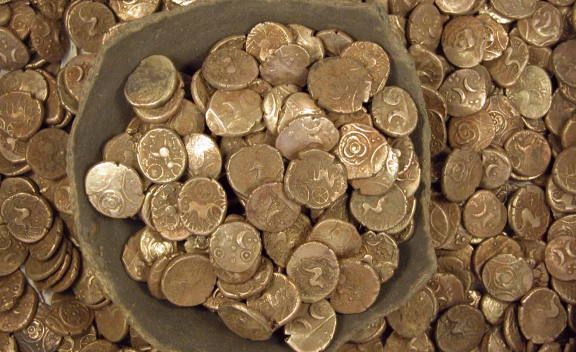
The hoard of gold coins from the British Iron Age has been called "the largest hoard of British Iron Age gold coins to be fully studied," and it was significant in shedding light on "a great deal of new information about the Iron Age, and especially about East Anglia at the end of the Iron Age." Since the Waddon-Chase Iron Age burial in 1849, this was the greatest cache of staters discovered.
The trove was purchased by the Ipswich Museum for £316,000 in June 2011.
After 25 years of looking for metals in the fields around Wickham Market, a sixty-year-old auto technician named Michael Darke, who at first requested anonymity, discovered his first gold coin on March 16, 2008. Through the use of the Internet, Darke determined the coin to be a Freckenham stater, so named from the trove in which the typeface was first discovered in 1885.
Darke discovered eight more gold staters a week later, despite the snowfall from his earlier visit to the field and working in the wet snow. He continued to look, and after a while he said that his metal detector "suddenly went crazy" and that he "knew for a fact that he was standing right on a jug of gold."
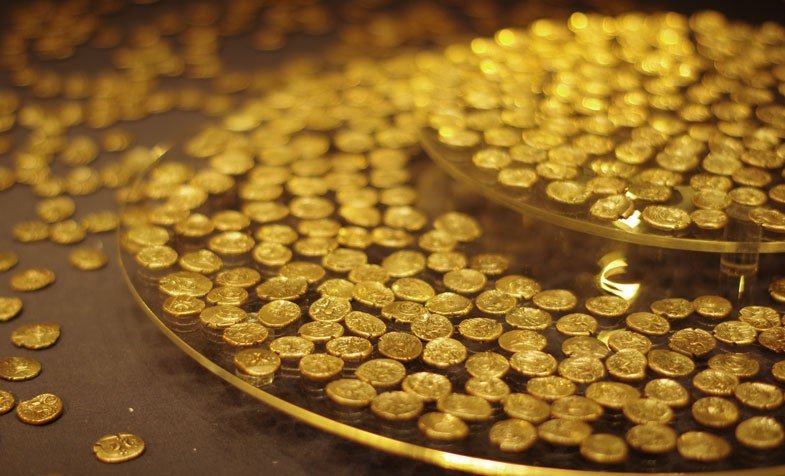
He placed stones to mark the location and then made the decision to wait until the following night to retrieve the coins. He gave the justification that the coins had "waited two thousand years for me to find them, so they can wait another night for me." He unearthed another 774 coins with a shovel.
The soil in the field was clay-like and hadn't been plowed since 1980, but prior agricultural operations had spread the coins over a 5–10 m (16–33 ft) area when the top of the black clay pot in which they were buried cracked. The majority of the coins were discovered 6-8 inches (15-20 cm) underneath, but some were still inside the broken pot.
Darke delivered the landowner the coins after washing them in warm water, and the landowner then informed the Suffolk County Council Archaeological Service about the discovery.
Since 450 to 800 and 2,000 Iron Age gold staters were discovered by an agricultural worker in a field on the Waddon Chase near Milton Keynes in 1849, the treasure had the most Iron Age gold staters ever discovered.
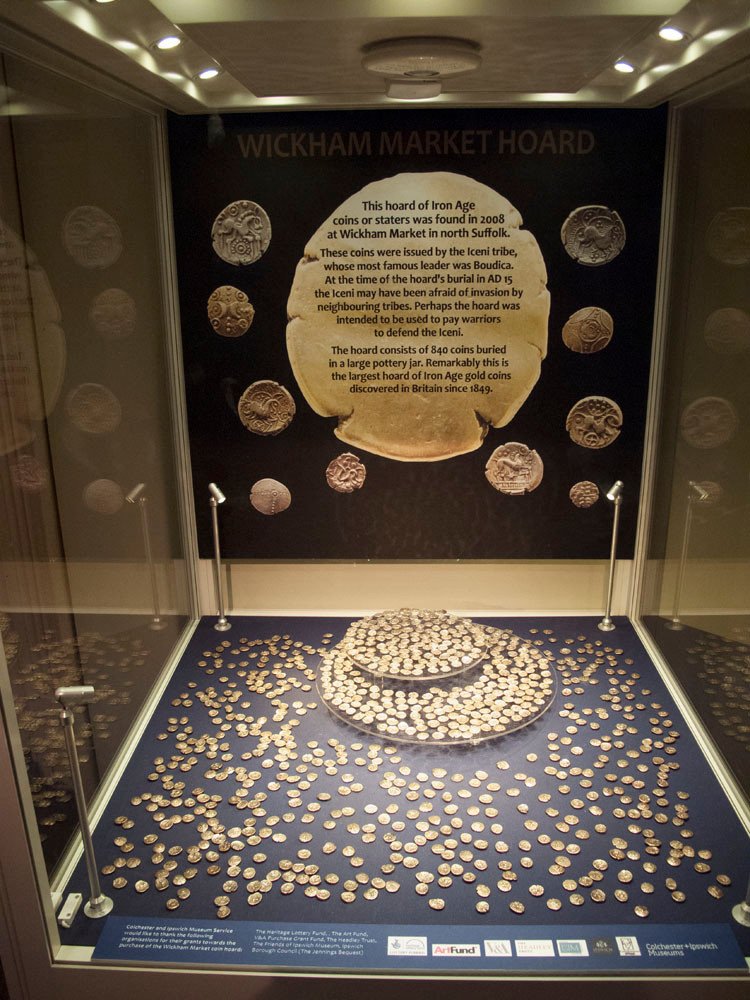
Although the reason for the wealth's burial is unknown, there are a number of possibilities. One of the beliefs holds that the treasure was a vow treasure or common treasure that was "collected and buried for the good of the community," either as a war chest in case of an imminent threat or as payment of tribute to ward off an invasion.
"The discovery is important because it underscores the likely political, economic, and religious importance of the area," according to Jude Pluviez of Suffolk County Council's Archaeological Service. This specific find also provided "much new information about the Iron Age, and especially about East Anglia in the late Iron Age."
This is the largest collection of British Iron Age gold coins to have been thoroughly investigated, according to Ian Lanes, the British Museum's then-Iron Age coin curator.