Are you ready to explore with us some mysterious and bizarre discoveries? Watch the video for more and enjoy!
Scientists Finally Uncovered The Book Of Thoth Under The Nile In Egypt That Revealed This Knowledge
In the video below we will explore the knowledge revealed by the Book of Thoth, which was uncovered by scientists under the Nile in Egypt. Enjoy!
The Biggest Secrets Of The Ancient World
In this video we will be discussing the biggest secrets of the Ancient World. Enjoy!
What Lives At The Bottom Of The Mariana Trench?
Do you ever wonder what lives at the bottom of the mariana trench? This top 10 list of creepy deep sea monsters has some giant and bizarre creatures that are scary and mysterious!
8 Unreal Creatures Explained!
Check out these 8 unreal creatures explained! This top 10 list of mysterious unbelievable animals sometimes caught on camera don't actually exist and this video explains their origins!
Mysterious Discoveries From India!
Check out the most mysterious discoveries from india! These bizarre ancient findings feature some unbelievable unexplained mysteries discovered during indian archaeology!
Amazing Extinct Animals You Probably Never Heard Of!
Check out these Amazing EXTINCT Animals You Probably Never Heard Of! From giant turtles to unicorns, this top 10 list of mysterious creatures forced into extinction has some of the biggest animals that ever lived!
10 Most Incredible Recent Archaeological Discoveries
From a long lost water cult to temples that have been hidden under river sand for years, here are 9 incredible recent archaeological discoveries. Enjoy!
No One Knows: Do You Know Who Built These Structures?
There are several mysterious structures that have been discovered or uncovered in various parts of the world and beyond. Watch the video to find out more and enjoy!
Dramatic new discoveries in the ancient Egytptian burial ground
Twenty miles south of Cairo, on the Nile's west bank, where riverfed crop fields give way to desert, the ancient site of Saqqara is marked by crumbling pyramids that emerge from the sand like dragon's teeth. Most striking is the famous Step Pyramid, built in the 27th century B.C. by Djoser, the Old Kingdom pharaoh who launched the tradition of constructing pyramids as monumental royal tombs. More than a dozen other pyramids are scattered along the five-mile strip of land, which is also dotted with the remains of temples, tombs and walkways that, together, span the entire history of ancient Egypt. But beneath the ground is far more—a vast and extraordinary netherworld of treasures.

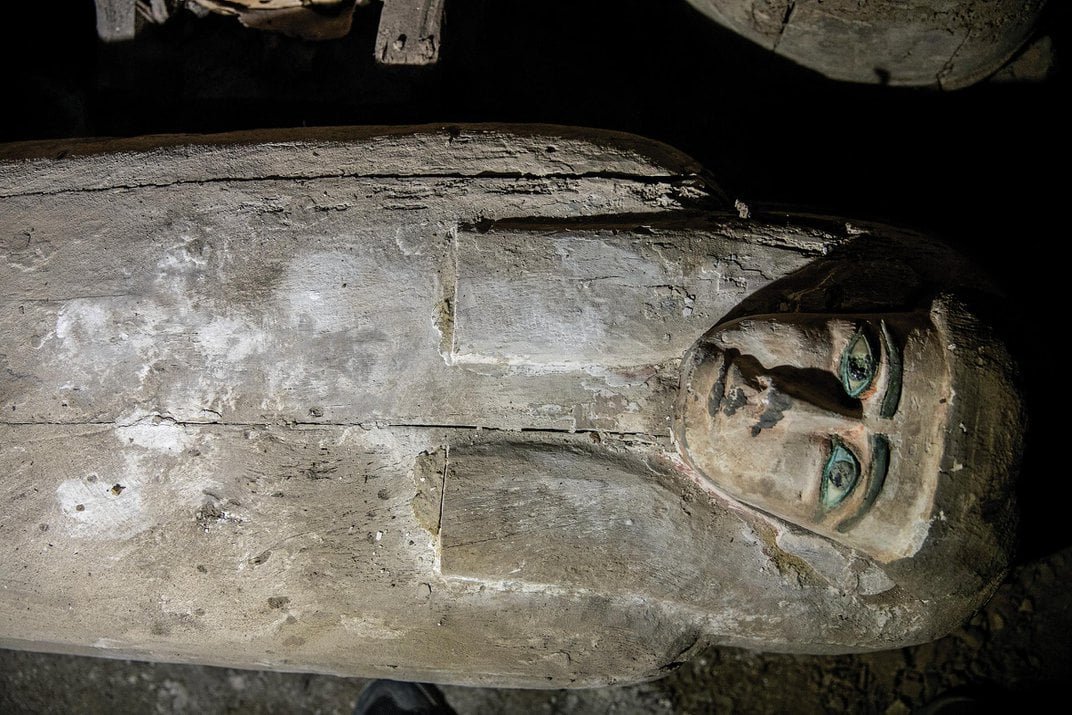
One scorching day last fall, Mohammad Youssef, an archaeologist, clung to a rope inside a shaft that had been closed for more than 2,000 years. At the bottom, he shined his flashlight through a gap in the limestone wall and was greeted by a god’s gleaming eyes: a small, painted statue of the composite funerary deity Ptah-Sokar-Osiris, with a golden face and plumed crown. It was Youssef’s first glimpse of a large chamber that was guarded by a heap of figurines, carved wooden chests and piles of blackened linen. Inside, Youssef and his colleagues found signs that the people buried here had wealth and privilege: gilded masks, a finely carved falcon and a painted scarab beetle rolling the sun across the sky. Yet this was no luxurious family tomb, as might have been expected. Instead, the archaeologists were astonished to discover dozens of expensive coffins jammed together, piled to the ceiling as if in a warehouse. Beautifully painted, human-shaped boxes were stacked roughly on top of heavy limestone sarcophagi. Gilded coffins were packed into niches around the walls. The floor itself was covered in rags and bones.
This eerie chamber is one of several “megatombs,” as the archaeologists describe them, discovered last year at Saqqara, the sprawling necropolis that once served the nearby Egyptian capital of Memphis. The excavators overseen by Youssef uncovered hundreds of coffins, mummies and grave goods, including carved statues and mummified cats, packed into several shafts, all untouched since antiquity. The trove includes many individual works of art, from the gilded portrait mask of a sixth- or seventh-century B.C. noblewoman to a bronze figure of the god Nefertem inlaid with precious gems. The scale of discoveries—captured in the Smithsonian Channel documentary series “Tomb Hunters,” an advance copy of which was made available to me—has excited archaeologists. They say it opens a window into a period late in ancient Egyptian history when Saqqara was at the center of a national revival in pharaonic culture and attracted visitors from across the known world. The site is full of contradictions, entwining past and future, spirituality and economics. It was a hive of ritual and magic that arguably couldn’t seem more distant from our modern world. Yet it nurtured ideas so powerful they still shape our lives today.

Travelers visiting Egypt have long marveled at the vestiges of the pharaohs’ lost world—the great pyramids, ancient temples and mysterious writings carved into stone. But Egyptology, the formal study of ancient Egyptian civilization, didn’t begin in earnest until Napoleon Bonaparte invaded at the turn of the 19th century and French scholars collected detailed records of ancient sites and scoured the country for antiquities. When Jean-François Champollion deciphered hieroglyphs, in the 1820s, the history of one of humanity’s great civilizations could finally be read, and European scholars and enthusiasts flocked to see not only the pyramids at Giza but also the colossal Ramses II statues carved into the cliffs at Abu Simbel and the royal tombs in Luxor’s Valley of the Kings.
Apart from its eroding pyramids, Saqqara was known, by contrast, for its subterranean caverns, which locals raided for mummies to use as fertilizer and tourists ransacked for souvenirs. Looters carted off not only mummified people but also mummified animals—hawks, ibises, baboons. Saqqara didn’t attract much archaeological attention until the French Egyptologist Auguste Mariette, who became the first director of Egypt’s Antiquities Service, visited in 1850. He declared the site “a spectacle of utter devastation,” with yawning pits and dismantled brick walls where the sand was mixed with mummy wrappings and bones. But he also noticed the half-buried statue of a sphinx, and probing further he found a sphinx-lined avenue leading to a temple called the Serapeum. Beneath the temple were tunnels that held the coffins of Apis bulls, worshiped as incarnations of Ptah and Osiris.

Since then, excavations have revealed a history of burials and cult ceremonies spanning more than 3,000 years, from Egypt’s earliest pharaohs to its dying breaths in the Roman era. Yet Saqqara has remained overshadowed by the glamour of Luxor to the south, where in the second millennium B.C. pharaohs covered the walls of their tombs with depictions of the afterlife, and the Great Pyramids just miles to the north.
It certainly took a while for Mostafa Waziri, the archaeologist directing the latest project, to be converted to Saqqara’s charms. He spent most of his career excavating in Luxor, but in 2017 he was appointed director of Egypt’s Supreme Council of Antiquities (making him, among other things, a successor to Mariette). The new job entailed a move to Cairo. Continuing to dig in southern Egypt was therefore no longer practical, he says, but on his doorstep was another great opportunity: “I realized it was less than one hour from my office to Saqqara!”
Working with an Egyptian team, including Youssef, the site director, Waziri chose to excavate near a mysterious temple called the Bubasteion, dedicated to the cat goddess Bastet, that had been cut into limestone cliffs near the site’s eastern boundary around 600 B.C. A group of French archaeologists had worked nearby for decades, where they found, among other discoveries, the 14th-century B.C. tomb of King Tutankhamen’s wet nurse, Maia. But Waziri targeted an area that the French team had used to pile the debris from their excavations, calculating that whatever lay beneath it had remained untouched.
His approach paid off. In December 2018, Waziri announced the discovery of a 4,400-year-old tomb, intact and ornately carved, that belonged to a high-ranking priest named Wahtye. The next season yielded intriguing caches of animal mummies—not just cats but a cobra, a lion cub, a mongoose and even a scarab beetle. Then, in September 2020, the team unearthed a vertical shaft dug 30 feet down into the bedrock, the first of the “megatombs.” In separate niches at the bottom were two giant coffins, and when the archaeologists cleared the surrounding debris they found dozens more. “I had to call the [antiquities] minister,” says Waziri. “He asked me, ‘How many?’” Eight months later, Waziri is still counting.
In a simple conservation lab set up at the site, Youssef and his colleagues admired the first coffin to be removed from the shaft. Sealed with black resin, it was roughly human-shaped but huge and squat—more than 7.5 feet long and 3 feet wide—with a wide, impassive face. Removing the intricately carved wooden lid revealed a glint of gold: A second coffin was nested inside, complete with gilded mask. Beautifully preserved, it showed the face of a woman with large, kohl-lined eyes. The rest of the inner coffin was intricately painted in blue, green and red, and included flower and leaf motifs and a depiction of the sky goddess, Nut, with outstretched wings. Most exciting, though, were the hieroglyphs, because they provided valuable information about the occupant: not just spells to aid her journey to the afterlife but details of her family, as well as her name: Ta-Gemi-En-Aset.
These details and the distinctive style of the coffin indicate that she lived during the sixth or seventh century B.C., at the start of Egypt’s Late Period, when a pharaoh named Psamtik I reunified the country after a period of instability and foreign invasions. Egypt was strong and prosperous once again, a global power alongside Babylon and Persia. Psamtik also revived the powerful city of Memphis, then home to around two million people, and nearby Saqqara to hold its dead. According to Campbell Price, curator of Egypt and Sudan at the Manchester Museum in England, the name Ta-Gemi-En-Aset means “she who was found by Isis.” The coffin inscriptions describe her mother as a singer, and include a symbol representing a sistrum, a musical rattle used in temples. Price suggests that Ta-Gemi may have belonged to the cult of Isis, and perhaps played a role in rituals and festivals in a nearby temple devoted to the goddess.
The second coffin retrieved from the shaft was similar to Ta-Gemi’s, and it also contained an inner coffin with a gilded mask. This time, the portrait mask showed a bearded man named Psamtik (probably in honor of one of several pharaohs of this period who shared the name). At first, the team wondered whether Ta-Gemi and Psamtik were related. The hieroglyphs revealed that their fathers had the same name: Horus. But their mothers’ names were different, and further discoveries revealed a different picture.

The team dug deeper, a painfully slow process that involved the help of local laborers, who scooped out the sand by hand and hauled basketsful of debris to the surface using a traditional wooden winch called a tambora, the design of which hasn’t changed in centuries. Below Psamtik’s burial niche was a room filled with many additional coffins, covered in rubble and damaged by ancient rockfalls. The bottom of the shaft led to a second, even bigger cavern, inside of which were jammed more than a hundred coffins of different styles and sizes. There were also loose grave goods, including ushabtis, miniature figures intended as servants in the afterlife, and hundreds of Ptah-Sokar-Osiris statuettes. There were even coffins buried in the base of the shaft itself, as if whoever put them there was running out of space. The result was a megatomb described by the research team as the largest concentration of coffins ever unearthed in Egypt.
Great collections of mummies and coffins have been found before, but never grouped so densely together. This was mass burial on an astonishing scale, and it shines a light on Egyptian culture at a moment of transition. In the Old Kingdom, in the third millennium B.C.—Djoser’s time—the elites appear to have favored private family spaces such as the priest Wahtye’s rock-cut tomb, which included an ornate, above-ground chapel for visitors lined with painted reliefs, inscriptions and statues of Wahtye himself. Burial shafts dug into the floor of such tombs were dedicated to particular family members. By the Late Period, some 2,000 years later, well-to-do Egyptians such as Ta-Gemi and Psamtik were packed into tight, shared spaces like cheap crates. Why did people who could clearly afford expensive coffins settle for such a crowded resting place?
According to Aidan Dodson, an Egyptologist at the University of Bristol, in England, they did so in part because by then the practice was simply routine. Shared tombs became popular across Egypt around 1000 B.C., driven by economic necessity as the kingdom faced a period of instability and collapse. When Psamtik I restored order in the seventh century B.C., the practice stuck. “We know that from the Late Period, that’s how burials are done,” Dodson says.
Campbell Price, of the Manchester Museum, adds that the answer also has to do with Saqqara’s pyramids. The necropolis had always been a center for religious cults, from the time high-ranking Egyptians were first buried there, often in low, flat-roofed tombs called mastabas, and probably long before. To help bring the country together after turbulent times, Psamtik encouraged a revival of traditional rituals and belief; after a long period as a backwater, Saqqara exploded again in popularity. Far more than a local cemetery, says Price, it became a pilgrimage site, “like an ancient Mecca or Lourdes,” attracting visitors not just from Egypt but from all over the eastern Mediterranean. Buildings such as the Step Pyramid were already thousands of years old at this time, and people believed their creators, such as Djoser and his architect Imhotep, were gods themselves. Cults and temples sprang up. Pilgrims would bring offerings, and they vied for burial spaces for themselves and their families near the ancient, sacred tombs. “Saqqara would have been the place to be seen dead in,” says Price. “It had this numinous, divine energy that would help you get into the afterlife.”
That created conditions for a thriving commercial operation entwined with the spiritual one, resulting in a kind of real estate market for the dead. “It’s a business,” says Dodson. There was probably a sliding scale of options available. Senior officials and military officers were interred in large tombs near the Old Kingdom pyramids of Unas and Userkaf, for example, while the poorest in society were probably buried “in the desert in a sheet.” But the wealthy middle classes appear to have opted for a shared shaft, perhaps with a private niche if they could afford it, or were simply piled with others on the floor. If you wanted to be close to the magical energy of Saqqara’s gods and festivals, Dodson says, “you bought yourself a space in a shaft.”
The supersized burials unearthed by Waziri’s archaeology team reveal how intense the desire for particular locations became—and how profitable they were. Instead of digging new tombs, the priests in charge of burials reused older shafts, expanding them and, Price and Dodson suggest, cramming in as many coffins as they could. The cliffs of the Bubasteion, overlooking the landscape and close to the main processional route, may have been one of the most sought-after spots of all.
On October 2020, the archaeologists found a new shaft beneath the ruins of the Bubasteion—the chaotic, painted chamber illuminated by Youssef’s flashlight. It was another megatomb, bursting with some of the finest coffins and mummies yet discovered, as well as grave goods including a falcon-topped wooden box (possibly a canopic chest, used to store internal organs removed during mummification) and numerous painted Ptah-Sokar-Osiris statues, one of which contained seeds, a symbol of rebirth.
Many of the burials date later than the other finds at Saqqara, to the era of Greek rule in Egypt following the Late Period, after Ptolemy, one of Alexander the Great’s top generals, founded a new dynasty of pharaohs in 305 B.C. With the Ptolemaic pharaohs came strong Greek cultural influences, particularly at the Mediterranean capital of Alexandria, home to some of the finest scholars of the Hellenistic world, such as the mathematician Euclid and the physician-anatomist Herophilus. Hundreds of thousands of migrants from across the Greek world settled elsewhere in Egypt, and many were awarded plots of land. Public life was Greek-run, but in private life, including religious worship, there was considerable freedom, and many of the new arrivals appear to have adopted Egyptian beliefs and customs, including mummification. As time went on, says Dodson, “more people who self-identified as Greeks were being buried according to Egyptian customs.” Saqqara was as busy as ever, and the new discoveries suggest the priests were still squeezing as many bodies as possible into the shafts.
In a nearby shaft, the team unearthed cat mummies along with human remains. Previous excavations had discovered a huge cat necropolis at the Bubasteion, where the animals, sacred to the feline goddess Bastet, were embalmed and left as offerings. It was one of many local animal cults. Just north of the Bubasteion is the Anubieion, a temple complex dedicated to the jackal-headed god of death, Anubis, where mazelike tunnels are estimated to have held millions of mummified dogs. Beyond that are catacombs once filled with mummified ibises, hawks and baboons. To the west is the Serapeum, where Apis bulls were laid to rest.
These cults always existed at Saqqara. Their roots stretch back to predynastic times, and they thrived especially in the Late Period, during the renaissance inaugurated by Psamtik, perhaps because they were seen as archetypally Egyptian, says Salima Ikram, an Egyptologist based at the American University in Cairo—a symbol of national identity when foreign influence was an ever-present threat. But they became even more popular under the Greeks, with millions of animals bred to order, presumably on nearby farms, and often sacrificed shortly after birth. Waziri and his colleagues found animal mummies of varying qualities, which were probably priced accordingly. X-rays reveal that some “mummies” have no cat remains inside at all. And the mix with human bones suggests that if priests ran out of space in the dedicated animal catacombs, they simply commandeered older human tombs. The animal cults, in other words, became an ever more significant economic and spiritual force, helping to drive Saqqara’s final flourish. Or as Price puts it: “Saqqara was like an enormous, divine magnet or battery, powered by all these animal mummies.”
To the Greeks, part of the appeal of such Egyptian customs may have been the ease of making a personal plea to the gods, by visiting a stall selling mummified animals and choosing from a range of prepared products on offer. And the reward would likewise have been appealing: the promise, unique to Egyptian theology at that time, of an eternal afterlife of splendor. By contrast, “Greek ideas for the afterlife were pretty dull,” says Price. In classic Greek literature, for example, the dead were mere shadows inhabiting a dark underworld. The Babylonian and Jewish traditions had very exclusive notions of heaven; eternal life was reserved for the gods. But Egyptian texts covering the walls inside the Saqqara pyramids describe the king’s soul rising up after death to join the sun in the sky. By around 2000 B.C., resurrection spells were written onto coffins directly, enabling even ordinary citizens such as Ta-Gemi to make the journey to idyllic, golden fields. Although the details of the afterlife changed over time, the most desirable postmortem destination during the Ptolemaic period was the “Field of Reeds,” an agricultural paradise with unfailing harvests and eternal spring.
After Cleopatra ended her life in 30 B.C., bringing the Ptolemaic era to an end, Rome ruled Egypt. Whereas the Greeks had integrated into Egyptian culture, the Romans remade it, imposing their laws and administrative systems and, in time, their newly adopted Christian faith. At Saqqara, the last Egyptian mummies date to the third century A.D. Despite the cultural triumph of Rome, however, some Egyptian iconography lives on in Christian narratives. Many scholars have noted similarities between Egyptian and Christian religious symbolism, for example in stories of the goddess Isis and her son Horus and the Virgin Mary and her son Jesus. “A lot of the iconography in Christianity is derived from ancient Egypt,” says Ikram, of the American University in Cairo.
Which is not to say that these images were necessarily appropriated directly; rather, in antiquity these influences ran in many directions. The historian Diarmaid MacCulloch, of Oxford, notes that Christian ideas of the afterlife in particular drew heavily on Greek belief, which by then had developed a “vocabulary” for concepts such as Plato’s notion that the human soul “might reflect a divine force beyond itself.” Plato, for his part, was influenced by Pythagoras, who is thought to have studied in Egypt in the sixth century B.C. “By the time Christians were beginning to construct their own literature,” MacCulloch writes in Christianity: The First Three Thousand Years, “their writers clearly found such talk of the individual soul and of resurrection completely natural.”
Today, the pace of discoveries at Saqqara remains high. “We found something last Saturday,” Waziri said recently, buzzing from excitement. “But I can’t tell you about it yet.” Salima Ikram is working with Japanese archaeologists just north of the Bubasteion, where some coffins appear to have been deposited directly in the sand. The archaeologist Zahi Hawass recently reported finding a temple belonging to a previously unknown wife of the Old Kingdom pharaoh Teti. A group working near Unas’ pyramid found a Late Period mummification workshop, complete with embalmer’s platform, incense burner and rock-cut channels to drain the blood. Waziri hopes to discover workshops where the wooden coffins were made. “What we found in the last three years,” he says, “is not even 10 percent of what we will find.”
Egyptologists, meanwhile, are eager to study the hundreds of new mummies and coffins. “The interesting thing would be to try to map these people onto the landscape,” says Price. He has previously used geophysical techniques to probe below the ground at Saqqara, which revealed the remains of numerous temples lining the processional route to the Serapeum, but this approach can’t yield texts or names to identify which gods were worshiped at these sites. Now we can add the “social layer,” he hopes, to discover who the people working in these temples were and what they believed. Ikram says the coffin inscriptions might identify relationships between individuals, perhaps revealing if families were buried together or with people of similar occupations.
Already, though, the recent discoveries are helping to redefine this necropolis not as a silent graveyard but as a vibrant economic and spiritual center, filled with temples, embalming houses, stalls and workshops. There were offerings and burials to suit all budgets, profit squeezed out of every encounter, and above all, the fierce determination to defy earthly mortality and survive forever. The secret of Saqqara, then, wasn’t death. It was life.
Skeletons Found Under a Florida Wine Shop May Be Some of America’s First Colonists.
In the last few weeks, archaeologists digging under the floor of a wine shop in St. Augustine, Florida, have discovered the skeletal remains of seven people, including three children, believed to be some of the earliest colonists in North America, report Jessica Clark and Melissa Guz at FirstCoast News.

According to FirstCoast, last October hurricane Matthew damaged a wine shop on St. Augustine’s plaza. After the hurricane, building owner David White decided to renovate the space. According to a press release from the city, the floor of the building was built on a joist system constructed in 1888, which left the soil below relatively intact. White offered the city archeologist Carl Hibert a chance to take a peek under the floor before the repairs began.
Hibert accepted the offer, but did not have high hopes of finding anything. He was wrong—after just a few shovelfuls of dirt, he found human remains.
During the first week of digging in February, archeologists first discovered an intact adult skeleton and an adult skull nearby. According to Susan Parker at The St. Augustine Register, the bodies have been preliminarily identified as a relatively young white European woman and a man of African ancestry. Outside of the wine shop, they found a leg bone and another skull from two other graves. Last week, they discovered the remains of the children.
Though the remains have not been fully analyzed, a bioarcheologist believes the children were all under 7 years old. All of the human remains were found in a 6-by-12-foot area, reports Clark.
Pottery fragments found with the skeletons date the burials between 1572 and 1586, a few years after St. Augustine, known as America’s oldest city, was founded.
There are indications that there may be other remains in the same area.
The History Blog reports that Hibert believes the burials may come from the floor of the Church of Nuestra Señora de la Remedios, the parish church built in St. Augustine soon after the colony was established by conquistador Pedro Menendez de Aviles in 1565, 42 years before the Jamestown Colony was established by the English and 55 years before the Pilgrims arrived in Massachusetts.
The church was burned down in a raid by British privateer Sir Francis Drake in 1586. The rebuilt church burned again during a hurricane in 1599 and was destroyed for good when the British torched the structure in 1702.
The exact location of the church, however, was not discovered until 2010, reports Marcia Lane at St. Augustine.com. During construction on Aviles Street in the city’s historic downtown, Halbirt discovered a trench and a wall that marked the rear of the church. The digging also uncovered some human bones that the researcher believes may have been the bodies of priests.

It’s believed that the footprint of the church extended all the way to the present day wine shop, and the bodies were likely buried under the church floor, a standard practice for Catholics at the time. “The mission churches across Florida buried everybody in the church floor,” Ellsbeth “Buff” Gordon, an architectural historian, tells Clark and Guz. “It was consecrated ground, of course.”
“What you’re dealing with is people who made St. Augustine what it is,” Halbirt tells Clark and Guz. “You’re in total awe. You want to treat everything with respect and we are.”
The skeletons found inside the wine shop will remain where they are, though the bones collected from outside the shop will be removed to a nearby Catholic cemetery to make way for a city water line.
Rabbit Hole Leads To A Secret 700-Year-Old Cave Network Built By Knights Templar
An apparently ordinary rabbit's hole in a farmer's field leads to an underground sanctuary said to have been used by devotees of a medieval religious order - but is everything what it seems?


According to local legend, the Caynton Caves, near Shifnal, in Shropshire, were used by followers of the Knights Templar in the 17th Century.
Located less than a metre underground, they appear to be untouched structurally.
Their original purpose is shrouded in mystery, but Historic England, which describes the caves as a "grotto", believes they were probably built in the late 18th or early 19th Century - hundreds of years after the Templar order was dissolved.

In its report, it said the caves appear to be used for "black magic rites" by modern-day visitors.
Michael Scott, from Birmingham, went to photograph the caves after seeing a video of them online.
He said: "I traipsed over a field to find it, but if you didn't know it was there you would just walk right past it. Considering how long it's been there it's in amazing condition, it's like an underground temple."
The tunnel leads to a network of walkways and arches carved out of sandstone, as well as a font.

Mr Scott said the cave was "quite cramped" and those nearing 6ft (1.8m) tall would have to bend down to fit in. Some chambers are so small that those exploring have to enter them on hands and knees.
"I had to crouch down and once I was in it was completely silent. There were a few spiders in there but that was it. It was raining so the slope down was quite sludgy but inside the cave was bone dry," he added.
The caves were reportedly sealed up in 2012 in a bid to keep away vandals and practitioners of "black magic".

While the rumoured connection between the caves and medieval knights seems unlikely, who were the Templars?
The Catholic military order was founded in the 12th Century to guard pilgrims on their way along the dangerous roads that led to Jerusalem.

Its members were effectively armed monk-like knights who were granted certain legal privileges and whose status was backed by the Church. They were reputed to be the possessors of great wealth and power.
In 1095, Pope Urban II promised the knights of Europe forgiveness of their sins if they went on a Crusade to win back Jerusalem for Christianity. Many responded by "taking the cross" and showed this act by cutting out red crosses before sewing them into their tunics.


Liopleurodon | The Jaws of the Jurassic
If you have seen Walking with Dinosaurs, then the Liopleurodon should be no stranger. It was an apex predator who terrorized the deep, and made sharks look like goldfish. However, despite its unforgettable portrayal in the show, the real Liopleurodon was a bit different, but this isn’t to say it was less impressive, as not all of its traits and features were displayed in the show, all of which helped it rule over other Pliosaurs, Plesiosaurs, Ichthyosaurs, and Fish.
Top 3 Oldest Sites On Earth (NOT Gobekli Tepe)
3 of the oldest archaeological sites on earth. There are several other sites just as old I want to take a look at in the future so don't be concerned if I missed your favorite site. These archaeological sites go back into prehistoric times when they say man was in the stone age but these ruins tell a different history. These ruins show advanced ancient architecture and ancient technology beyond what we believe them to have been capable of. Ancient man was not primitive and built incredible sites like these three we are looking at here. These may be the oldest ruins on earth today but more still exist waiting to be uncovered by archaeologists.
Tom Scott vs Irving Finkel: The Royal Game of Ur
YouTuber Tom Scott has flown drones through lightning, he’s taken on the first human-powered theme park, he’s even visited Penistone. But he’s never taken on a British Museum curator in the world’s oldest playable board game… UNTIL NOW!
For International Tabletop Day 2017, Tom Scott was challenged by British Museum Curator Irving Finkel to a round of the oldest playable board game in the world – The Royal Game of Ur – a game whose rules were rediscovered and deciphered by Irving himself.
The First Crusade
The First Crusade was one of the most extraordinary, bloody and significant episodes in medieval history. It began with an appeal for aid from the Christian Byzantine Empire, threatened by the rising power of the Muslim Seljuk Turks. But when Pope Urban II preached a sermon at Clermont in 1095, the result was unlike anything ever seen before.
12 Most Mysterious Ancient Egypt Finds
Historians know a lot about ancient Egypt, but there are still enormous gaps in their knowledge. In fact, a book of the things we don’t know about Egypt would be a lot longer than a book of the things we do know about it! Let’s see if we can fill in a few of the gaps in your knowledge with the contents of this video.
12 Most Incredible Underwater Finds
We live in a time when billionaires build private space rockets and launch celebrities into orbit. As much as exploring space would be wonderful, there’s something closer to home we should probably finish exploring first - the ocean. Vast areas of the world’s oceans remain unexplored, which is a huge shame, as when people do explore them, they often come up with finds like the ones you’re about to see in this video!
Scientists Found This In Egypt And It Can Change Everything!
Egypt, a country known for its ancient secrets and incredible archaeological discoveries, has captivated people worldwide for hundreds of years. Its fascinating past and mysterious structures still bewilder and impress both researchers and enthusiastic individuals. In this adventure, we’ll delve into the most spine-chilling scientific and archaeological findings in Egypt, unearthing tales and puzzling occurrences that have fascinated adventurous explorers who dared to venture into the depths of this mysterious land. Join us, as we uncover the top 15 Terrifying Scientific And Archaeological Discoveries In Egypt.
The New Discovery in Africa Has Scared The World
In the following video we will be talking about a new discovery in Africa that has scared the world. Watch the video to find out more!