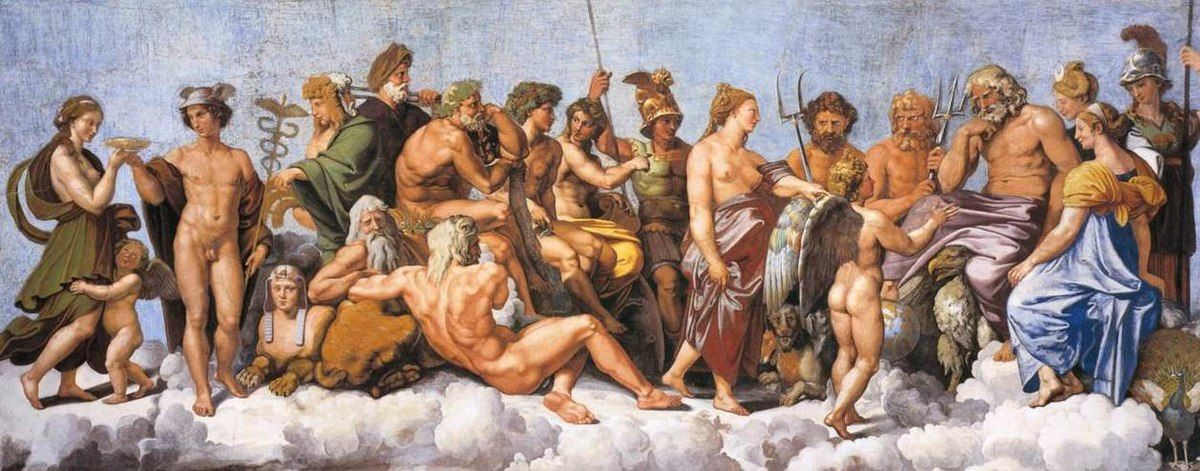
The religion of ancient Greece was a vibrant, decentralized polytheism. Rather than relying on a single sacred text, Greek religion was defined by shared myths, civic rituals, and a sprawling pantheon of anthropomorphic deities. At the absolute apex of this cosmic hierarchy sat the Twelve Olympians, who were believed to reside on the cloud-shrouded summit of Mount Olympus.
1. The Generational War: The Origin of Olympus
The Olympians were not the first rulers of the cosmos. According to Hesiod’s Theogony, they won their supreme status through a cosmic civil war known as the Titanomachy.
The Titan king, Cronus, swallowed his children at birth to prevent a prophecy that he would be overthrown. His wife, Rhea, tricked him by hiding her sixth child, Zeus, and feeding Cronus a swaddled stone instead. Once grown, Zeus returned, forced his father to regurgitate his siblings, and led a ten-year rebellion. The victorious Olympians imprisoned the Titans in the deep abyss of Tartarus and divided the universe among themselves.
2. The Big Three: Rulers of the Cosmos
Following their victory, the three most powerful brothers drew lots to divide the realms of reality.
Zeus (Jupiter): King of the Gods
Realm: The sky, weather, law, and cosmic order.
Symbolism: The thunderbolt, the eagle, and the royal scepter.
Character: Zeus maintained ultimate cosmic justice (Dike) and protected the sacred laws of hospitality (Xenia). Despite his role as a supreme arbiter, myth portrays him as a deeply volatile figure whose frequent infidelities with mortals and nymphs drove much of the mythological narrative.
Poseidon (Neptune): The Earth-Shaker
Realm: The oceans, storms, earthquakes, and horses.
Symbolism: The trident, the bull, and the dolphin.
Character: Poseidon was a god of raw, unpredictable natural force. Sailors prayed to him for safe passage, while coastal cities built temples to appease his temper, which could trigger devastating tsunamis and earthquakes if provoked.
Hades (Pluto): The Silent Lord
Note on the Twelve: While Hades was one of the prime generational brothers, he is rarely counted among the traditional "Twelve Olympians" because he resided permanently in the Underworld and did not maintain a throne on Mount Olympus.
3. The Matriarchs of Olympus
Hera (Juno): Queen of Heaven
Realm: Marriage, childbirth, family, and the stars.
Symbolism: The peacock, the diadem (crown), and the cow.
Character: The sister-wife of Zeus, Hera was the majestic protector of the social order and the sanctity of marriage. In myth, her role often shifts to that of a vengeful punisher, ruthlessly pursuing Zeus’s lovers and illegitimate children (such as Heracles).
Demeter (Ceres): The Law-Bringer of the Soil
Realm: Agriculture, grain, harvest, and fertility.
Symbolism: Wheat stalks, the cornucopia, and the torch.
Character: Essential to human survival, Demeter controlled the cycles of life and death in the soil. Her profound grief over the abduction of her daughter Persephone by Hades caused the world’s first winter, establishing the mythic origin of the seasons.
Hestia (Vesta): The Steady Flame
Realm: The hearth, domestic life, and sacrificial fire.
Symbolism: The hearth fire and the kettle.
Character: A virgin goddess of peace and stability, Hestia chose to stay home and guard the eternal flame of Olympus rather than engage in divine wars or affairs. She was honored with the first and last libations at every Greek feast. In later periods, she occasionally yielded her seat among the Twelve to Dionysus.
4. The Intellectuals and Protectors
Athena (Minerva): The Maiden of Strategy
Realm: Wisdom, defensive warfare, civilization, and handicrafts (weaving).
Symbolism: The owl, the olive tree, and the Aegis (a protective shield bearing Medusa’s head).
Character: Born fully formed and armored from the forehead of Zeus, Athena represented the rational, strategic side of intellect and war. She was the patron of heroes like Odysseus and the namesake guardian of Athens, contrasting sharply with the reckless brutality of raw combat.
Apollo: The Light of Reason
Realm: Prophecy, music, poetry, truth, healing, and archery.
Symbolism: The lyre, the laurel wreath, the bow, and the sun.
Character: The twin brother of Artemis, Apollo embodied the Greek ideal of Kouros (athletic, harmonious youth). His sanctuary at Delphi housed the famous Oracle, making him the supreme divine voice of prophecy and moral purification across the Greek world.
Artemis (Diana): The Lady of the Wild
Realm: The hunt, wilderness, wild animals, childbirth, and the moon.
Symbolism: The silver bow and arrows, the stag, and the cypress tree.
Character: A fierce, fiercely independent protector of young girls and the natural boundaries of the wild. While she was a master huntress, she punished any mortal who hunted unsustainably or violated her sacred spaces, as seen in the tragic myth of Actaeon.
5. The Gods of Passion and Chaos
Ares (Mars): The Blood-Lust of Battle
Realm: Physical warfare, violence, courage, and bloodshed.
Symbolism: The spear, the helmet, the boar, and the vulture.
Character: Unlike Athena's strategic warfare, Ares represented raw, unbridled violence and physical chaos. He was generally unpopular among both mortals and his fellow gods, frequently depicted as short-tempered, brutal, and cowardly when wounded.
Aphrodite (Venus): The Standard of Beauty
Realm: Love, physical desire, beauty, and procreation.
Symbolism: The dove, the apple, the scallop shell, and the mirror.
Character: Born from the sea foam generated by the severed remains of the Titan Uranus, Aphrodite wielded immense power. Her magical girdle could compel any god or mortal to fall helplessly in love, making her a formidable force capable of starting wars, such as the Trojan War.
Hephaestus (Vulcan): The Master Artisan
Realm: Fire, metalworking, stone masonry, and sculpture.
Symbolism: The anvil, the hammer, and the tongs.
Character: The son of Hera, Hephaestus was born lame and was cast off Mount Olympus in disgust. He forged his way back into the pantheon through sheer craftsmanship, constructing the palaces, armor, and weapons of the gods. He was the only Olympian who engaged in manual labor, serving as the patron of smiths and artisans.
Hermes (Mercury): The Divine Messenger
Realm: Travel, trade, thieves, language, and sports.
Symbolism: The Caduceus (winged staff entwined with snakes), winged sandals, and the traveler's cap.
Character: A clever trickster god who moved fluidly between boundaries. As the Psychopomp, he held the solemn duty of guiding the souls of the dead down into the Underworld. His wit and speed made him the ultimate intermediary between Olympus and the mortal plane.
6. Cult and Ritual: Honoring the Twelve
The Greeks did not worship the Olympians as distant, abstract concepts; they interacted with them through localized, concrete practices.
The Panathenaia and Festivals: Each city-state championed specific Olympians. Athens celebrated Athena with the grand Panathenaic festival, while the entire Greek world gathered every four years at Olympia to honor Zeus through athletic competition.
Sacrifice (Thysia): The central act of worship involved animal sacrifice at an outdoor altar. The inedible portions (bones and fat) were burned for the gods, while the meat was roasted and shared among the community, reinforcing the social contract between citizens under the eyes of heaven.
The Twelve Olympians provided the ancient Greeks with a framework to understand the unpredictable forces of nature, the complexities of human psychology, and the absolute necessity of social order.