The Limes Germanicus (the Germanic Frontier) was one of the most gargantuan military engineering projects of the ancient world. Stretching over 550 kilometers (340 miles) from the Rhine River to the Danube, this heavily fortified border wall marked the northernmost boundary of the Roman Empire, separating the Romanized provinces of Germania Superior and Raetia from the unconquered, fragmented tribes of Magna Germania.
Rather than serving as a simple wall to keep invaders out, the Limes was a sophisticated, multi-layered early-warning system, trade filter, and staging ground for imperial power projection.
1. The Strategy: Shift to a Fixed Frontier
For the early Roman Empire, borders were fluid entities meant to expand eternally. That mindset shattered in 9 CE after the Battle of the Teutoburg Forest, where three Roman legions were completely wiped out in an ambush by Germanic tribes.
Realizing that conquering the dense, boggy forests of Germany was economically and militarily unfeasible, the Empire shifted its grand strategy. Under Emperors Domitian, Hadrian, and Antoninus Pius (1st to 2nd centuries CE), Rome began drawing a literal line in the dirt to consolidate and defend its existing territory.
2. Anatomy of the Border: The Multi-Layered Defense
The Limes Germanicus was not a singular, continuous brick wall like Hadrians's Wall in Britain. Instead, its architecture evolved based on geography and time, utilizing a complex defensive depth:
The Palisade: On the land-based stretches, Romans cleared a wide strip of forest to create a clear line of sight. They dug a deep ditch and built a steep earthen bank, topped by a formidable palisade of split oak logs bound together and sharpened at the tips.
The Watchtowers (Turres): Positioned within sight of one another along the entire length of the wall were hundreds of wooden (and later stone) watchtowers. Typically two to three stories high, these towers were permanently manned by small detachments of soldiers.
The Signal Network: The watchtowers acted as the nervous system of the frontier. Using torches and fire signals at night, smoke by day, and horns during poor visibility, tower guards could transmit coded messages across miles in minutes, alerting regional fortresses of an impending tribal raid.
3. The Castra and Castella: Garrisons of the Frontier
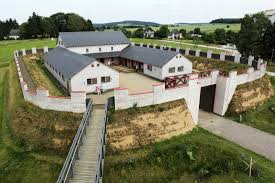
To support the thin line of watchtowers, the Romans built heavily fortified military bases at strategic intervals just behind the palisade line.
The Castella (Fortlets): Smaller stone or timber forts positioned every few kilometers, usually housing a century of auxiliary troops (roughly 80 men). These units could deploy immediately to plug small breaches in the wall detected by the watchtowers.
The Castra (Legionary Fortresses): Massive, self-sustaining military cities located further back from the line, housing entire legions of heavy infantry (around 5,000 to 6,000 citizens-soldiers). These bases featured grid-iron street layouts, headquarters buildings (principia), granaries (horrea), hospitals, and bathhouses. If a large Germanic coalition managed to breach the palisade, the legions would march out from these fortresses to crush them in a formal pitched battle.
4. The Border as an Economic Filter
A common misconception is that the Limes Germanicus was a sealed, militarized iron curtain meant to completely halt human movement. In reality, it functioned primarily as a highly regulated customs border and trade highway.
Controlled Crossings: The palisade featured heavily guarded gates positioned at major trade routes. Germanic tribesmen were required to disarm, identify themselves, pay import tariffs on their goods, and enter Roman territory only on designated market days under armed escort.
The Pax Romana Effect: The Limes fostered massive economic growth. Outside the fort walls, vibrant civilian settlements (vici) sprang up, filled with local traders, tavern keepers, craftsmen, and the families of soldiers. Roman goods—such as wine, glass, fine pottery (terra sigillata), and iron tools—flowed north into Germany, while amber, furs, hides, and Germanic slaves flowed south into the Empire.
5. The Auxiliary System: The Men on the Wall
The Roman legions did not actually patrol the watchtowers of the Limes. That grinding, daily border-policing work was outsourced entirely to Auxilia—non-citizen soldiers recruited from provinces across the empire.
Diversity on the Rhine: A Roman watchtower in the heart of Germany might be manned by javelin-throwers from Spain, archers from Syria, or cavalrymen from Thrace.
The Ultimate Incentive: These men signed up for grueling 25-year contracts. Their reward upon honorable discharge (honesta missio) was profound: full Roman citizenship for themselves and their descendants, alongside a plot of land or a cash payout, effectively turning the sons of conquered tribes into fierce defenders of the Roman state.
6. The Collapse of the System
The Limes Germanicus held the line successfully for nearly two centuries. However, by the 3rd century CE, the system faced structural collapse due to a deadly combination of internal Roman civil wars and changing external threats.
The small, decentralized Germanic tribes of the past began consolidating into massive, sophisticated confederations, such as the Alemanni and the Franks. When the Roman Empire plunged into the Crisis of the Third Century, legions were pulled off the frontier to fight rival emperors in Rome.
Sensing weakness, the Alemanni smashed through the palisades in a series of devastating invasions around 260 CE. The Romans were forced to abandon the trans-Rhine territories entirely, falling back to more easily defensible natural water borders of the Rhine and Danube rivers.
Today, the Limes Germanicus is recognized as a UNESCO World Heritage site. While the wooden palisades have long since rotted away, the earthen ditches, stone tower foundations, and buried fortresses still cut a visible path through the modern German landscape—a permanent scar showing where the classical Mediterranean world drew its line against the northern wild.