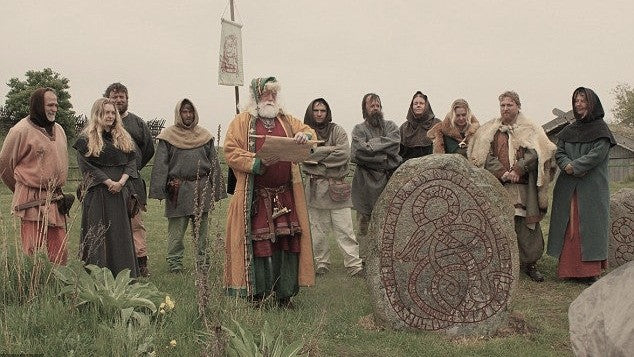
The expansion of the Viking Age reached its absolute geopolitical peak in the British Isles during the late 9th century. What began as sporadic, terrifying hit-and-run coastal raids transformed into a massive, coordinated war of conquest and settlement.
This movement culminated in the creation of the Danelaw—a vast geographic region spanning northern and eastern England where Danish laws, customs, and language held absolute sway, permanently altering the cultural and political trajectory of Britain.
1. The Great Heathen Army (865 CE)
For decades, Anglo-Saxon kingdoms had dealt with small Viking fleets that plundered monasteries and sailed away. That dynamic shattered in 865 CE with the arrival of the Great Heathen Army (Micel Here).
Led by the legendary sons of Ragnar Lodbrok—including Ivar the Boneless, Halfdan, and Ubba—this was not a raiding party; it was a highly organized coalition of thousands of Scandinavian warriors intent on permanent land acquisition.
The army utilized a highly effective strategy of mobile warfare. They seized horses to travel rapidly overland, captured fortified towns like Nottingham and York during the winter, and systematically exploited the political rivalries within the fractured Anglo-Saxon kingdoms.
2. The Collapse of the Anglo-Saxon Kingdoms
In 865 CE, England was divided into four independent, often hostile Christian kingdoms. Within a single decade, the Great Heathen Army systematically dismantled three of them:
Northumbria (866 CE): The Vikings captured the capital city of York (Jorvik). When the rival Northumbrian kings united to take it back, they were slaughtered, and the Vikings established a puppet regime before taking direct control.
East Anglia (869 CE): The Danish forces overwhelmed the kingdom. King Edmund of East Anglia was captured and martyred—according to legend, used as target practice for Viking archers because he refused to renounce his Christian faith.
Mercia (874 CE): The central powerhouse of England collapsed after the Vikings drove King Burgred into exile and replaced him with a compliant client king, eventually splitting the kingdom's territory in half.
By 877 CE, only one independent Anglo-Saxon kingdom remained standing: Wessex, ruled by a young, desperate king named Alfred.
3. The Turning Point: Edington and the Treaty of Wedmore
In early 878 CE, the Danish leader Guthrum launched a surprise mid-winter attack on Alfred’s royal palace at Chippenham. Alfred was forced to flee into the swampy marshes of Somerset, waging a desperate guerrilla war from a hidden base at Athelney.
Alfred successfully rallied the shattered levies of Wessex, Somerset, and Wiltshire. In May 878 CE, the two armies clashed at the Battle of Edington (Ethandun).
Alfred's forces formed a dense, unbreakable shield wall, grinding down Guthrum’s warriors and forcing them to retreat to their fortified camp. After a two-week siege, starving and exhausted, the Danes surrendered.
The resulting Treaty of Wedmore established a historic compromise:
Guthrum agreed to withdraw his forces from Wessex.
Guthrum accepted Christianity and was baptized with Alfred acting as his godfather.
England was formally partitioned along a diagonal boundary running from London to Chester.
4. Geography and Governance of the Danelaw
The land north and east of this boundary became known as the Danelaw (Danalagh). It was not a single, unified kingdom, but a patchwork of autonomous Scandinavian territories.
The Five Boroughs
The military and economic core of the southern Danelaw was anchored by the Five Boroughs: Derby, Leicester, Lincoln, Nottingham, and Stamford. Each borough was ruled as a fortified military district by a Danish jarl (earl) who maintained his own mercenary army, controlled local trade markets, and administered justice.
Legal and Social Identity
The region earned its name because it was bound by Danish legal customs, which differed significantly from Anglo-Saxon tradition:
The Wapentake: Traditional Anglo-Saxon administrative districts (hundreds) were replaced by wapentakes, a term derived from the Old Norse vápnatak, referring to the voting assembly where freemen clashed their weapons to show agreement.
The Freemen (Drengs): The Danelaw fostered a uniquely egalitarian social structure compared to the feudal south. It featured a vast class of independent, small-scale Scandinavian farmers (sokemen) who owned their land directly and owed military allegiance but not personal servitude to the local lords.
5. The Reconquest and the Unification of England
The Danelaw existed as an independent political entity for less than a century. Alfred the Great spent the remainder of his reign building a network of fortified towns (burhs) and a permanent navy to contain the Danish threat.
His successors went on the offensive:
Edward the Elder and Æthelflæd: Alfred’s son, Edward, alongside his brilliant daughter Æthelflæd, Lady of the Mercians, launched a highly coordinated, fortress-building campaign that systematically reclaimed East Anglia and the Five Boroughs by 920 CE.
The Fall of Jorvik (954 CE): The final independent remnant of the Danelaw was the Kingdom of York. In 954 CE, the volatile Viking king Eric Bloodaxe was driven out and assassinated in an ambush at Stainmore, marking the permanent absorption of the Danelaw into a newly unified, single Kingdom of England under King Eadred.
6. The Indelible Norse Legacy
Though its political independence was crushed, the Danelaw permanently reshaped the cultural fabric of England.
The integration of Danish settlers was so deep that hundreds of English towns still bear Old Norse names—specifically those ending in -by (meaning village/town, like Grimsby or Derby) and -thorp (meaning farmstead, like Scunthorpe). Furthermore, the blending of Old English and Old Norse accelerated the simplification of the English language, introducing vital everyday words like sky, knife, take, they, and law.