In the following video we will analyze forbidden texts the Church doesn’t want us to know about. Watch the video to find out more!
This is the Oldest Family Tree in the World
Long barrows are the earliest great monuments of the British Isles. They could be over 100m/330ft long and there are hundreds of them, dating from 3800 BC.
But what were they? But who built them? Why did they put so much effort into making them?
And what can the latest studies on ancient DNA tell us, about the family relationships of the people buried inside them and the societies that they lived in?
This is the story of the mysterious Long Barrows of Neolithic Britain.
5 Strangest Ancient Accounts of The Edge Of The World
In the video below we will analyze the 5 strangest ancient accounts of the edge of the world. Watch the video to find out more!
England's Virgin Queen: Her Story & Facial Reconstructions Revealed
Elizabeth I lived a life of tremendous ups and downs. In her 69 years, she was at one point a bastard Princess, a prisoner, and a glorious monarch - ruling as a woman in her own right. Elizabeth was one of the most astute rulers England ever had. So what did she really look like? In today’s video, we’ll explore her life, history, and true appearance. We’ll discuss which portraits of her may be the most accurate, her resemblance to her mother Anne Boleyn, and of course reveal some re-creations.
History & Facial Reconstructions of the Celtic Rebel & British Hero
Meet the woman who gathered the largest army the Roman Empire ever faced.
Boudica was the Queen of the Iceni tribe, located in what is now Norfolk, England. She led an uprising of Celtic tribes after the Romans pillaged her town, and raped her daughters. Although she was eventually defeated, she remains a British folk hero to this day.
But what's most mysterious is her appearance. Boudica’s grave and body have never been found.
The only physical description we have to work from comes from Roman Historian Cassius Dio, although he was writing over a hundred years after her death:
"In stature she was very tall, in appearance most terrifying, in the glance of her eye most fierce, and her voice was harsh; a great mass of the tawniest hair fell to her hips; around her neck was a large golden necklace; and she wore a tunic of diverse colors over which a thick mantle was fastened with a brooch…"
We’ve created Boudica’s appearance based on what we know - she was in her late twenties or early thirties when she died. She would have classic Celtic-Briton features, which are all backed up by the description given by Dio - she would be tall, with light coloring - red or blonde hair, blue eyes, and pale skin. Common Celtic-Briton facial features are a high forehead, defined cheekbones, narrow nose, and eyebrows that lay close to the eyes.
The Celts are not a unified people, so different tribes would have different traditions. But overall, the Celts were a very decorated people - they loved brightly colored clothing, woven with wool and dyed with natural dyes. Actually, Celtic outfits were so colorful that the Romans often remarked upon it, which is probably why Dio mentions it in his description of Boudica.
The design of the garments would be something like a Roman tunic.
Dio also mentions this large gold necklace that she wears - and he’s talking about a Torc - this thick gold ring worn around the neck. There are dozens of archaeological examples of these.
Despite romantic depictions of Boudica as a painted warrior queen, she probably never wore the blue face paint called woad, although she may have worn eyeliner or other makeup.
We know her hair was long and tawny - although Romans use this term loosely, most assume she had red or red-gold hair. Celtic women would decorate their hair with braids or twists, as well as beads or bits of metal. The warriors would sometimes use chalk-lime to bleach or decorate their hair, although we aren’t sure if Boudica did this.
So while a definitive likeness of Boudica is no longer possible, this is a reliable depiction of what a Celtic Queen from Roman-Era Britain could have looked like!
Odysseus and the Cattle of Helios - The Ruin of Odysseus' Crew
In the following video we will be talking about Odysseus and the Cattle of Helios, the ruin of Odysseus' crew. Watch the video to find out more!
The Druids | Keepers of Celtic Wisdom (Filmed in a Druid's Den)
In today’s video we will be talking about the Druids, the keepers of Celtic Wisdom. Watch the video below for more!
2,500-year-old bronze artefacts found in eastern Poland
A metal detectorist has uncovered a hoard of bronze artefacts during a survey in the village of Czernięcin Poduchowny, eastern Poland.
The discovery was made by Łukasz Jabłoński, a licensed detectorist who notified authorities at the Provincial Office for the Protection of Monuments in Lublin.
A total of 13 bronze artefacts dating from 2,500-years-ago have been located, including pins for clothing, shin guards, and bracelets which are associated with the Lusatian Culture.
The Lusatian Culture emerged during the Late Bronze Age and expanded their territories across most of present-day Poland, parts of the Czech Republic, Slovakia, eastern Germany and western Ukraine during the Early Iron Age.
What Is The Real History Behind The Legendary Trojan War? | Troy: Myth or Reality
The Trojan War is maybe one of the most significant events that never happened, or at least not in the way that we all know it. Examine the real history behind the legendary Trojan war and discover how much of this epic is a myth and what may be reality.
The New Discovery in Egypt That Scares Scientists
In the realm of ancient wonders, Egypt has once again unveiled a revelation that has sent shockwaves through the scientific world. Prepare to be enraptured as we venture into the depths of this enigmatic discovery, shrouded in mystery, poised to ignite our imagination and forever etch its secrets into the annals of history. From the 4300-year-old mummy to the first full-color complete mummy portraits, today, we embark on a captivating exploration of the 15 strangest things recently discovered in Egypt.
Scientists Claim This Is Why The Byzantine Empire Collapsed – And Humans Today Should Be Scared
Even though the Roman Empire was one of the world's greatest civilizations, that did not stop it from falling apart. What's more, albeit roman culture figured out how to live on inside the Byzantine Realm, this powerful realm would likewise happen to disintegrate ultimately. Therefore, what is preventing our societies from suffering the same fate? According to scientists, not much, although it is possible that the same threat that was believed to have decimated the Byzantines may still exist today. Watch the video for more!
The 6,000-year-old Lovers of Valdaro discovered in a Neolithic tomb
Discovered in a Neolithic tomb in Italy, the Lovers of Valdaro are a pair of skeletons that have been holding each other for 6,000 years.
In 2007, a team of archaeologists discovered a tomb near Mantua in the region of Lombardy, Italy. Inside, they found a pair of skeletons lying face to face, their bodies intertwined as if holding each other in a “lovers’ embrace.”
Photos of the skeleton couple quickly circulated throughout the media — and the fact that the Lovers of Valdaro, as they came to be known, were discovered just before Valentine’s Day made the story especially resonant.
For many, the positioning of the bodies called to mind the story of Romeo and Juliet, star-crossed lovers who met an untimely and tragic end. As archaeologists examined the Valdaro Lovers, they made a number of curious discoveries.
How the BLACK DEATH affects YOU! How the Black Death has affected our DNA
WHY did some people survive the BLACK DEATH when others did not and how is arguably the most famous plague in history still affecting us today? In this video we’re going to look at this medieval disaster, which swept through Europe and parts of Asia in the 14th century and hear how new research shows how one of the long-term effects of the Black Death has affected our DNA so that it is still protecting and harming us, even now.
We’ll start with a history of the Black Death, which was caused by the yersinia pestis bacterium and spread to humans by a mixture of rats and fleas. We’ll then look at how the Black Death was spread, the symptoms of the Black Death, famous victims of the Black Death and how many people died from the Black Death, for its mortality rate was so high that it is considered by many to be the most deadly plague in history. We’ll also learn why was it called the Black Death and spoiler alert, it has nothing to do with the symptoms of the disease. After this overview we’ll look at research released in 2022 and based on a scientific study of hundreds of skeletons of victims of the Black Death from England and Denmark which shows that those with a particular trait in their DNA were 40% more likely to survive it (and pass on their stronger genes to later generations). This would make the pestilence one of the most important natural selection events in human history, but that this genetic quirk also makes modern possessors of it more likely to succumb to certain auto-immune diseases.
Museum exhibit in Norway reveals new details on Neanderthals
No one knows what happened when we, Homo sapiens, first encountered the Neanderthals. But we know we met.
We know that for thousands of years we lived side by side in Europe and Asia. And we know we had children together. So you’re probably carrying around a bit of Neanderthal DNA.
Kind of cool to be part Neanderthal, don’t you think? It’s not as strange an idea as you might think.
Discovered huge dinosaur bone store stuck in the Sahara desert
There are 20 tons of dinosaur bones covered in sand in the south-central Sahara.

Sereno and his team uncover a sail-backed dinosaur called an ouranosaurus in Niger in 2018. (Matthew Irving)
Reptiles with wings exist. a being that resembles a dog with armor. There are eleven unidentified species, all of which have lengthy necks. According to scientists, they roamed the desert up to 200 million years ago, when it was still green.
A world-class display in Niger has long been envisioned thanks to one of Africa's largest fossil caches, a prehistoric cemetery. The unique find is at risk from sand dunes that are collapsing and looters. However, excavation must be postponed while the country deals with a second wave of the coronavirus in addition to growing Islamist insurgencies.
Boubé Adamou, an archaeologist at the Institute for Research in Human Sciences in the nation's capital, Niamey, who assisted in the discovery of the treasure, remarked, "This is our cultural identity." But saving the lives of the living comes first.
About twice the area of France and made up primarily of desert, Niger has long been known for its dinosaur wealth. Many bones can be seen poking through the sand. In order to access what scientists refer to as the continent's most diversified collection of extinct giants, paleontologists must endure a scorching trip through bandit country.
Foreign explorers have received the most of the credit for these remains throughout history. Even now, for both practical and aggravating reasons, the country's dinosaurs tend to migrate to Europe or North America. Richer nations provide temperature-controlled chambers to stop bones from breaking. Termites have infected Niger's premier museum.

Sereno brushes sand off a skull cap, part of a burial some 8,000 years old. The bones belonged to people who lived in the Sahara when it was green, he said. (Matthew Irving)
Before the pandemic, leaders were working to restore such cultural infrastructure. They desired a long-lasting location for their scattered findings.
Mahamadou Ouhoumoudou, the chief of staff to the president of Niger, stated that "we need to make it so that everything that has been taken from us can be returned."
Paul Sereno, a well-known University of Chicago paleontologist whose decades-long explorations in Niger have contributed nine species to the catalog of dinosaur species, collaborated with local experts.
Two new museums, one in the capital and one in the desert region of Agadez, were the result of a collaborative partnership. Sereno's discoveries, which are currently housed at his laboratory in Chicago, would be stored there, along with whatever the upcoming generation of explorers found in the soil of Niger.
Sereno observed, generally speaking, "The best place for priceless specimens in any country is on display. Everyone is aware of their location. They're well-known. They develop into treasures."
The land has already been designated by Niger. The NigerHeritage project is expected to cost tens of millions of dollars. Officials reported that international donors including the World Bank expressed interest.

Sereno's team found 20 tons of dinosaur bones in Niger's Agadez region over a series of trips in 2018 and 2019. (Matthew Irving)
However, when the epidemic broke out, planning came to a halt, and now 20 tons of bone are lying in the midst of the Sahara.
Unintentional discovery
The beginning of the dinosaur saga in Niger was another secret graveyard.
Early in the 1960s, French nuclear energy agency prospectors were searching for uranium in the Ténéré wilderness when they came across a massive, bluish-stone object.
French paleontologist Philippe Taquet quickly determined that they were the vertebral columns of a dinosaur.
He had never gone on a fossil expedition when he was 24 years old and fresh out of college. But he was dusting off a new species just a few days after joining the prospectors.
Taquet described the incident in his 1994 memoir, writing, "There is a place on this Earth where, simply by hopping out of your car, you risk suddenly finding yourself nose to nose with a dinosaur."
Although the French team had government approval to excavate, until the late 1980s there were no rules preventing foreigners from collecting dinosaurs from Niger. In the US, France, and Italy, some bones found their way into the hands of private collectors. Others wound up at London's British Museum.
The Ténéré fossils were sent back to Niamey by Taquet after he investigated them in France; they are still housed in wooden crates at the National Museum.

A member of Sereno's team cleans rock from a 60-foot dinosaur. (Matthew Irving)
The Frenchman's efforts gave Sereno's group a route to follow. To make fresh discoveries, scientists and armed escorts in Land Rovers heed local advice: For large teeth, go this route.
Over the course of a series of journeys covering around 1,000 km in 2018 and 2019, the researchers cataloged hundreds of bones in Agadez. They were led by a man riding a moped to a massive spinosaurus, also known as a "spine lizard."
"It's everything, everywhere in Niger," Sereno declared. In actuality, it's excessive.
The specimens' excavation took several months. They span all geological time periods, including mammals, humans, and dinosaurs. One Neolithic woman wore an ivory bracelet even now. Before being given names, the 11 new dinosaur species must first undergo peer assessment.
Each skeleton was given a temporary plaster covering by Sereno's team. To cover them, they brushed sand over the top. They hoped that anything sticking out would be mistaken for rocks by onlookers.
Paleontologists frequently rebury dig sites before coming back with moving trucks. But for at least a year, that process has been halted by the pandemic.
Niger has sent soldiers to guard the expanse from looters. Bandits are known to roam those parts, while extremist groups typically operate hundreds of miles south. Nomads are also keeping an eye on the dinosaurs, periodically texting Sereno with updates.

Locations of fossil discoveries
So far, no one has reported a theft or sand avalanche.
“I have my fingers crossed that the wind god is on my side,” Sereno said, “and things will look the same in a year.”
‘We can’t keep them like this’
One of the world's poorest nations must shoulder a significant burden in order to preserve dinosaurs. It became harder due to the pandemic. Leaders are juggling issues that are more urgent.
Extremist group attacks increased at this time. On January 2 2021, Islamic State fighters carried out the worst ambush in recent memory, murdering at least 100 people in two villages in the southwest.
The Armed Conflict Location & Event Data Project reports that during 2019 and 2020, the number of Nigeriens killed in such violence more than doubled. Al-Qaeda and the Islamic State affiliates have used a sense of despondency to expand their ranks throughout West Africa ever since extremists seized control of the neighboring country of Mali nearly ten years ago.

Sereno's team collects the surface fragments of a dinosaur. (Matthew Irving)
"We need education, services, and jobs that support young people," said Moulaye Hassane, director of the violent extremism program at the National Center for Strategic and Security Studies in Niamey. "In that sense, dinosaurs and tourism could be great for Niger."
At the National Museum in Niamey, resolve for that aim is present even though it is shaken.
Crates labeled "FRAGILE" contain pieces of Taquet's early discoveries that are on the tile floor. Brooms, some rope, and a toilet brush are placed nearby. Termite cracks can be seen in the walls.
Director of the museum Haladou Mamane said, "We can't keep them like way.
In the past, visitor traffic generated $370 on average per day. People posed with replicas of the long-necked jobaria and sail-backed suchomimus dinosaurs, which Sereno found in the 1990s.
The seasoned Sahara rover is aware of what is still undiscovered. He was traveling with Sereno when he went to the restroom and came across a 10,000-year-old human skull.
Old pals Mamane and Amadou discussed taking back their national heritage. There would be vaccines. Travel limitations would be loosened. They hoped that the coronavirus would decline.
Adamou remarked that dinosaurs were more valuable than uranium, oil, or anything like. They are welcome here.

Paleontologists in Agadez usually travel after dawn and near dusk with the help of a GPS device and local guides. (Matthew Irving)
The typical threats were manageable for him. Since 2008, when bandits raided his caravan, the researcher has never gone fossil hunting without a rifle.
Reasonable risk. A priceless reward.
The prospect of the dinosaurs from Niger being at last at home makes him grin.

How Do Movies Enhance Quick Learning of History?
I am a staunch advocate for using historically-themed movies as a viable method of quickly absorbing historical information, gaining an immersive understanding of the eras they portray, and stimulating the imagination.
Firstly, in the realm of rapid historical learning, these movies condense years, even centuries, of events into a palatable 2 to 3 hours of viewing time. They draw on extensive research to construct their narratives, making it possible for viewers to acquire a broad understanding of the major events, key figures, and societal norms of the period in question. Even though these films may not always be 100% accurate, they are often good launching pads for further investigation into the historical periods they depict.

Up: Bonaparte Before the Sphinx (1886) painting by Jean-Léon Gérôme.
Down: Napoleon the movie (2023) Directed by Ridley Scott.
Secondly, historical films provide an invaluable sense of the "vibe" of the times they represent. Unlike textbooks, which typically present history in a more detached, factual manner, films engage audiences in a far more visceral and emotive way. By utilizing elements such as costuming, set design, and dialect, films immerse viewers in the atmosphere of the era. They offer a tangible experience of the past that the written word alone cannot convey, thus making historical events feel more relevant and alive.
Moreover, the cinematographic techniques, music, and visuals used in these films can create intense, memorable scenes that anchor historical events in the viewer's memory. For example, Spielberg's "Saving Private Ryan" provides a powerful, visceral sense of the horrors of D-Day that is hard to forget. Such scenes make the past resonate in a way that is more immediate and personal than most traditional historical accounts.
Lastly, and most importantly, historical movies are fertile ground for cultivating imagination. As viewers, we are not just passive recipients of the historical narrative but active participants who imagine ourselves in the shoes of the characters, questioning their decisions, and pondering alternative outcomes. These films invite us to think about how we would act in similar circumstances, sparking our creativity and empathy.
In addition, the speculative elements in historical fiction can further stimulate the imagination. Movies like "Inglourious Basterds" or "The Man in the High Castle," for example, offer alternate histories that invite us to reimagine the world as we know it.
In conclusion, historical movies, with their richly drawn narratives and immersive atmospheres, offer a vibrant and imaginative way to learn about history. They bridge the gap between the past and the present, transforming what might otherwise be seen as dry facts into living, breathing experiences. Thus, while they shouldn't replace thorough historical research or study, they serve as a compelling supplement that fosters a more vivid and imaginative understanding of the past.

The First European Map of Tenochtitlan, 1524: Bridging Two Worlds
BY THE ARCHAEOLOGIST EDITOR GROUP
Throughout the annals of history, maps have always played a critical role in revealing the mysteries of the world to mankind. In this context, the first European map of Tenochtitlan, the capital of the Aztec Empire, holds a significant position. This map, drawn in 1524, is a milestone not only in the history of cartography but also in the confluence of two contrasting civilizations: the indigenous peoples of Mesoamerica and the European explorers.
The Fall of Tenochtitlan
In 1521, Hernán Cortés, leading the Spanish conquistadors, succeeded in overthrowing the last emperor of the Aztecs, Cuauhtémoc, marking the fall of the mighty Aztec empire. Tenochtitlan, the empire's sprawling capital located on an island in Lake Texcoco in present-day Mexico City, was virtually decimated. Despite the destruction, the city's elaborate system of canals, temples, causeways, and marketplaces captivated the Spaniards.

The Conquest of Tenochtitlan Painting, 16th century
Crafting the Map
With a desire to document this unique city and its intricate urban layout, a map was commissioned. It was to be a testimony to the magnificence of the fallen city and serve as a valuable resource for the new rulers. The task fell upon an indigenous group of artists and scribes who had formerly worked for the Aztec elites. They were fluent in both the indigenous Nahuatl language and Spanish and skilled in the European and Mesoamerican cartographic traditions.
The map they created was a blend of European and Aztec cartographic styles. On the one hand, it adhered to the European tradition of creating bird’s-eye view cityscapes. On the other hand, it incorporated indigenous symbols and color coding, similar to the pictorial manuscripts known as codices used by the Aztecs to record their history and religious beliefs.

Author Friedrich Peypus
Unveiling the Aztec Capital
The map of Tenochtitlan is a testament to the city's grandeur and the Aztecs' advanced urban planning. The city, divided into four zones, was depicted with its complex network of canals, which served as streets for their canoe traffic. Iconic landmarks like the Templo Mayor, the royal palace, and the bustling marketplace of Tlatelolco were illustrated with careful detail.
Moreover, the map revealed the city's relationship with its environment. Tenochtitlan was surrounded by Lake Texcoco and connected to the mainland by three causeways. These causeways and the aqueduct that brought fresh water from the mainland were carefully depicted.
Tenochtitlan: The Venice of the New World
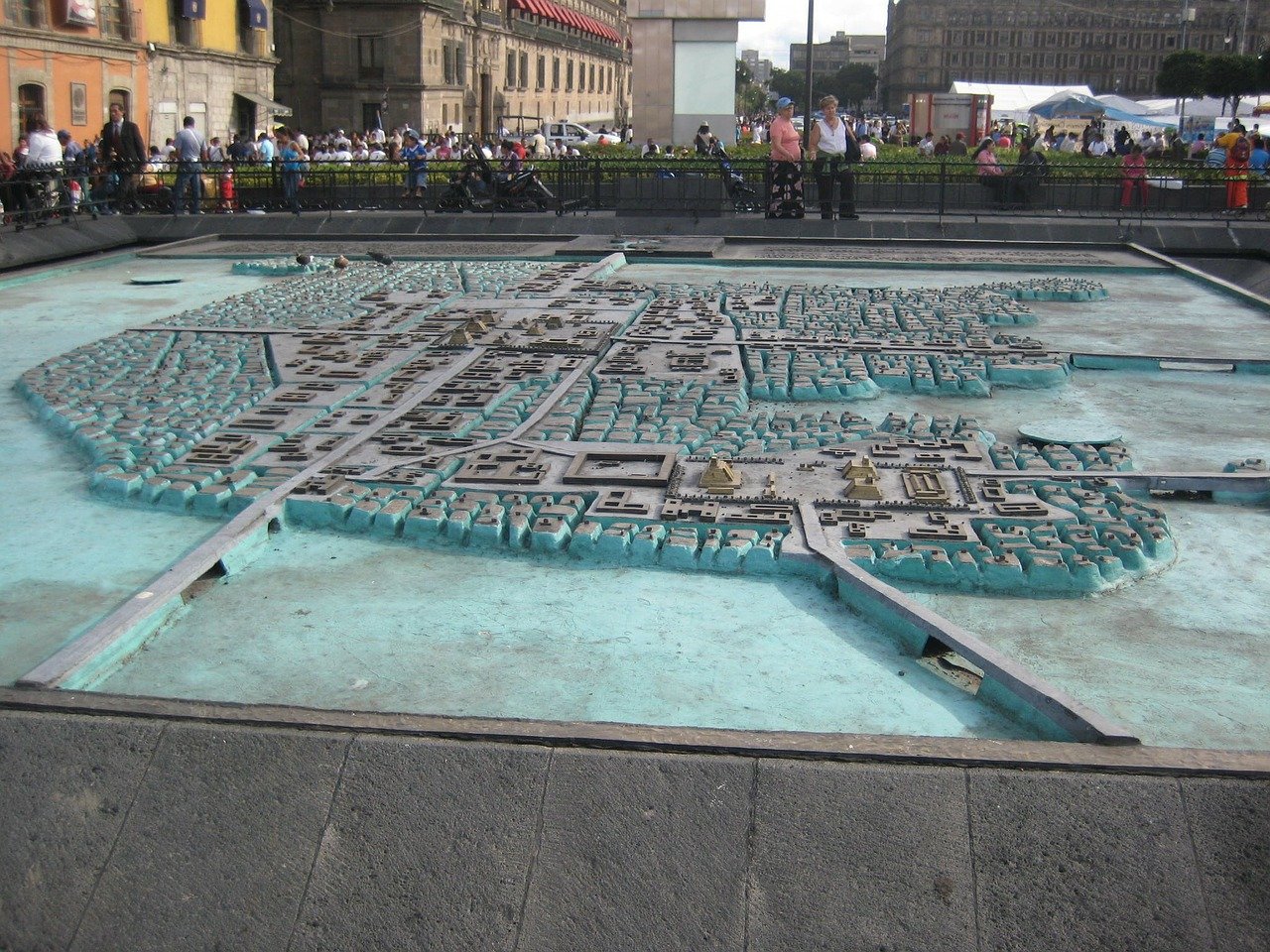
Tenochtitlan was a large city-state located on an island in Lake Texcoco, in the Valley of Mexico. Founded in 1325, it rapidly grew to become the capital of the expansive Aztec Empire. At its peak, the city had a population of between 200,000 and 250,000 people, making it one of the largest cities in the world at that time.
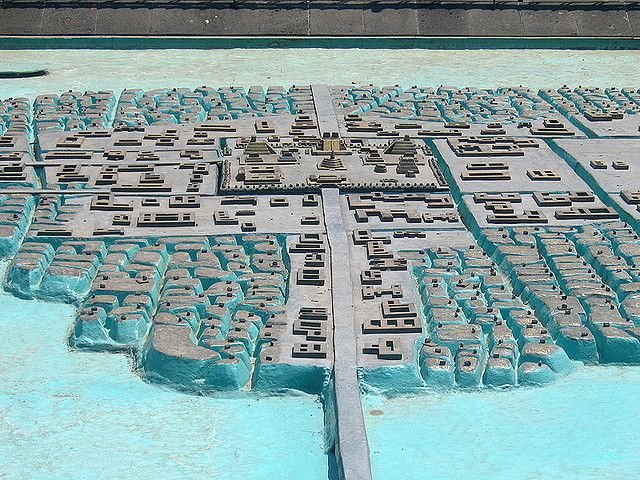
The city was designed around a ceremonial center, where important political and religious buildings were situated. The most prominent of these was the Templo Mayor, a large pyramid dedicated to the gods Huitzilopochtli and Tlaloc. Surrounding the ceremonial center were four main districts, or 'campan', which were divided into 20 precincts ('calpullis').
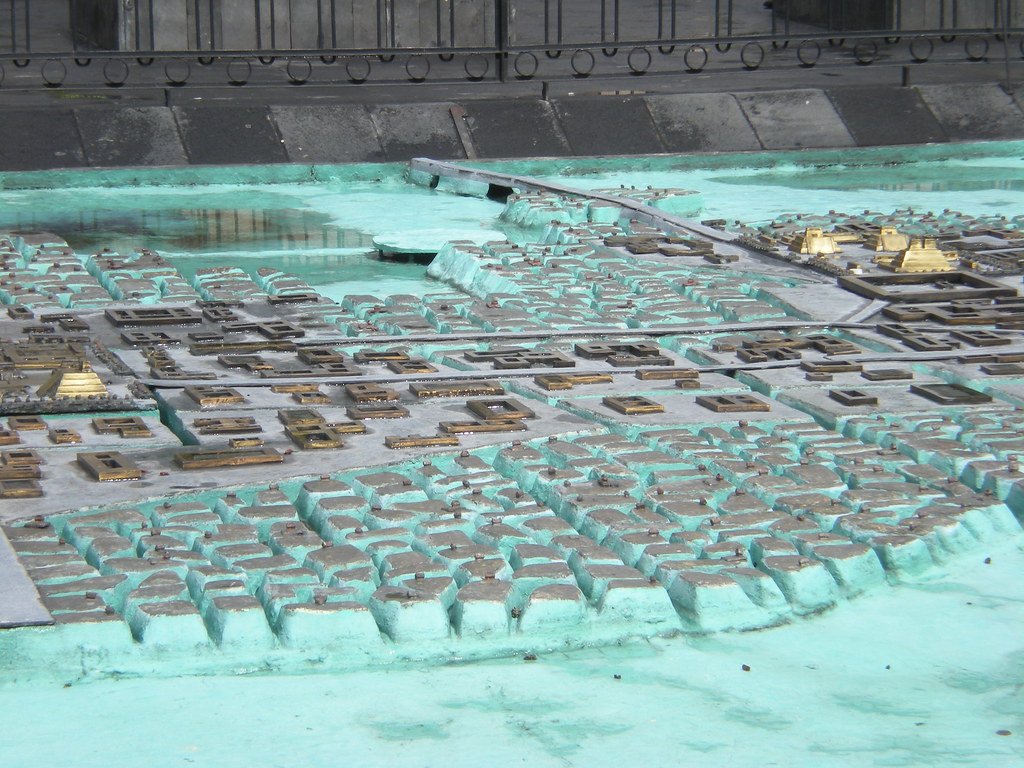
A sophisticated system of canals ran through the city, enabling transport by canoe. Large causeways connected Tenochtitlan to the mainland, which was a marvel of engineering at the time. The city was also notable for its public buildings and marketplaces. The largest marketplace was in the nearby city of Tlatelolco, which was eventually absorbed into Tenochtitlan.

Gary Todd from Xinzheng, China - Painting of Tenochtitlan-Tlatelolco on Lake Texcoco
The economy of Tenochtitlan was based on agriculture, trade, and tribute from conquered territories. The Aztecs employed a system of agriculture known as 'chinampas', or floating gardens, which were small, rectangular areas set upon the shallow lake bed. They grew various crops, most notably maize, beans, squash, and chili peppers.
Trade was carried out at a local, regional, and long-distance level, with goods from as far away as Central America and the American Southwest reaching Tenochtitlan. The city's grand marketplaces were filled with goods such as textiles, pottery, food, precious stones and metals, feathers, and other items.
Tenochtitlan was the center of Aztec civilization, which was rich in mythology and religious traditions. Society was stratified, with nobles, priests, warriors, traders, artisans, farmers, and slaves each having their place. The Aztecs had a complex system of education, with separate schools for the nobles (calmecac) and the commoners (telpochcalli).
The ruins of the Templo Mayor were rediscovered in the 20th century, and today they provide an important archaeological site in the heart of Mexico City. The rich history of Tenochtitlan continues to influence modern Mexican culture and is a potent symbol of the country's indigenous heritage.
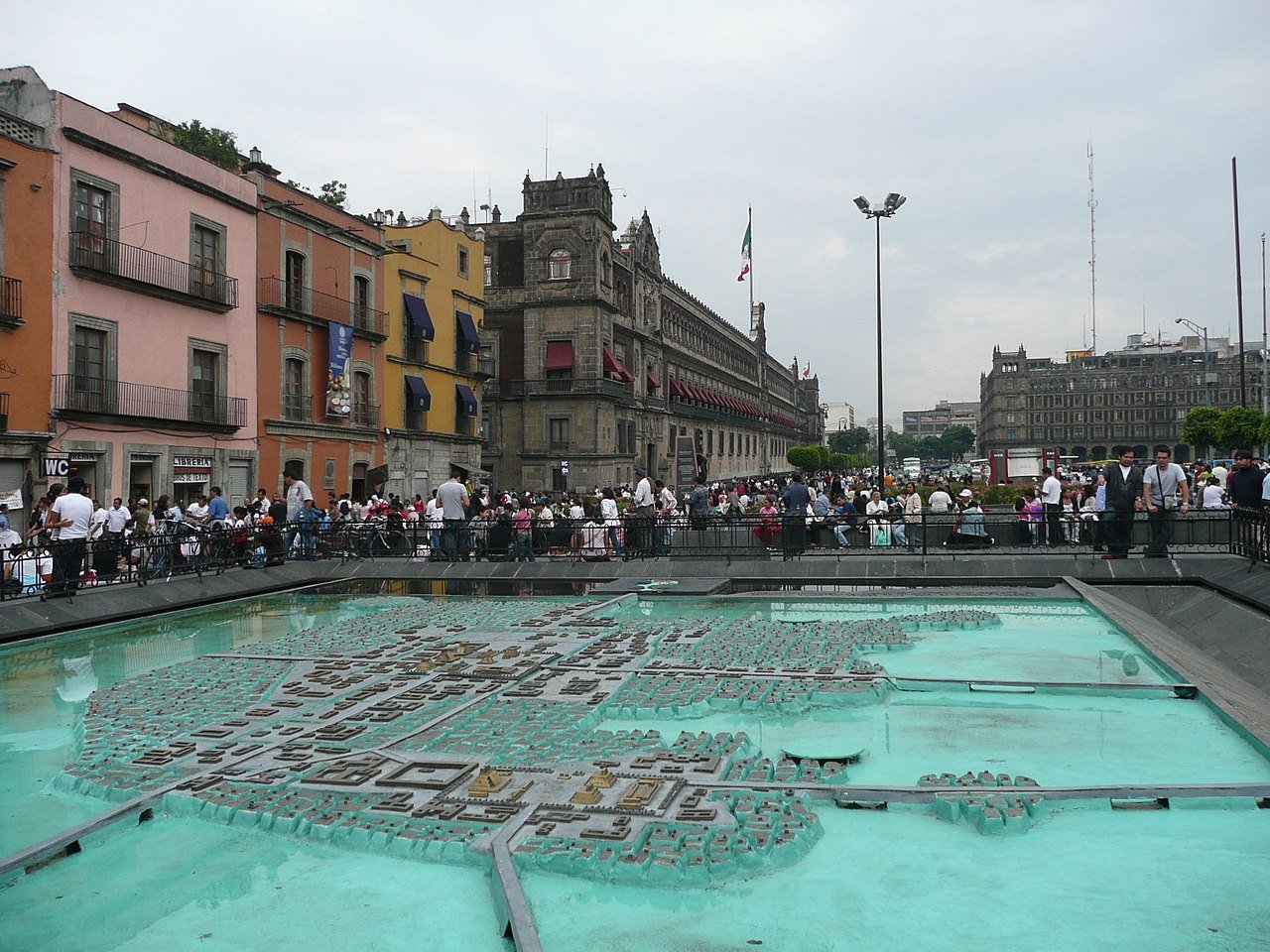
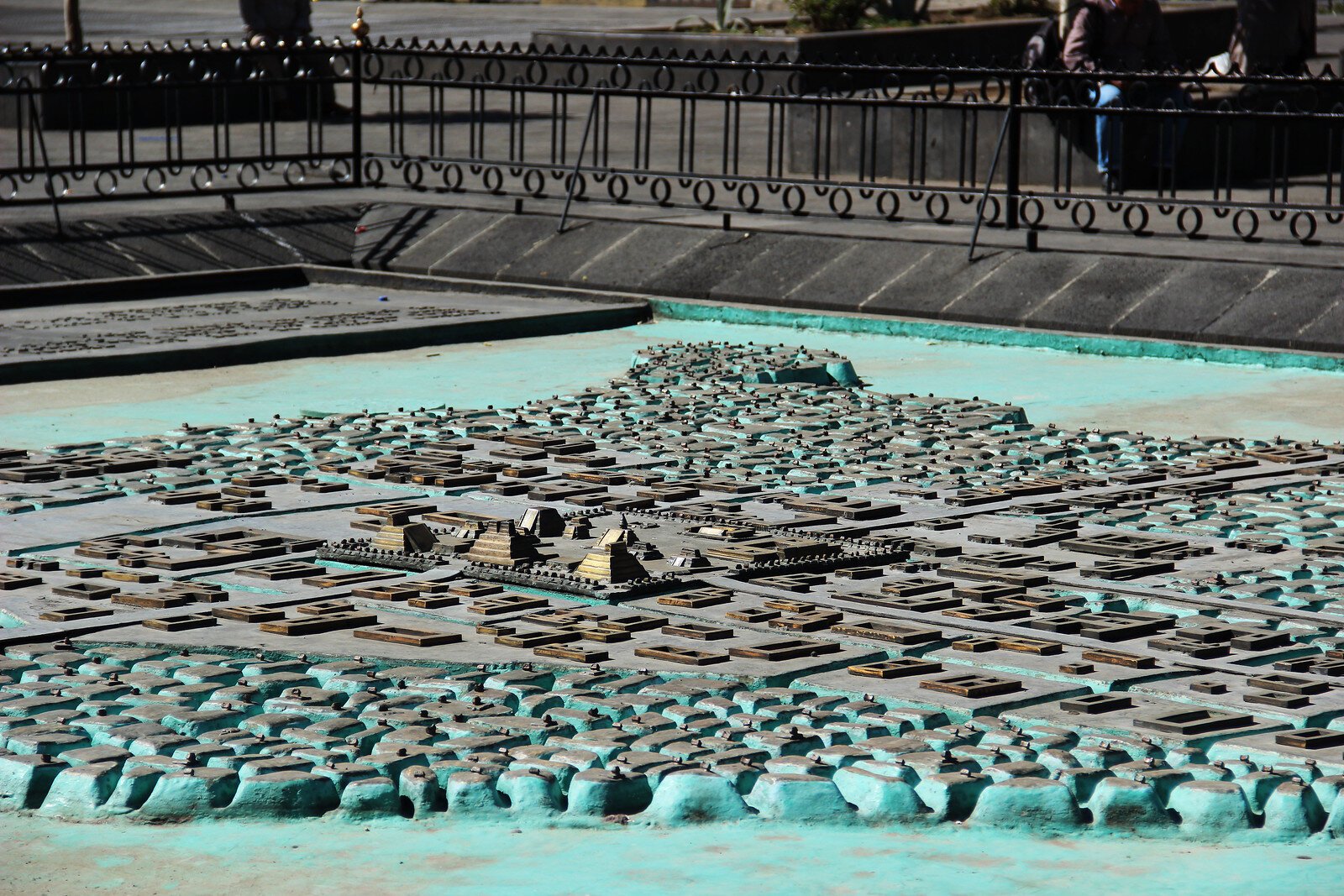
Model of the the Ancient Aztec City of Tenochtitlan, Zocalo Square, Plaza de la Constitucion, Mexico City:
Aftermath and Impact
The map was sent to Charles V, the Holy Roman Emperor, in 1524. The map provided Europe with its first visual representation of the New World's urban complexity, shifting perceptions about the so-called "primitive" societies of the Americas. It served as a tool for the Spanish administration to better understand and govern their newly acquired territory.
Yet this map was not merely a practical tool; it became an emblem of conquest, a symbol of European domination over the New World. By asserting European spatial understanding over an indigenous landscape, the map participated in a broader colonial project of control and appropriation.
Nevertheless, the enduring legacy of this map lies in its syncretic character. It serves as a tangible symbol of a moment of profound cultural encounter, blending European and Aztec conventions to create a document that both records and transcends its historical moment.
To this day, the 1524 map of Tenochtitlan continues to fascinate scholars and the general public alike. As a window into a lost world, it speaks volumes about the richness of Aztec civilization and the early days of intercultural contact in the New World.
Forbidden Confucius Quotes Filled With Wisdom That Inspire And Motivate
Wise quotes from Confucius have been helping people all over the world to live in harmony with nature for many centuries. Confucius lived at the turn of the 4th-6th centuries. The best quotes and aphorisms of Confucius are like diamond thoughts. The wise sayings of Confucius influenced many great figures, conquerors, scholars and ordinary people. The wisdom that Confucianism keeps in itself is cherished not only by the Chinese, but also by other peoples around the world.
The great wisdom of Confucius will help you strengthen your character, find peace and become a wise person.
The Irish DNA Story
In the video below we will analyze the Irish DNA story. Watch the video to find out more!
What Just Appeared In The Grand Canyon SHOCKED Scientists!
Today, rumors reverberate throughout the world, all emanating from the heart of the Grand Canyon—an iconic wonder transformed into a confusing riddle that has perplexed even the most seasoned experts. A mystery has emerged among the formerly calm beauty, evading explanation and leaving the globe in amazement. What lurks within the Grand Canyon's depths, provoking such intense curiosity? Today, let's go into the unknown, unraveling the unfathomable and searching for solutions.
In northwest Arizona, the Colorado River cuts through a canyon that is over a mile deep. Forty distinct sedimentary layers, including rocks that are a mind-boggling 1.8 billion years old, have been exposed to its erosive effect. Watching the flaming sun fade into the starry night as the purple shadows of dusk fall is a sight to behold.