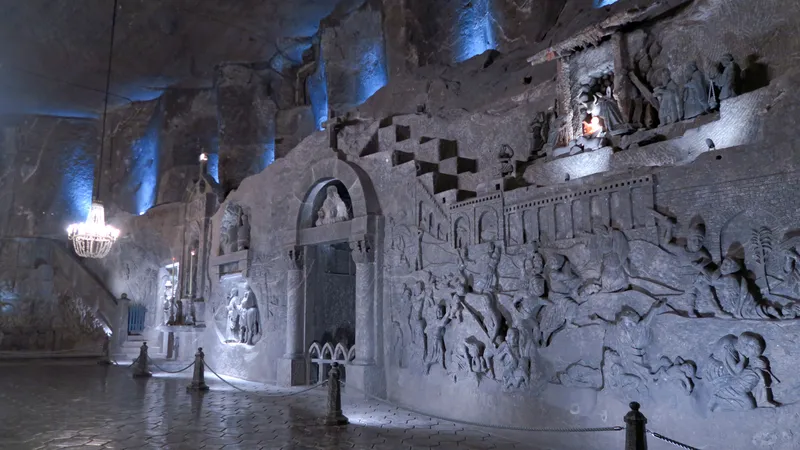
Beneath southern Poland, near Kraków, lies a hidden realm of salt. While salt has been harvested in this region for millennia, mining operations ceased in the 1990s, transforming the site from a medieval industrial center into an underground marvel. Today, it boasts a vast network of chapels, museums, and sculptures all carved entirely from salt.
The history of Wieliczka is deeply intertwined with salt. Around 13.5 million years ago, seawater flooded the basin at the base of the Carpathians. Over time, tectonic movements drained the water, leaving massive deposits of salt embedded in the local geology.
Archaeologists have uncovered the oldest salt-working tools in Central Europe near the town, dating back to the Neolithic. Early workers extracted brine from natural springs and boiled it until only the salt remained, which was likely used both for seasoning and food preservation.
This method continued until the 11th and 12th centuries CE, when natural salt springs began to diminish. To maintain production, saline wells and eventually formal mines were constructed in Wieliczka, which has been actively mined since the 13th century, making it one of the world’s oldest known salt mines.