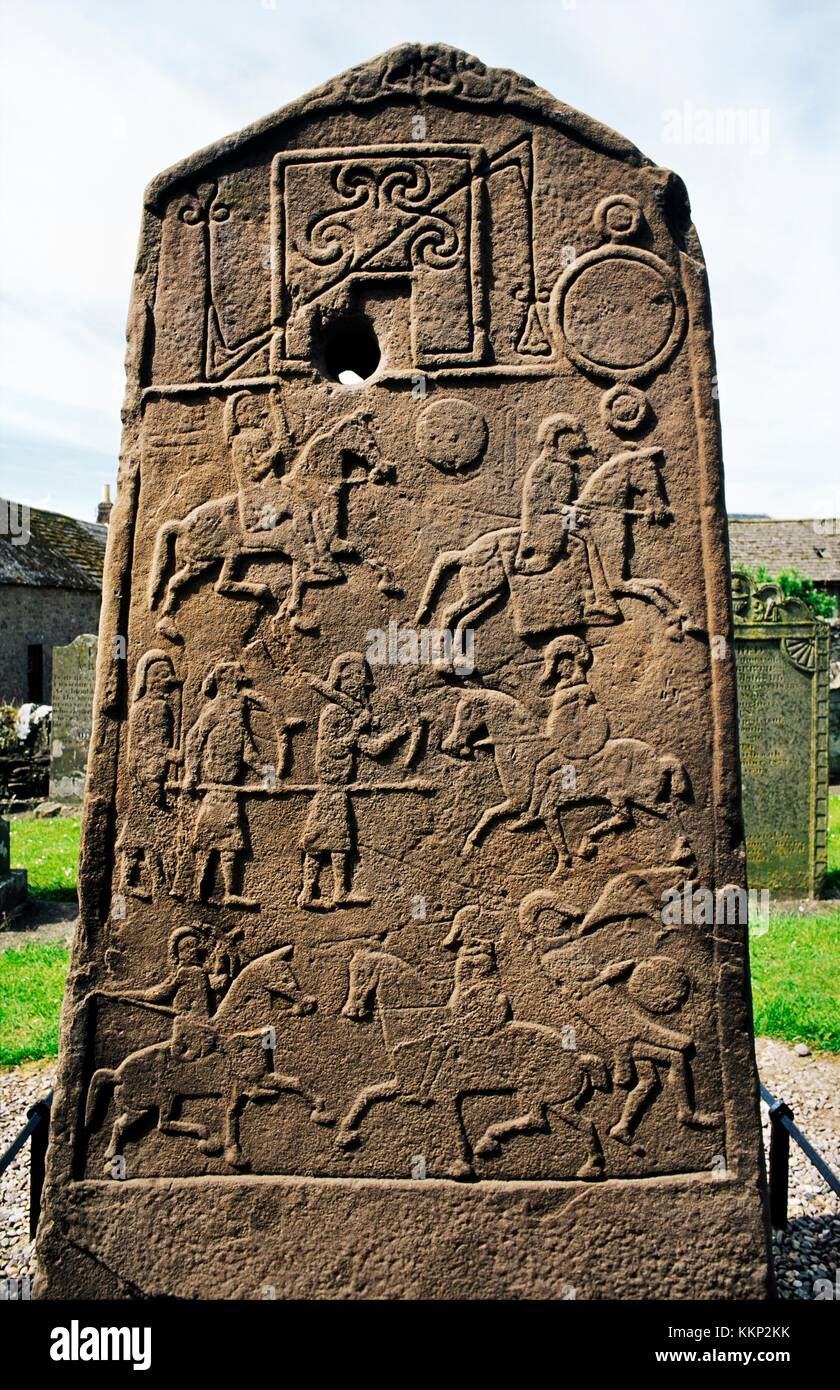
The Aberlemno Stones in Angus are among the most spectacular examples of Pictish carved stone art.
Several stones at Aberlemno preserve elaborate carvings representing:
Pictish symbols;
Christian crosses;
animals;
warriors;
and geometric patterns.
Together, they provide an extraordinary visual record of early medieval Scotland.
The Pictish Stone Tradition
Pictish stones were erected between approximately the sixth and ninth centuries.
They can be divided broadly into different categories based on their imagery and form.
Some display only symbolic designs.
Others combine symbols with Christian crosses.
Cross Slabs
A cross slab is a large stone slab bearing a carved Christian cross, often accompanied by additional decoration.
The Aberlemno examples are particularly elaborate.
Christian Imagery
Christian crosses demonstrate the importance of Christianity in Pictish society.
The designs can include:
interlace;
spirals;
animals;
and geometric patterns.
Pictish Symbols
The stones also preserve traditional Pictish motifs.
These include:
serpent;
double disc;
Z-rod;
mirror;
comb;
and other symbols.
Their exact meanings remain uncertain.
Warriors
Some Aberlemno carvings depict armed figures.
These images may represent:
warriors;
elites;
historical individuals;
or symbolic figures.
The Battle Interpretation
One of the Aberlemno stones has frequently been associated with the Battle of Dunnichen because of its depiction of armed figures.
However, this identification remains interpretive rather than definitively proven.
The imagery could represent a broader scene of warfare.
Weapons and Armor
Carved warriors provide clues about early medieval military equipment.
They may show:
shields;
spears;
swords;
helmets;
and other equipment.
Artistic Skill
Pictish stone carvers demonstrated extraordinary technical ability.
They created complex designs with:
deep relief;
precise lines;
interlaced patterns;
and carefully proportioned figures.
Symbolic Communication
Because written Pictish texts are limited, these carvings are especially important.
The stones may have communicated information about:
identity;
status;
religion;
political authority;
and ancestry.
The Landscape
The placement of the stones was probably meaningful.
Monuments could be positioned near:
settlements;
routes;
churches;
burial places;
or important territorial locations.
Preservation
The stones have survived for more than a millennium, although weathering has affected some carvings.
Conservation efforts are necessary to protect the remaining details.
Why Aberlemno Matters
Aberlemno provides one of the richest surviving collections of Pictish visual culture.
The stones combine traditional Pictish symbols with Christian imagery and representations of human figures.
Conclusion
The Aberlemno Stones are among Scotland's most important early medieval monuments.
Their carvings preserve a sophisticated visual language developed by Pictish communities more than 1,000 years ago.
Although many of the symbols remain mysterious, the stones clearly demonstrate artistic skill, religious transformation, social identity, and an advanced culture capable of communicating complex ideas through stone.
They stand as an extraordinary surviving record of the Pictish world.