This summer, Tate Modern will present the UK’s first major exhibition in more than a decade devoted to the multidisciplinary artist Ana Mendieta (1948–1985). Active during the 1970s and 1980s, Mendieta developed a radical artistic practice that redefined the boundaries of sculpture, photography, and film. Describing her work in her own terms, she is best known for her “earth-body” pieces, in which she traced or shaped her body within the landscape using natural materials such as soil, fire, flowers, and stone.
Bringing together more than 150 works, the exhibition will be organized thematically around symbolic places, tracing key stages in Mendieta’s career and underscoring her lifelong engagement with nature. Her celebrated Silueta Series (1973–80) will be shown alongside newly remastered films, rarely exhibited paintings and drawings, later sculptures, and re-created installations. Together, these works offer fresh insight into her practice and highlight its continued resonance for contemporary audiences.
Mendieta’s search for origins and her deep connection to the natural world were shaped by early experiences of displacement. Born in Havana, Cuba, she was sent to the United States with her sister after the Cuban Revolution, separated from her family and homeland at the age of 12. While studying archaeology and art at the University of Iowa, she began making works that reconnected her to Cuban history and culture. Her film Ochún (1981), for example, shows a sand-sculpted figure on the shore of Key Biscayne, Florida, symbolically linking the waters between the US and Cuba. During return visits to Cuba in the 1980s, she created Esculturas Rupestres (1981), carving figures directly into limestone rock. These works drew inspiration from her evolving Silueta forms, Afro-Cuban traditions, and indigenous Taíno culture. As Mendieta explained in 1984, she viewed her work as rooted in a Neolithic tradition, valuing the emotional and sensory qualities of materials over formal concerns.
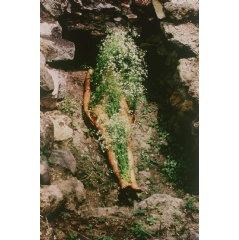
The Silueta Series began during a trip to Mexico in 1973, where Mendieta created life-size, temporary works exploring themes of presence, renewal, and transformation. She burned, carved, and molded silhouettes into landscapes across the Americas and Europe, often returning to sites connected to ancient histories or personal meaning. Intended to erode and disappear over time, these works challenged conventional ideas of art as permanent objects. Through photographs and film documentation, visitors will follow the development of the series—from early works using flowers placed over the artist’s body to later impressions left along riverbanks and shorelines.
The exhibition also emphasizes Mendieta’s connections across social, political, and geographic contexts. While studying in the University of Iowa’s experimental Intermedia program between 1972 and 1977, she became part of a vibrant artistic community. After moving to New York in 1978, she engaged closely with the city’s art and activist circles and joined A.I.R. Gallery, the first nonprofit, artist-run gallery for women in the United States. Reflecting her commitment to education, the exhibition will include early collaborative videos made with her students, such as Parachute (1973).
Premiering in the UK, a selection of newly remastered films made between 1971 and 1981 will demonstrate Mendieta’s innovative use of film, including techniques such as scratching and painting directly onto the celluloid. Film also served as a way to capture her performance-based and site-specific works, allowing audiences to experience pieces such as Anima, Silueta de Cohetes (Firework Piece) (1976) and Bird Run (1974), which shows the artist running along a beach covered in feathers. Her interest in transformation is further explored through the photographic series Untitled (Facial Cosmetic Variations) (1972), in which she alters her appearance using makeup, wigs, and expressive gestures.
In 1983, Mendieta received the Prix de Rome fellowship at the American Academy in Italy. After years of working primarily outdoors, her time in Rome marked a shift toward studio-based sculpture, enabling the creation of more lasting works. Tate Modern will display several of these pieces, including floor works made from earth and binder such as Nile Born (1984), as well as La Jungla (Totem Grove) (1985), a multi-part sculpture of tree trunks burned with gunpowder to form dark silhouettes. These will be shown alongside delicate drawings on leaves and paintings from the Amategram series, which depict totem-like forms on bark paper and continue her exploration of the female body.
To reflect the living and impermanent nature of Mendieta’s practice, several ephemeral works will be restaged during the exhibition. Ñañigo Burial (1976), a Silueta formed from black ritual candles, will be lit regularly throughout the show. Visitors will also encounter a reconstruction of her first indoor earth-body installation, created from branches, leaves, soil, moss, and stones to transform the gallery into a forest-like environment. Extending beyond the museum, one of Mendieta’s tree sculptures—first made in 1982—will be reactivated outside Tate Modern, embodying the themes of transformation and resilience that define her work.