Introduction
Rope and cordage were essential technologies in many ancient societies. They could be used for carrying loads, securing boats, constructing buildings, making nets, tying tools, and handling containers. Because fibers usually decay, direct evidence for ancient rope is often scarce.
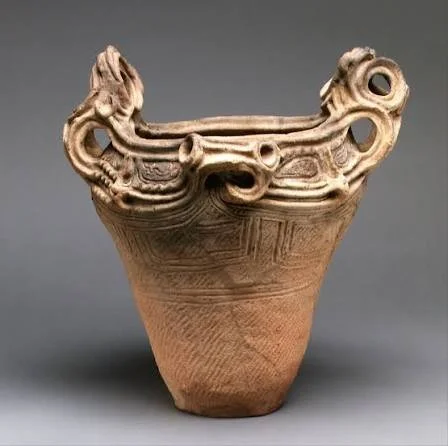
Impressions preserved on pottery can provide indirect evidence of cordage technology. When wet clay comes into contact with twisted fibers, woven materials, or knotted cord, it may retain a pattern after the organic material disappears or is removed.
These impressions can reveal aspects of how cordage was made and used. However, a pattern on pottery does not always represent a rope. It may come from woven fabric, basketry, mats, or another textured surface.
How Impressions Form
Pottery is often shaped while clay is still soft. If a cord or woven material is pressed against the clay, its surface can leave a negative impression.
The impression may preserve details of the original material, including the direction of twist, the arrangement of strands, and the pattern of a woven structure.
Such traces can occur on the exterior or interior of a vessel. They may reflect a technique used during shaping, a method for supporting the vessel, or decoration applied to the surface.
Researchers must establish how the impression relates to the manufacturing process before using it to reconstruct a specific type of rope.
Twisting and Braiding Fibers
Cordage can be made by twisting fibers together, braiding strands, or combining several cords into a thicker rope. The chosen method affects strength, flexibility, and resistance to wear.
Fibers may come from plant materials, animal hair, or other locally available resources. Their suitability depends on length, flexibility, strength, and how they respond to moisture.
Impressions may preserve clues about the number of strands and the direction of twisting. However, compression during clay shaping can distort the original pattern.
A careful analysis compares the impression with experimental examples made using different cordage techniques.
Identifying the Material
The impression may reveal the structure of the cord without identifying the original fiber. Plant fibers, animal hair, and other materials can produce similar patterns when twisted or braided.
In some cases, microscopic traces of the original material may survive in the clay. These can potentially be investigated through microscopy or chemical analysis.
However, such traces may be absent or contaminated. Researchers should not claim that a rope was made from a specific plant simply because that plant was available in the region.
The strongest identification combines surviving material, impression morphology, environmental evidence, and comparison with known cordage traditions.
Cordage and Pottery Manufacture
Rope impressions may be connected with the production of pottery itself.
A vessel could be formed against a woven support or wrapped structure that helped hold the clay during shaping. Cord may also have been used to create decorative patterns or texture.
In some cases, impressions can help researchers reconstruct how a vessel was built. The direction and arrangement of marks may indicate whether a cord was pressed into the surface intentionally or whether the clay was shaped against a cord-covered support.
Yet similar impressions can arise from different manufacturing methods, so the interpretation should be tested against the vessel's overall structure.
Nets, Fishing, and Maritime Activity
Cordage was important for fishing nets, lines, and other equipment. Pottery impressions may therefore contribute to research on the technologies associated with fishing and maritime life.
However, a rope impression on a pot does not directly prove that the rope was used for fishing. Cordage served many functions, including transport, construction, clothing, and securing loads.
Fishing-related interpretations become stronger when the pottery is associated with fish remains, net weights, hooks, or other evidence of aquatic resource use.
Measuring Twist and Strand Structure
Researchers can record the direction of twist, the number of visible strands, the spacing between them, and the angle of the impression.
These details can be compared with experimental cords made using different fibers and techniques.
The analysis may reveal whether the original material was a simple cord, a thicker rope, or part of a woven structure. However, preservation and compression can obscure fine details, and impressions may not capture the entire cord.
Researchers should therefore record uncertainty rather than reconstructing a complete rope from an incomplete mark.
Experimental Archaeology
Experimental archaeology can help test how different cords leave impressions in clay.
Researchers can create cords using various fibers and twisting methods, press them into clay under controlled conditions, and compare the results after drying or firing.
Experiments can investigate how moisture, pressure, cord thickness, and clay composition influence the final impression.
The results help narrow the range of plausible techniques. They cannot always identify the exact ancient method, because modern experimental materials and manufacturing conditions may differ from those used in the past.
Cordage and the Wider Economy
Cordage connects several areas of ancient life. Fishing, farming, construction, transport, and textile production all depend on strong and reliable fibers.
The ability to make cord could influence how people moved goods, secured structures, and exploited environmental resources.
If similar cordage patterns occur across multiple sites, researchers may investigate whether they reflect shared techniques, exchange, or independent solutions to similar practical problems.
Similar impressions do not necessarily prove direct contact. Communities can develop comparable technologies independently when they face similar needs and have access to similar materials.
Preservation and Interpretation
Direct rope remains may survive in waterlogged, dry, frozen, or otherwise unusual environments. In most archaeological contexts, however, cordage disappears while the objects it contacted remain.
Pottery impressions are therefore especially valuable, but they are indirect evidence.
The impression may represent a cord used during vessel production rather than a rope used in everyday activity. A decorative pattern might imitate cordage without recording an actual rope.
Researchers should compare the mark with the vessel's construction, the location of the impression, and other evidence of manufacturing.
Conclusion
Ancient rope impressions on pottery provide an important way to investigate cordage technology where the fibers themselves have not survived. They can preserve clues about twisting, braiding, strand structure, and the relationship between cordage and pottery production.
However, an impression does not automatically identify the material, function, or exact manufacturing technique. It may represent rope, woven material, basketry, or a support used while shaping clay.
By combining detailed surface recording, experimental archaeology, microscopic analysis, and contextual evidence, researchers can reconstruct plausible cordage technologies and explore their role in fishing, transport, construction, and daily life. These impressions demonstrate how an otherwise perishable technology can leave a durable trace in another material.