Introduction
Bone has been used as a raw material for tools in many parts of the world. It can be shaped into points, needles, awls, fishing equipment, and other implements suited to activities that require precision or flexibility.
In Arctic environments, bone and antler could be particularly valuable because they were available from animals hunted for food, clothing, transport, and other necessities. The study of micro-wear examines tiny changes on an object's surface that may have developed during manufacture, use, or burial.
The forensic analysis of bone tool micro-wear can help archaeologists investigate how tools functioned in hunting camps. However, microscopic marks rarely identify a tool's exact purpose on their own. Researchers must distinguish use-related wear from manufacturing marks, environmental damage, and modern handling.
Why Bone Was Used for Tools
Bone has a different structure from stone, wood, and metal. Its internal organization can make it strong in certain directions while allowing it to be shaped into relatively fine points or edges.
Antler, ivory, and bone are not identical materials. They have different properties and may be selected for different tasks.
In cold environments, organic materials could be important for making tools and equipment suited to hunting, fishing, clothing production, and transportation.
The availability of particular materials depended on local animal populations, ecological conditions, and hunting practices.
What Is Micro-wear?
Micro-wear refers to small-scale changes on a tool's surface. These may include scratches, polish, edge rounding, tiny fractures, and other traces created when an object contacts another material.
Researchers examine these features using magnification and compare them with wear patterns produced by experimental tools.
Different activities can create different kinds of wear, but the patterns are not always unique. Cutting meat, scraping hide, working plant fibers, and processing other materials may produce overlapping traces.
The interpretation depends on the tool's material, shape, use history, and the conditions in which it was buried.
Manufacturing Marks Versus Use-wear
A bone tool may acquire marks during shaping. Cutting, scraping, grinding, and polishing can leave traces that resemble those produced during use.
Researchers therefore examine the location and orientation of marks, their relationship to the tool's edges, and whether they are consistent with a plausible action.
For example, repeated wear near a working edge may support the interpretation that the edge was used, while marks distributed across the surface may reflect manufacture or later abrasion.
Even this distinction can be difficult when the tool was heavily modified or used for several purposes.
Experimental Archaeology
Experimental studies can help identify plausible sources of micro-wear. Researchers manufacture replicas using selected techniques, then use them for controlled activities such as cutting, scraping, piercing, or processing animal materials.
The resulting surfaces are examined and compared with archaeological specimens.
These experiments are valuable because they link known actions with observable changes. However, modern experiments cannot reproduce every condition of prehistoric use. Differences in raw material, user skill, force, duration, and environmental exposure may affect the results.
Micro-wear interpretation should therefore rely on comparative patterns rather than assuming that one microscopic feature proves a single function.
Arctic Hunting Camps and Organic Materials
Arctic archaeological sites may preserve bone, antler, ivory, and other organic materials under favorable conditions. Cold or waterlogged environments can sometimes slow decomposition, although preservation varies considerably.
Hunting camps may contain tools associated with animal processing, clothing production, fishing, and other activities.
The presence of bone tools at a camp does not automatically mean they were used for hunting itself. Some may have been used to prepare hides, manufacture clothing, repair equipment, or process food after an animal was captured.
A tool's function should be reconstructed in relation to the entire assemblage.
Hunting Technology and Tool Function
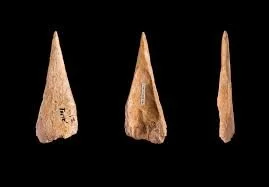
Bone points may have been used as projectile components, while pointed implements could also serve as awls or piercing tools. A tool's shape provides clues, but similar forms can be used in different ways.
Researchers may examine breakage patterns, impact damage, polish, residues, and the distribution of tools within the site.
If a point shows impact-related fractures and is associated with evidence of hunting, a projectile function may be plausible. Yet breakage can occur during manufacture or post-depositional processes.
A reliable interpretation combines several forms of evidence rather than relying on shape alone.
Contamination and Post-Depositional Damage
Micro-wear can be altered after a tool is discarded. Sediment movement, trampling, water transport, chemical changes, and contact with other objects may produce scratches or polish.
Excavation and laboratory handling can also introduce damage. Cleaning methods may remove residues or alter fragile surfaces.
Researchers must document the condition of an artifact before analysis and compare the suspected use-wear with known forms of post-depositional alteration.
Control samples from the surrounding sediment can sometimes help identify environmental processes responsible for surface damage.
Residue Analysis
Organic residues may survive on bone tools, although preservation varies. Proteins, lipids, plant compounds, and other traces may provide clues about contact with particular materials.
However, residues can be introduced by soil, handling, conservation products, or later contamination. The presence of an animal-derived compound on a tool does not automatically prove that the tool processed a specific animal.
Residue analysis is most useful when combined with micro-wear, tool form, archaeological context, and appropriate contamination controls.
Reconstructing Tasks at a Hunting Camp
A hunting camp may have supported many activities beyond the capture of animals. People could butcher carcasses, prepare hides, repair equipment, make clothing, cook food, and maintain tools.
Different micro-wear patterns across an assemblage may help distinguish these tasks.
For example, tools with evidence of cutting, scraping, and piercing could suggest a sequence of processing activities. However, the same tool might have been reused for multiple tasks, and some activities may leave little visible wear.
Researchers should therefore reconstruct a range of possible activities rather than forcing every artifact into a single functional category.
Conclusion
The forensic study of bone tool micro-wear can reveal valuable information about the technologies used in Arctic hunting camps. Microscopic scratches, polish, fractures, and residues may help researchers reconstruct manufacturing methods and the tasks performed with organic tools.
However, micro-wear is not a simple code in which each mark corresponds to one activity. Manufacturing, use, burial, and handling can produce overlapping traces.
By combining microscopy with experimental archaeology, residue analysis, tool morphology, and site context, researchers can build stronger interpretations of ancient technology. Bone tools offer a particularly important perspective on Arctic life because they reveal how people transformed animal materials into equipment suited to hunting, processing, clothing production, and survival in demanding environments.