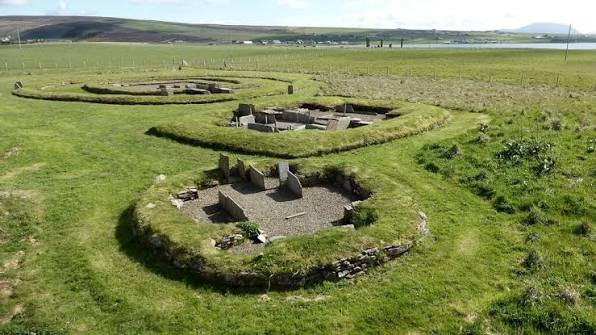
Barnhouse, located near the famous prehistoric monuments of Orkney, Scotland, is an important Neolithic settlement dating to approximately 5,000 years ago.
The site consists of the remains of several stone-built houses and is particularly significant because of its proximity to monumental structures such as the Stones of Stenness and the Barnhouse Stone.
Together, these sites demonstrate that Neolithic Orkney was a complex landscape where domestic life, communal gatherings, agriculture, ritual, and monumental construction were closely connected.
Neolithic Orkney
The Neolithic period brought major changes to Britain.
Communities increasingly practiced:
agriculture;
livestock herding;
permanent settlement;
pottery production;
and monument construction.
Orkney became one of the most important centers of Neolithic architecture in northern Europe.
The Barnhouse Village
Barnhouse contained multiple stone houses.
These houses were not simple temporary shelters.
They featured:
stone walls;
hearths;
internal divisions;
stone furniture;
and carefully planned layouts.
House Architecture
Some Barnhouse houses share architectural characteristics with later Orkney settlements.
Typical features included:
central hearths;
beds or sleeping platforms;
storage areas;
and stone-built internal structures.
The repeated design suggests shared architectural traditions.
Agriculture
Neolithic communities depended increasingly on domesticated plants and animals.
They cultivated crops such as:
barley;
wheat;
and other cereals.
They also raised livestock, including:
cattle;
sheep;
and goats.
Food Preparation
Grinding stones were used to process grain.
Grain could be crushed into meal or flour and then cooked.
Other food sources included:
meat;
milk products;
fish;
shellfish;
and wild plants.
Pottery
Neolithic pottery is common at Orkney sites.
Ceramic vessels could be used for:
cooking;
storage;
serving;
and possibly ceremonial activities.
The distinctive Grooved Ware tradition later became particularly important in Orkney.
Monumental Landscapes
Barnhouse did not exist in isolation.
Nearby monuments include:
the Stones of Stenness;
the Ring of Brodgar;
the Barnhouse Stone;
and Maeshowe.
These structures formed a remarkable ceremonial landscape.
The Barnhouse Stone
The Barnhouse Stone is a large standing stone positioned in relation to the surrounding monuments.
Its alignment has been discussed in relation to astronomical phenomena, particularly the winter solstice.
Whether every alignment had a deliberate astronomical meaning remains debated.
Community Organization
Monument construction required:
planning;
labor;
transportation;
and cooperation.
Large stones had to be:
quarried;
transported;
positioned;
and stabilized.
This demonstrates a significant capacity for communal organization.
Domestic and Ritual Life
One of the most interesting aspects of Barnhouse is the relationship between ordinary houses and monumental architecture.
People lived within a landscape containing enormous communal monuments.
This suggests that ritual activity was integrated into everyday life rather than separated from it.
The Ness of Brodgar
The broader landscape also includes the extraordinary Ness of Brodgar complex.
Although distinct from Barnhouse, it demonstrates the enormous scale of ceremonial activity in Neolithic Orkney.
Why Orkney Was Special
Orkney's location provided:
fertile land;
marine resources;
abundant stone;
and relatively open landscapes suitable for monument construction.
The islands became an important cultural center.
Why Barnhouse Matters
Barnhouse provides a rare opportunity to study both:
domestic architecture;
and monumental ceremonial landscapes.
The combination reveals how people organized their homes, food production, social relationships, and religious activities.
Conclusion
Barnhouse demonstrates that Neolithic Orkney was a highly organized society.
People built substantial stone houses, farmed the land, raised animals, produced pottery, and constructed enormous monuments nearby.
The settlement shows that domestic life and ceremonial activity were not separate worlds.
They formed part of one integrated cultural landscape.